TL;DR:
- Simple, non-permanent changes like decluttering and vertical storage can greatly improve kitchen space. Extending cabinets to the ceiling, using full-extension drawers, and defining work zones optimize accessibility and efficiency. Proper organization, right-sized appliances, and creative storage solutions make small kitchens more functional without structural renovations.
The most effective ways to optimize kitchen space do not require tearing out walls or spending tens of thousands of dollars. Non-structural changes like aggressive decluttering, vertical storage, work zone planning, and multi-function accessories deliver more daily usability than most costly remodels. These methods work for both homeowners and renters because most require no permanent alterations. This article covers 10 practical, proven strategies you can apply right now to get more from the kitchen you already have.
1. Ways to optimize kitchen space start with aggressive decluttering
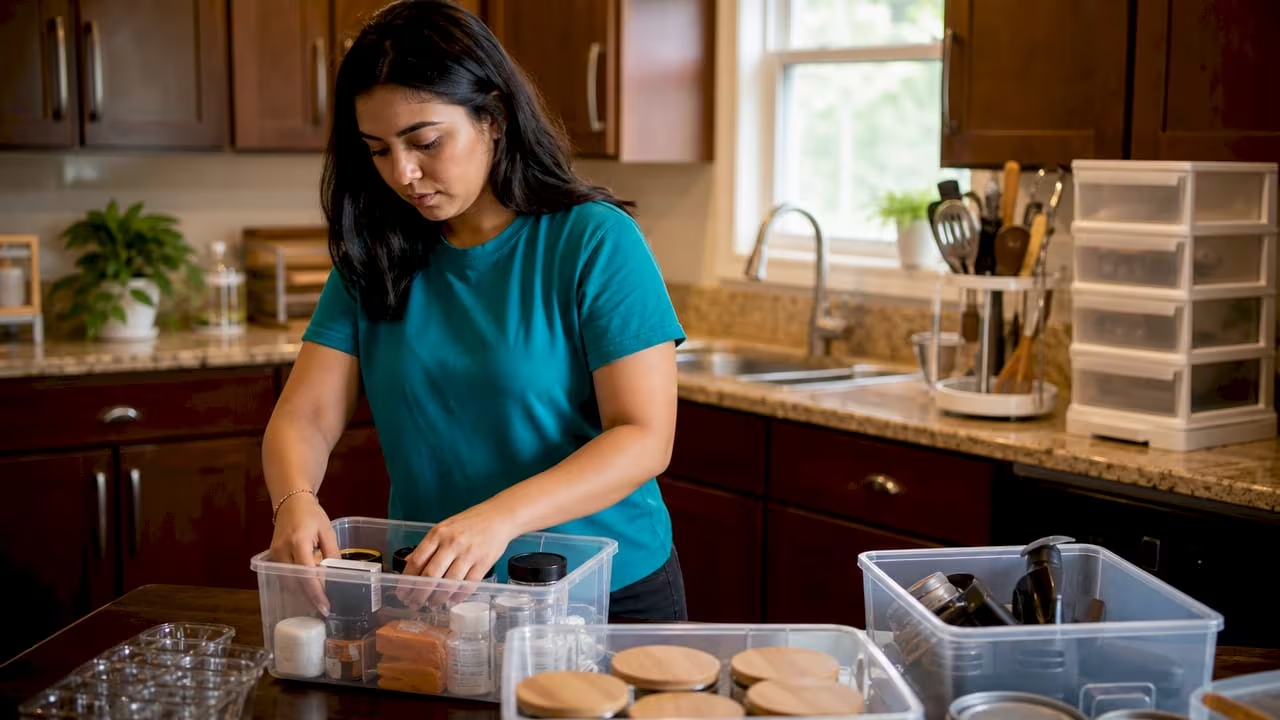
Decluttering is the single highest-return action you can take in a kitchen. Remove every item from your cabinets and countertops, then sort by function and frequency. Duplicates, broken tools, and gadgets you have not used in six months go out. What remains gets organized by zone.
Decluttering steps include removing everything, sorting essentials by zone, reorganizing with vertical storage tools, and maintaining a weekly routine. The routine part is what most people skip. Without it, the clutter returns within three months.
Pro Tip: Pull everything out of one cabinet at a time rather than emptying the whole kitchen at once. You will make better decisions and finish the job in a single session.
2. Maximize vertical wall space
Most kitchens use only the bottom two thirds of their wall height. Magnetic knife strips, wall-mounted pot racks, floating shelves, and backsplash-mounted organizers all reclaim that unused vertical real estate. Each of these costs under $50 and installs without a contractor.
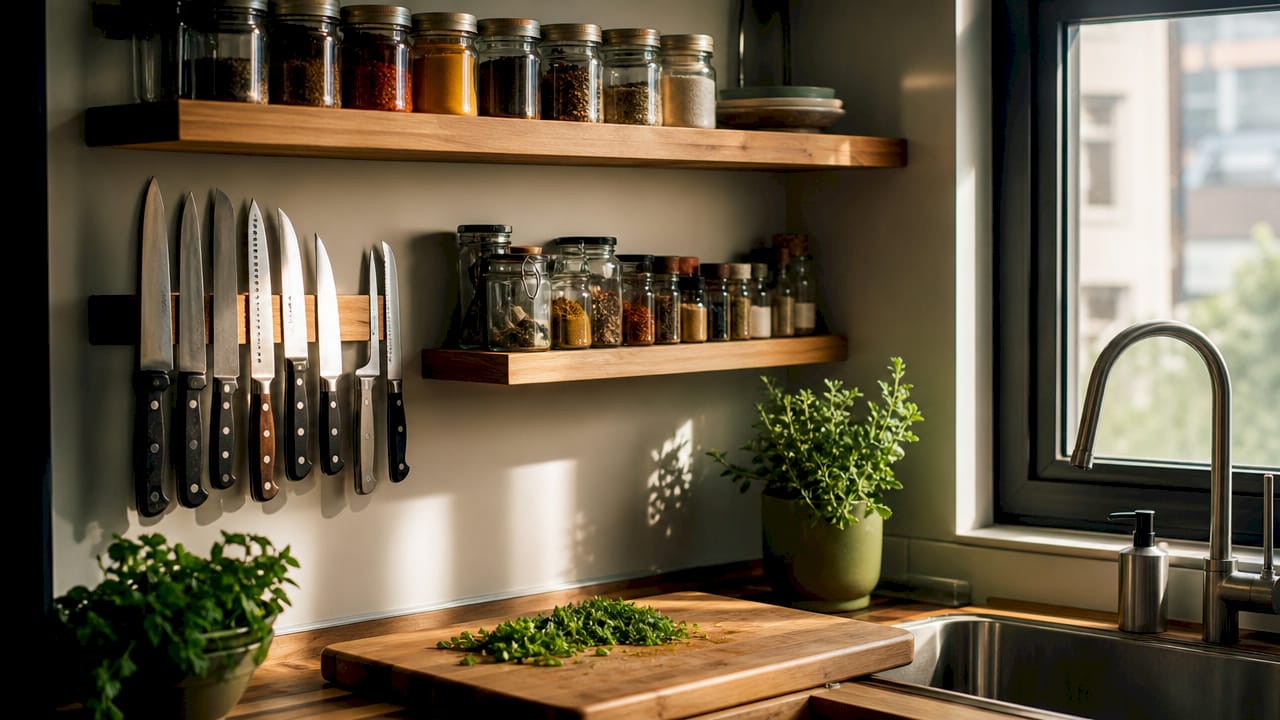
The payoff is immediate. Countertops clear up, and frequently used tools stay within arm’s reach. Renters can use removable adhesive hooks and freestanding shelving units to get the same result without drilling.
3. Extend cabinets to the ceiling
Standard upper cabinets stop 12 to 18 inches below the ceiling. That gap collects dust and does nothing else. Extending cabinets to the ceiling provides dust-free storage for seasonal items and frees lower shelves for daily use. The top 20–30 cm of vertical wall space is commonly wasted in standard kitchen design.
Store holiday serving dishes, extra appliances, and bulk pantry overflow in those upper cabinets. You free up prime real estate below for the items you reach for every day. This is one of the most cost-effective upgrades a homeowner can make during a cabinet replacement or kitchen renovation.
4. Replace deep cabinet doors with full-extension drawers
Deep base cabinets are notorious dead zones. Standard cabinets over 60 cm deep hide items in the back 40 cm that most people cannot easily reach. The result is that you buy duplicates of things you already own because you cannot find them.
Full-extension drawers solve this completely. They pull out to reveal the entire cabinet depth, turning a frustrating black hole into a fully visible, fully accessible storage space. This upgrade is worth every dollar on base cabinets near the stove and sink, where pots, pans, and cleaning supplies live.
Pro Tip: Drawer inserts with adjustable dividers let you reconfigure the layout as your storage needs change. Buy adjustable, not fixed.
5. Use tiered drawer organizers
Flat drawer organizers waste the vertical space inside the drawer. Tiered drawer organizers can effectively double storage capacity in deep drawers by stacking items at different heights. That means more spices, utensils, or tools in the same footprint.
This approach works especially well in junk drawers and spice drawers, where small items pile up and become impossible to find. Tiered organizers force you to assign every item a fixed position. That habit alone cuts meal prep time noticeably.
6. Define clear kitchen work zones
A kitchen without zones is a kitchen that fights you. The three core zones are prep, cooking, and cleaning. Each zone should contain only the tools and supplies relevant to that task. Knives and cutting boards belong in the prep zone. Pots, pans, and spatulas belong near the stove.
Zoning reduces the number of steps you take during cooking and keeps countertops from becoming dumping grounds. It also makes it obvious when something is out of place, which keeps the kitchen organized with minimal effort. You can read more about how layout supports zoning in Agny’s guide to kitchen layout examples.
7. Organize your pantry proportionally
Pantry organization should be proportional to kitchen size, with bulk items decanted into accessible containers near cooking zones. Oversized pantries crammed with bulk purchases create the same problem as cluttered cabinets: you cannot find what you need, so you buy more.
Decanting means transferring dry goods like flour, rice, and pasta into clear, labeled containers. You see exactly what you have, and the uniform containers stack efficiently. Keep the items you use daily at eye level. Move rarely used items to the highest or lowest shelves.
- Use clear containers for dry goods so contents are visible at a glance
- Label every container with the item name and expiration date
- Group items by meal type: breakfast, baking, snacks, grains
- Rotate stock so older items stay at the front
8. Apply light colors and reflective surfaces
Color and light do not add physical storage, but they change how spacious a kitchen feels. Light and neutral paint palettes and reflective backsplashes make small kitchens feel larger and visually open. Reflective stone or tile backsplashes enhance perceived space by bouncing light around the room.
White, cream, and pale gray cabinetry keep the eye moving rather than stopping at a dark surface. Glossy cabinet finishes amplify this effect. For renters, a peel-and-stick backsplash in a light, reflective tone achieves a similar result without permanent changes.
9. Use the backs of cabinet doors
The inside of a cabinet door is prime, overlooked storage space. Spice racks, small hooks, and over-door organizers mount directly to the door surface and hold dozens of items. This works on pantry doors, under-sink cabinet doors, and upper cabinet doors alike.
A pantry door fitted with a full-height organizer can hold spices, oils, foil, plastic wrap, and cleaning supplies. That frees an entire shelf inside the pantry for larger items. The investment is minimal and the installation takes under 30 minutes.
10. Choose right-sized appliances
Oversized appliances shrink your usable counter and cabinet space. A stand mixer that sits on the counter permanently takes up roughly two square feet of prep space. If you use it twice a month, it belongs in a cabinet or on a pull-out shelf.
Choose appliances sized for your actual cooking habits. A compact toaster oven that handles 80% of what a full-size oven does takes up a fraction of the space. Multi-function appliances like an Instant Pot replace several single-purpose gadgets and consolidate storage needs. Every appliance on your counter should earn its place daily.
Pro Tip: Store appliances you use less than once a week. The counter is for prep, not for display.
How kitchen layout affects space optimization
The shape of your kitchen determines which storage strategies work best. Three layouts appear most often in American homes: galley, L-shape, and single-wall.
| Layout | Best for | Space-saving strength | Main challenge |
|---|---|---|---|
| Galley | Narrow rooms | Efficient workflow, both walls usable | Traffic flow with two cooks |
| L-shape | Corner rooms | Natural zoning, corner storage options | Corner cabinet dead zones |
| Single-wall | Studio apartments | Open feel, simple layout | Limited counter and storage space |
A functional galley kitchen requires 1.0 to 1.2 meters clearance between countertops for easy access and appliance operation. Less than that and oven doors and dishwashers block each other when open. More than that and the cook takes unnecessary steps between tasks.
L-shape kitchens benefit most from corner pull-out systems and lazy Susans, which reclaim the dead zone where two cabinet runs meet. Single-wall kitchens gain the most from ceiling-height cabinets and a rolling island that adds prep space and rolls away when not needed.
Pro Tip: Before buying any storage product, measure your clearance distances. A beautiful pull-out shelf that blocks your dishwasher door is worse than no shelf at all.
Creative storage solutions for vertical and hidden kitchen areas
The most underused storage in any kitchen is above eye level and behind doors. Ceiling-mounted pot racks work well in kitchens with 9-foot or higher ceilings. They keep heavy, frequently used cookware accessible and free up every base cabinet shelf those pots previously occupied.
Open shelving can make a small kitchen feel airier if only regularly used items are displayed. The key word is regularly. A shelf holding your everyday plates and glasses looks intentional. A shelf holding 40 mismatched mugs looks like a yard sale.
Here are the most effective creative storage additions, ranked by impact:
- Magnetic strips on the backsplash for knives and metal utensils
- Floating shelves above the counter for oils, vinegars, and daily spices
- Under-cabinet hooks for mugs and measuring cups
- Over-door organizers on pantry and under-sink doors
- Ceiling-mounted pot rack for large cookware in high-ceiling kitchens
- Pull-out trash and recycling bins inside a base cabinet
Pro Tip: Open shelves look best when you limit each shelf to one category. Mix categories and it reads as clutter within weeks.
Decluttering and organizing tips to increase functional space
An organized kitchen reduces prep time and stress. The process works in four steps.
- Remove everything from one zone at a time
- Sort items into keep, donate, and discard piles based on use frequency
- Return only the keepers, organized by task and zone
- Set a monthly 15-minute reset to catch creep before it becomes chaos
Once items are back in place, these organizing habits keep them there:
- Use drawer dividers for utensils so every tool has a fixed spot
- Stack pots with their lids stored separately in a lid organizer
- Place the most-used items at the front of every shelf and drawer
- Keep countertops clear of everything except the coffee maker and one cutting board
Decanting bulk pantry items into uniform containers is the single organizing move that has the biggest visual impact. It also makes inventory obvious at a glance, which reduces food waste and duplicate purchases.
Key takeaways
The most effective kitchen space improvements combine decluttering, vertical storage, and clear work zones to deliver real daily gains without structural changes.
| Point | Details |
|---|---|
| Declutter first | Remove duplicates and rarely used items before adding any storage product. |
| Go vertical | Use wall space, ceiling height, and cabinet door backs to multiply storage without expanding footprint. |
| Zone your kitchen | Assign prep, cooking, and cleaning zones so tools stay where you use them. |
| Fix deep cabinets | Full-extension drawers reclaim the back 40 cm of base cabinets that standard doors hide. |
| Right-size appliances | Store appliances used less than weekly to keep countertops clear for actual prep work. |
What I have learned after years of kitchen renovations
The homeowners I work with most often make the same mistake: they buy storage products before they declutter. A beautiful set of cabinet organizers installed in a cluttered kitchen just organizes the clutter. The result looks tidy for two weeks and then collapses.
The sequence matters. Declutter first, then measure, then buy. Every time.
The second thing I have noticed is that people underestimate how much the ceiling-height cabinet upgrade changes a kitchen. It is not glamorous. Nobody posts it on social media. But reclaiming that top 20–30 cm of wall space and using it for seasonal items frees the shelves below for daily use. That shift alone changes how a kitchen feels to work in.
For renters, the constraint is real but not as limiting as most people think. Removable hooks, freestanding shelving, over-door organizers, and tiered drawer inserts require zero permanent changes and zero landlord approval. A renter can transform a kitchen in a weekend with under $200 in products.
The one thing I warn against consistently is open shelving done wrong. Open shelves work when you display only what you use every day. The moment you add decorative items or overflow storage, the shelf reads as clutter. Keep it functional or keep it closed.
— Grzegorz
How Agny can take your kitchen further
When DIY organization reaches its limit, custom millwork and professional renovation unlock what no shelf organizer can.

Agny specializes in New York kitchen renovation and custom cabinetry designed around how you actually cook and live. The team builds ceiling-height cabinet systems, full-extension drawer stacks, and integrated storage solutions that fit your exact kitchen dimensions. If budget is a concern, Agny’s renovation financing options make professional upgrades accessible without paying everything upfront. Whether you are planning a full remodel or a targeted cabinet upgrade, Agny brings the same precision to a 60-square-foot galley as to a full open-plan kitchen.
FAQ
What is the fastest way to free up kitchen space?
Decluttering is the fastest method. Remove duplicates, broken tools, and rarely used appliances from countertops and cabinets in a single session to immediately recover usable space.
How do I maximize storage in a small kitchen?
Use vertical space with wall-mounted shelves, ceiling-height cabinets, and over-door organizers. Replace deep cabinet doors with full-extension drawers to access the full cabinet depth.
What clearance does a galley kitchen need to function well?
A galley kitchen needs 1.0 to 1.2 meters clearance between countertops so oven doors, dishwashers, and drawers open without blocking traffic or each other.
Can renters optimize kitchen space without making permanent changes?
Yes. Removable adhesive hooks, freestanding shelving, over-door organizers, and tiered drawer inserts require no drilling or landlord approval and can be removed when you move out.
Do tiered drawer organizers actually make a difference?
Tiered organizers can effectively double usable storage in deep drawers by stacking items at different heights, which eliminates the flat-pile problem that makes drawers impossible to search.