
TL;DR:
- Effective millwork quality control involves comprehensive, multi-stage inspections aligned with recognized standards to prevent costly on-site rework.
- Pre-fabrication shop drawing review, precise CAD coordination, and clear accountability significantly reduce errors, delays, and project costs.
Quality control in millwork is the systematic process of verifying that every fabricated component meets precise dimensional tolerances, material grades, and installation specifications before it reaches the job site. The importance of quality control in millwork becomes clear the moment you calculate what poor fit costs: field rework averages 0.38% precompletion and climbs to 0.76% with postcompletion corrections, directly compressing already thin construction margins. For business owners and project managers overseeing renovation or commercial build-outs, those percentages translate to real dollars lost on cabinets that don’t fit, trim that needs reordering, and schedules that slip. Industry frameworks like AWI Standards 2026 and NAAWS exist precisely to prevent those losses by giving every stakeholder a shared technical language.
What does quality control in millwork actually involve?
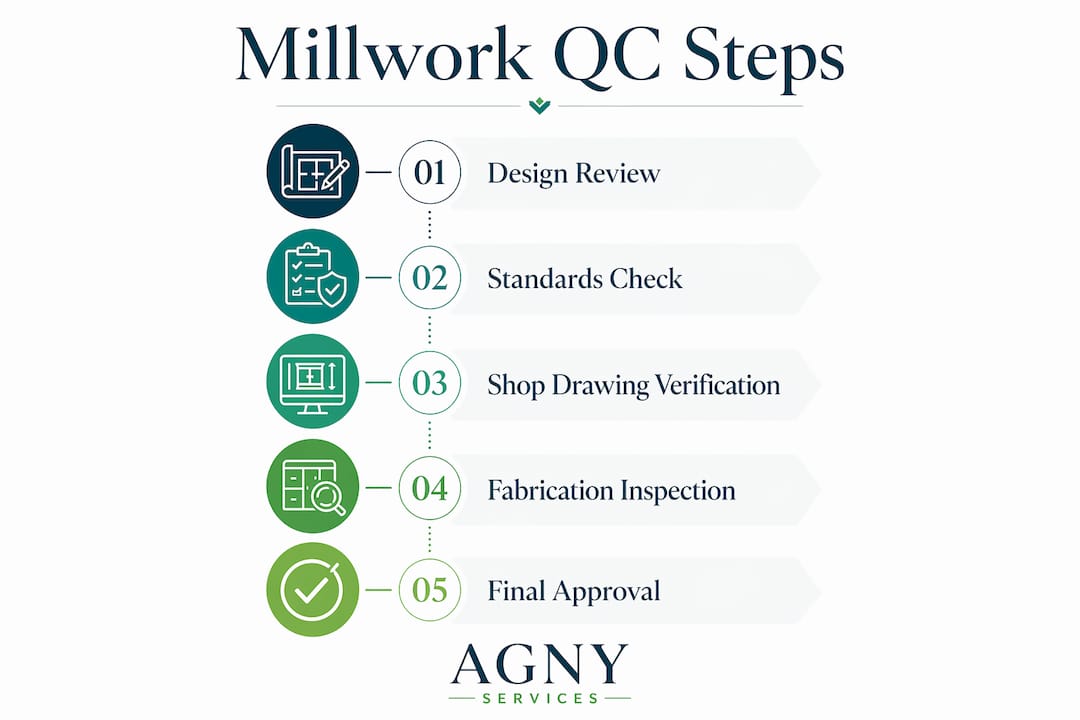
Quality assurance in millwork is not a single inspection at the end of production. Engineering standards define measurable acceptance criteria through three sequential checkpoints: initial material inspection, in-process fabrication checks, and final product inspection before shipment. Each stage catches a different class of defect, and skipping any one of them shifts the cost of discovery downstream where fixes are far more expensive.
The three core components work like this:
- Initial material inspection: Verify lumber grades, sheet goods, hardware specifications, and finish materials against the project spec before any cutting begins. A wrong veneer grade discovered at this stage costs minutes to correct. Discovered after installation, it costs days.
- In-process fabrication checks: Inspect critical dimensions, joinery, and assembly sequences during production. This is where tolerance stack errors, the compounding effect of small measurement deviations across multiple components, get caught before they become systemic.
- Final inspection before shipment: Confirm fit, finish, hardware function, and labeling against shop drawings. This checkpoint also verifies that packaging protects components during transit, since a perfect cabinet damaged in a truck is still a defect.
Pro Tip: Build your QC checklist directly from the shop drawings, not from memory or generic templates. Every dimension on the drawing is a potential failure point, and your checklist should mirror it line by line.
The role of engineering standards here is not ceremonial. Standards link safety, performance, and consistent quality from design intent through installation, giving inspectors objective criteria rather than subjective judgment calls.
How do standards and documentation reduce millwork disputes?
Reference standards serve as operational infrastructure, not just specification references. They reduce ambiguity and stabilize project expectations across manufacturers, designers, and contractors by providing neutral baselines for material performance, fabrication methods, and installation tolerances. When a dispute arises over whether a cabinet door gap is acceptable, a standards-based acceptance criterion ends the argument in minutes. Without one, the same argument can consume days of project management time.
AWI Standards 2026 consolidates 14 woodwork standards into a single reference, covering material grades, fabrication tolerances, and installation intent. The document is freely available online, which means your QC team can pull it up on a tablet during a shop inspection in real time. That accessibility matters because millwork quality standards only protect you when people actually use them.
Here is how standards-based documentation compares to undocumented QC in practice:
| Approach | Outcome |
|---|---|
| Standards-based acceptance criteria | Disputes resolved by objective reference; consistent results across crews |
| Undocumented or verbal QC | Subjective judgment varies by inspector; disputes escalate to costly change orders |
| Standards integrated into shop sign-offs | Fabrication errors caught at source; training becomes repeatable |
| Finish-only inspection checklists | Upstream dimensional conflicts missed; rework discovered on site |
“Standards-based QC reduces ambiguity rather than all risk. It aligns all parties around consistent quality metrics, significantly reducing late-stage rework.” — Wood Industry
Scaling QC requires turning standards into structured internal systems that include inspections, signoffs, training, and field verification. A millwork shop that operates from a single craftsman’s intuition cannot replicate quality across multiple crews or project sites. A shop that has codified AWI or NAAWS criteria into its production workflow can.
How do CAD details and design coordination affect QC outcomes?
The single most underappreciated lever in millwork quality assurance is what happens before fabrication starts. Fully coordinated shop drawings cut rework by up to 52% and reduce site installation time by up to 30%. Those numbers reflect the cost of dimensional conflicts discovered too late, and they make a compelling financial case for investing in thorough CAD documentation upfront.

Millwork CAD details serve as the fabrication instruction set. Every critical dimension, clearance, and tolerance in those drawings becomes a physical reality in the shop. When drawings fail to account for real site conditions, such as wall variances, floor level offsets, or MEP conflicts, the fabricated components arrive on site and simply do not fit.
| CAD coordination element | Risk if omitted |
|---|---|
| Wall straightness tolerance | Cabinet runs that bow or gap at walls |
| Floor level offset | Base cabinet heights inconsistent across a run |
| MEP clearance verification | Panels cut on site to clear pipes or conduit |
| Structural interference check | Filler pieces added at cost and schedule impact |
Small dimensional discrepancies of 2 to 3 mm can cause misfit or outright rejection of millwork components. That margin is smaller than the thickness of two credit cards, yet it determines whether a kitchen installation proceeds on schedule or requires a reorder. QC must verify tolerances against actual site conditions, not just against the architectural drawings, which frequently do not reflect as-built reality.
Pro Tip: Schedule a site dimension verification visit after rough-in is complete but before shop drawings are finalized. Catching a 5 mm floor variance at that stage costs an hour. Catching it after fabrication costs weeks.
Coordination with MEP, structural, and site conditions is not a luxury on complex projects. It is the mechanism by which accurate CAD details reduce on-site modifications, scrap, and delays. Project managers who treat shop drawing review as a formality rather than a QC checkpoint are accepting risk they have not priced.
What are the measurable financial benefits of millwork quality control?
The financial logic behind rigorous millwork quality control is straightforward once you understand where rework costs originate. Design errors and omissions drive approximately 1.5% of construction-phase costs in rework, compared to less than 0.1% from vendor fabrication errors. That ratio tells you exactly where to focus your QC investment: upstream, in design coordination and shop drawing review, not downstream in finish inspection.
The benefits of quality control compound across a project in several ways:
- Budget protection: Catching a dimensional conflict in shop drawings costs a fraction of the labor, material, and schedule impact of correcting it on site. Investing in thorough shop drawings produces savings that vastly exceed drawing costs on any typical project value.
- Schedule protection: On-site modifications to millwork components are among the most disruptive delays in interior construction. They block other trades, consume superintendent attention, and frequently trigger cascading schedule impacts.
- Margin protection: For general contractors and renovation firms, millwork rework is a direct hit to project margin. A 1% rework rate on a $500,000 millwork scope is $5,000 gone before the client even sees the finished product.
- Reputation protection: Clients remember fit and finish failures long after they forget schedule delays. Consistent quality assurance in millwork is what converts first-time clients into repeat clients and referral sources.
QC programs that employ multi-stage checks and peer reviewers catch tolerance stack errors before fabrication begins, preventing the kind of systemic errors that affect entire cabinet runs rather than individual components. A single missed tolerance in a base cabinet detail can propagate through 20 linear feet of cabinetry.
How can project managers implement effective millwork QC?
Setting up a millwork QC program that actually works requires structure from the first day of design, not a checklist added at the end of fabrication. Here is a practical sequence that Agny applies on renovation and commercial projects:
- Define acceptance criteria at project kickoff. Document material grades, fabrication tolerances, and installation intent in writing, referenced to AWI Standards 2026 or NAAWS. This document becomes the binding QC reference for every stakeholder.
- Conduct a pre-fabrication shop drawing review. Assign a qualified reviewer to check dimensional coordination, tolerance stacks, and MEP clearances before any material is cut. This is the highest-leverage QC step on any project.
- Implement in-process fabrication inspections. Schedule checkpoints at key production milestones: after material cutting, after assembly, and before finishing. Each checkpoint uses the acceptance criteria document, not informal judgment.
- Verify against actual site conditions. Before delivery, confirm that shop drawing dimensions reflect as-built site geometry. Use field measurements taken after rough-in, not architectural drawings.
- Conduct a pre-installation inspection at delivery. Check components against the shop drawing package before they leave the truck. Damaged or non-conforming pieces are far easier to address before installation begins.
Pro Tip: Assign one person as the QC owner for each millwork scope. Shared responsibility for quality is the same as no responsibility. A named QC owner with sign-off authority creates accountability that checklists alone cannot.
Standards-based internal QC systems enable scale and repeatability beyond what individual craftsmanship can deliver. When your QC process is documented and tied to recognized millwork quality standards, you can train new team members, audit past projects, and replicate results across different crews and locations. That consistency is what separates a quality-focused contractor from one that gets lucky on some projects and struggles on others.
Key takeaways
Quality control in millwork protects project budgets, schedules, and margins by catching dimensional and design errors upstream, where corrections cost a fraction of on-site rework.
| Point | Details |
|---|---|
| Upstream QC delivers the highest ROI | Design errors drive 1.5% of construction costs in rework; shop drawing review prevents most of it. |
| Standards eliminate subjective disputes | AWI Standards 2026 and NAAWS give all stakeholders objective acceptance criteria for materials and tolerances. |
| CAD coordination prevents site failures | Fully coordinated shop drawings reduce rework by up to 52% and cut installation time by up to 30%. |
| Multi-stage checks catch systemic errors | In-process inspections stop tolerance stack problems before they propagate across entire cabinet runs. |
| QC ownership requires named accountability | Assigning a single QC owner with sign-off authority converts checklists into enforceable quality gates. |
Why I think most millwork QC programs fail before fabrication starts
After years of managing renovation and millwork scopes across New York City projects, I have seen the same failure pattern repeat itself: teams treat quality control as a finish-line activity rather than a starting-line discipline. They invest in beautiful shop drawings, approve them quickly under schedule pressure, and then discover on installation day that a wall is 8 mm out of plumb and the entire cabinet run needs shimming, scribing, or reordering.
The uncomfortable truth is that most millwork quality failures are design coordination failures wearing a fabrication costume. The cabinet itself is perfect. The drawing it was built from did not reflect reality. That distinction matters enormously because it tells you where to spend your QC budget: on pre-fabrication review, site verification, and clash detection, not on more elaborate finish inspections.
I have also watched contractors resist adopting AWI Standards because they feel like bureaucratic overhead. That resistance is expensive. A custom millwork vs stock cabinetry decision, for example, only delivers its full value when the custom scope is executed against a documented quality standard. Without that standard, “custom” just means “expensive and unpredictable.”
The industry is moving toward tighter standard adoption and more rigorous pre-fabrication coordination, and that shift rewards contractors who build QC into their process rather than bolting it on at the end. View QC as the mechanism that protects your margin, your schedule, and your client relationship. It is not a cost. It is the cheapest insurance you can buy on a millwork project.
— Grzegorz
How Agny approaches millwork quality on every project
Agny brings the same standards-based QC discipline to every renovation and millwork scope it manages in New York City. From kitchen renovations to commercial interior build-outs, the process starts with documented acceptance criteria, runs through coordinated shop drawing review, and finishes with pre-installation field verification.

If you are planning a renovation where millwork quality directly affects the outcome and the budget, Agny’s team can help you structure a QC process that prevents rework before it starts. Explore Agny’s approach to New York kitchen renovation projects to see how precision millwork and rigorous quality assurance translate into finished spaces that perform as designed. For a broader look at how Agny manages quality across renovation scopes, visit the construction management services overview.
FAQ
What is quality control in millwork?
Quality control in millwork is the process of verifying that fabricated wood components meet specified dimensional tolerances, material grades, and installation requirements at each stage of production. It includes material inspection, in-process fabrication checks, and final inspection before delivery.
Why does millwork quality control matter for project budgets?
Design errors and omissions drive approximately 1.5% of construction-phase costs in rework, compared to less than 0.1% from fabrication errors. Rigorous QC catches those errors in shop drawings, where corrections cost far less than on-site modifications.
What standards govern millwork quality?
AWI Standards 2026 is the primary reference, consolidating 14 woodwork standards covering material grades, fabrication tolerances, and installation intent. NAAWS provides additional guidance for architectural woodwork specifications used across North America.
How do CAD details affect millwork quality outcomes?
Fully coordinated millwork CAD details reduce rework by up to 52% and cut site installation time by up to 30% by accounting for real site conditions including wall variances, floor offsets, and MEP clearances before fabrication begins.
What is the most common cause of millwork rework?
Dimensional conflicts originating in design handoffs are the leading cause, not fabrication errors. Multi-stage peer review of shop drawings before production is the most effective way to catch and resolve these conflicts before they become costly on-site problems.