
TL;DR:
- Modular millwork is a prefabricated wood system made from interchangeable components that install quickly and can be reconfigured over time. It offers significant schedule and cost savings, improved quality control, and increased flexibility compared to traditional on-site millwork. Proper early coordination and BIM integration are crucial for successful implementation and maximizing its long-term value.
Modular millwork is defined as a factory-built, prefabricated woodwork system made from interchangeable components that install quickly and reconfigure over time. Unlike traditional site-built cabinetry, modular millwork is manufactured in controlled shop environments, then delivered and assembled on location. Building Information Modeling (BIM) software drives the design process, allowing precise coordination before a single piece ships. Systems Millwork, a recognized approach in commercial construction, treats each cabinet run as a coordinated assembly rather than a one-off build. For business owners managing renovation timelines and budgets, this distinction matters more than most architects will tell you upfront.
What is modular millwork vs. traditional millwork?
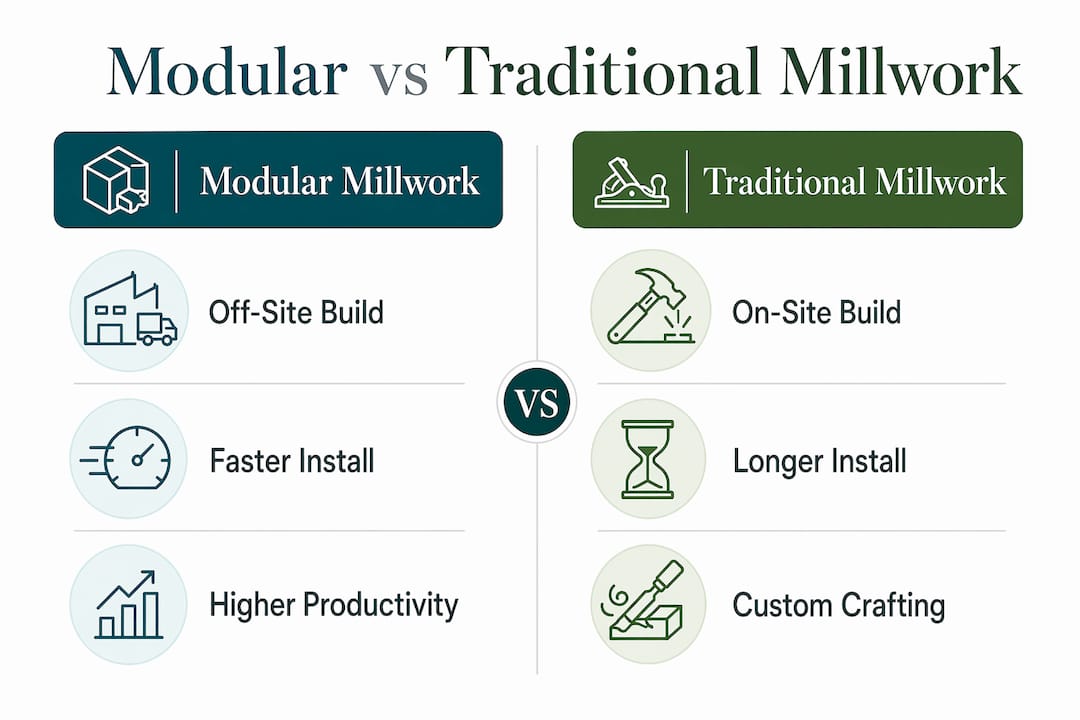
Modular millwork and traditional millwork both use wood-based materials to create built-in elements, but they differ in where and how they are built. Traditional millwork is custom-fitted on site, with carpenters measuring, cutting, and finishing in place. Modular millwork is fabricated off site to standardized dimensions, then assembled like a precision kit on the job.
The practical difference shows up in your schedule and your budget. Shop fabrication increases labor productivity by 20–40% compared to on-site construction. That gain comes from controlled conditions, specialized equipment, and repeatable processes that a job site simply cannot replicate.
Modular casework is a related but distinct category. Casework refers to utilitarian storage and work-surface units, think lab counters, mailroom stations, and reception credenzas. Modular millwork covers the same functional ground but adds architectural finish quality. The result is a product that merges built-in aesthetics with layout flexibility, making it well suited for offices and healthcare environments where appearance and adaptability both matter.
Modular millwork vs. traditional millwork vs. modular casework
| Feature | Modular Millwork | Traditional Millwork | Modular Casework |
|---|---|---|---|
| Build location | Off-site shop | On-site | Off-site shop |
| Customization | High (finishes, dimensions) | Very high | Moderate |
| Installation time | 2–3 days | Up to two weeks | 1–3 days |
| Reconfigurability | Yes | No | Yes |
| Primary use | Commercial and residential | Residential, high-end commercial | Labs, offices, healthcare |
| Permanence | Semi-permanent | Permanent | Semi-permanent |
The table above shows why many commercial project managers now default to modular systems. The custom millwork vs. stock cabinetry decision often comes down to how long you plan to occupy a space and how much flexibility you need.
How does the modular millwork design and installation process work?
The process follows a clear sequence, and skipping any step creates problems downstream. Here is how a well-run modular millwork project unfolds:
- Site measurement and programming. A millwork coordinator surveys the space and documents ceiling heights, utility locations, and structural offsets. Precise field measurements feed directly into the design model.
- BIM and 3D modeling. Designers build the millwork into a full Building Information Model. BIM integration with smart components is critical for detecting clashes between cabinetry runs and mechanical, electrical, or plumbing systems before fabrication begins.
- Shop fabrication. Components are cut, finished, and assembled in a controlled factory environment. Quality control happens at the source, not on a dusty job site.
- Concurrent site preparation. While the shop builds, the general contractor prepares walls, floors, and rough-in utilities. This parallel workflow is what compresses project schedules so dramatically.
- Delivery and installation. Pre-built modules arrive labeled and sequenced. Installation typically completes in 2–3 days versus up to two weeks for traditional on-site finishing.
- Punch list and adjustment. Minor field modifications address any remaining gaps. Because BIM caught most clashes earlier, this list is short.
One challenge deserves direct attention. Modular millwork requires higher early coordination than traditional millwork because standardized dimensions leave less tolerance for uneven walls or out-of-plumb floors. A site that has not been properly prepared will create costly delays at installation.
Pro Tip: Schedule a dedicated pre-construction coordination meeting between your architect, millwork fabricator, and general contractor before shop drawings are finalized. Catching a 1-inch discrepancy in a drawing costs nothing. Catching it on installation day costs a week.
What are the key benefits of modular millwork for business owners?
The benefits of modular millwork are economic, logistical, and strategic. Each one compounds when you are managing multiple locations or a tight renovation window.

Schedule compression. Modular installations complete in 2–3 days compared to two weeks on site. For a retail store or medical office that loses revenue every day it is closed, that difference is measurable in dollars, not just days.
Labor productivity. The 20–40% productivity gain from shop fabrication means your millwork budget goes further. Skilled labor is scarce in most U.S. markets right now. Prefabrication addresses skilled labor scarcity by concentrating specialized work in one facility rather than spreading it across multiple job sites.
Risk reduction. Modular millwork is a risk-mitigation tool that decouples project timelines from site-based delays caused by weather, trade conflicts, or material shortages. Your cabinetry is being built in a shop while your site work proceeds. A rain delay on the roof does not push your millwork back.
Tax advantages. In some jurisdictions, modular casework qualifies for 7-year depreciation rather than the longer schedule applied to permanent building components. That shorter depreciation window improves your after-tax return on the renovation investment. Confirm the classification with your accountant before budgeting.
Reconfigurability. Modular units are designed to be disassembled and reinstalled in new configurations or locations. If your business grows, relocates, or rebrands, your millwork moves with you instead of getting demolished.
“Treat modular millwork as a long-term asset, not a construction line item. The ability to reconfigure and relocate components turns a renovation expense into a reusable investment.”
Pro Tip: When budgeting a commercial renovation, ask your millwork vendor to price a standard module run alongside a fully custom run. The cost delta is often smaller than expected, and the schedule savings on the modular option frequently close the gap entirely.
Standardized modular components also simplify inventory management for multi-location businesses. Fewer cabinet sizes and universal parts mean you can order replacement components years later without a custom fabrication lead time.
What are the best applications for custom modular millwork solutions?
Modular millwork works across a wide range of commercial and residential environments. The common thread is a need for both visual quality and functional adaptability.
Commercial applications:
- Office environments. Reception desks, workstation credenzas, and conference room millwork benefit from modular systems because office layouts change frequently.
- Healthcare and labs. Nurse stations, exam room cabinetry, and laboratory casework require precise dimensions and durable finishes. Modular systems deliver consistent quality across multiple rooms or floors.
- Retail and hospitality. Display fixtures, back-bar millwork, and point-of-sale counters are natural fits. Seasonal reconfigurations become practical rather than prohibitively expensive.
- Mailrooms and support spaces. Modular casework handles sorting stations and storage runs efficiently, with interchangeable modules that adapt as workflows change.
Residential applications:
- Kitchen renovations. Modular millwork delivers the look of custom cabinetry with faster installation. For a kitchen renovation that adds real value, the combination of finish quality and schedule efficiency is hard to beat.
- Bathroom vanities and storage. Prefabricated vanity units with integrated storage reduce on-site carpentry time significantly.
- Built-in shelving and entertainment centers. Living spaces benefit from the architectural finish quality that modular millwork provides without the extended on-site labor of fully custom work.
Customization options available in modular systems
| Customization Type | Options Available |
|---|---|
| Finish | Painted, stained, laminate, veneer, thermofoil |
| Dimensions | Standard modules plus filler panels for non-standard widths |
| Hardware | Soft-close, push-to-open, integrated lighting |
| Configuration | Wall-mounted, floor-standing, island, peninsula |
| Material | Plywood box, MDF face frame, solid wood accents |
The carpentry work in complex commercial projects often combines modular millwork modules with site-built accent elements. This hybrid approach captures the schedule benefits of prefabrication while preserving the design flexibility of custom work where it matters most.
For business owners evaluating a renovation, the modular millwork definition matters less than the outcome: a finished space that looks custom, installs fast, and adapts to your needs over time.
Key takeaways
Modular millwork delivers measurable schedule, cost, and flexibility advantages over traditional site-built millwork when early coordination and BIM integration are in place.
| Point | Details |
|---|---|
| Productivity gains are real | Shop fabrication increases labor productivity by 20–40% versus on-site construction. |
| Installation is dramatically faster | Modular systems install in 2–3 days compared to up to two weeks for traditional millwork. |
| BIM integration is non-negotiable | Early 3D modeling prevents costly field clashes and keeps installation on schedule. |
| Reconfigurability protects your investment | Modular units disassemble and reinstall, making them reusable assets across locations or layouts. |
| Tax treatment can improve ROI | Modular casework may qualify for 7-year depreciation, improving after-tax returns on renovation spend. |
Why i think most owners underestimate modular millwork
Most business owners I work with come into a renovation thinking about millwork last. They finalize the floor plan, select finishes, and then ask about cabinetry as an afterthought. That sequence is exactly backwards, and it costs them time and money every single time.
The integrated design approach that modular millwork demands is actually its biggest hidden benefit. When you treat millwork as a core design element from day one, you force better coordination across all trades. The BIM model that your millwork fabricator needs is the same model that catches the HVAC duct running through your planned cabinet run. That clash costs nothing to fix in a drawing. It costs thousands to fix on site.
I have also seen owners dismiss modular systems because they assume “modular” means generic. The finish quality available today from prefabricated millwork shops rivals anything built on site. The difference is not visible in the final product. It shows up in your schedule and your invoice.
The one honest limitation I will name: modular millwork is less forgiving of imperfect sites. If your walls are out of plumb or your floors are uneven, you need to address that before installation day, not during it. That requires discipline from your general contractor and clear communication upfront. When those conditions are met, modular millwork is the most predictable renovation investment you can make.
— Grzegorz
How Agny handles modular millwork for NYC renovations
Agny brings modular millwork expertise to kitchen and bathroom renovations across New York City, coordinating fabrication, delivery, and installation as a single managed process. Whether you are reconfiguring a commercial office suite or upgrading a residential kitchen, Agny’s team integrates millwork planning from the first design meeting, not as a last-minute add-on.

Agny’s custom carpentry services cover the full range of modular and site-built solutions, from reception millwork to bathroom vanities. If you are planning a New York kitchen renovation and want the schedule efficiency of prefabricated systems with the finish quality of custom work, Agny is the team to call. Contact Agny today to discuss your project scope and timeline.
FAQ
What is the modular millwork definition in construction?
Modular millwork is a prefabricated woodwork system built from interchangeable components manufactured off site in a controlled shop environment. It combines architectural finish quality with the flexibility to reconfigure or relocate units over time.
How does modular millwork differ from modular casework?
Modular casework focuses on utilitarian storage and work-surface functions, while modular millwork adds architectural finish quality and design integration. Both are prefabricated off site, but millwork is the appropriate term when appearance and custom detailing are priorities.
What are the main benefits of modular millwork for commercial renovations?
The primary advantages of modular millwork include 20–40% labor productivity gains, installation times of 2–3 days versus up to two weeks, risk reduction through off-site fabrication, and reconfigurability that protects your long-term investment.
Does modular millwork work for residential projects like kitchens?
Yes. Modular millwork delivers custom-quality cabinetry for kitchens, bathrooms, and built-in storage with faster installation than traditional site-built methods. It is particularly effective in NYC apartments where minimizing disruption and construction time is a priority.
When should BIM be integrated into a modular millwork project?
BIM should be integrated at the start of the design phase, before shop drawings are finalized. Early 3D modeling detects clashes between millwork and mechanical or electrical systems, preventing costly field modifications during installation.