
TL;DR:
- Millwork shapes the structural and aesthetic foundation of interior spaces, defining proportions and character. Custom millwork offers precise fit and style integration that stock options cannot match, enhancing durability and perceived value. It plays a crucial role in rooms like kitchens, living areas, and entryways, regardless of style, through profiles, finishes, and proper scale.
Millwork is defined as the architectural connective tissue of interior spaces, encompassing crown molding, wall paneling, custom cabinetry, built-ins, wainscoting, and trim that integrate with a building’s structure rather than sit on top of it. The role of millwork in design goes far beyond decoration. It establishes the bones of a room, shaping proportions, rhythm, and spatial character before a single piece of furniture enters. Firms like Ashley Morgan Interiors have long argued that millwork is what separates an expertly designed space from one that is merely well-decorated. Understanding this distinction changes how you approach every interior project.
How does millwork enhance aesthetics and functionality in interiors?
Millwork serves two masters at once: visual depth and practical utility. That dual role is what makes it the most consequential decision in any interior project, and the one most often underestimated at the planning stage.
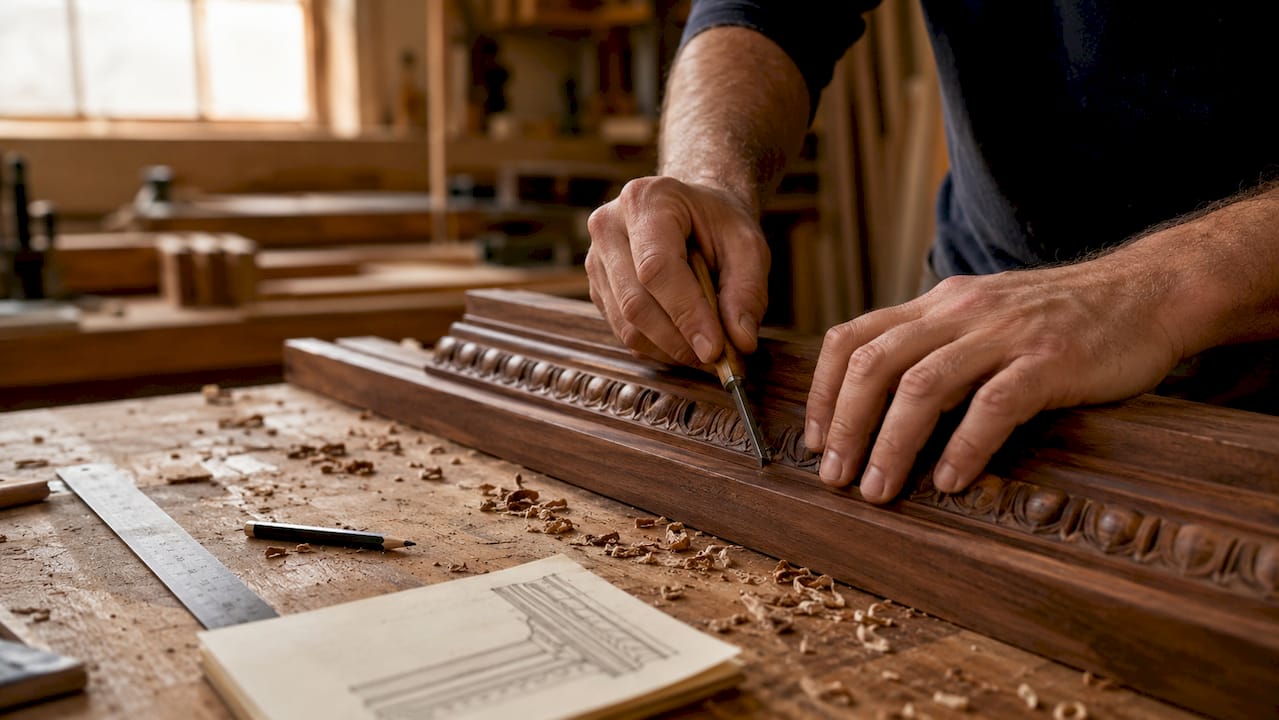
On the aesthetic side, millwork adds texture, scale, and architectural interest that paint and furniture simply cannot replicate. Crown molding makes ceilings appear taller, drawing the eye upward and adding a sense of volume to rooms that would otherwise feel flat. Wainscoting introduces a horizontal datum line that gives walls sophistication and visual weight. Coffered ceilings create a grid of depth that transforms an ordinary ceiling plane into a defining architectural feature.
The practical contributions are equally significant:
- Wall protection. Baseboards and chair rails shield drywall from daily impact, reducing long-term maintenance costs.
- Storage and organization. Built-in cabinetry and library walls use vertical space that freestanding furniture cannot reach.
- Spatial framing. Door casings and window surrounds define thresholds and create a clear visual hierarchy between rooms.
- Transition resolution. Millwork covers awkward gaps between materials, floor level changes, and structural irregularities that would otherwise read as construction errors.
- Design unity. Millwork acts as an architectural thread woven through a space, grounding varied furniture and décor into a coherent whole.
Pro Tip: Plan millwork profiles and depths before selecting furniture. The scale of your moldings sets the visual register for everything else in the room. Getting this order reversed is the single most common mistake in residential interiors.
The importance of millwork also shows up in perceived craftsmanship. High-quality millwork signals premium design to anyone who walks into a space, and buyers consistently recognize it as a hallmark of well-built homes. That perception translates directly into market value.
What are the benefits of custom millwork vs. stock options?
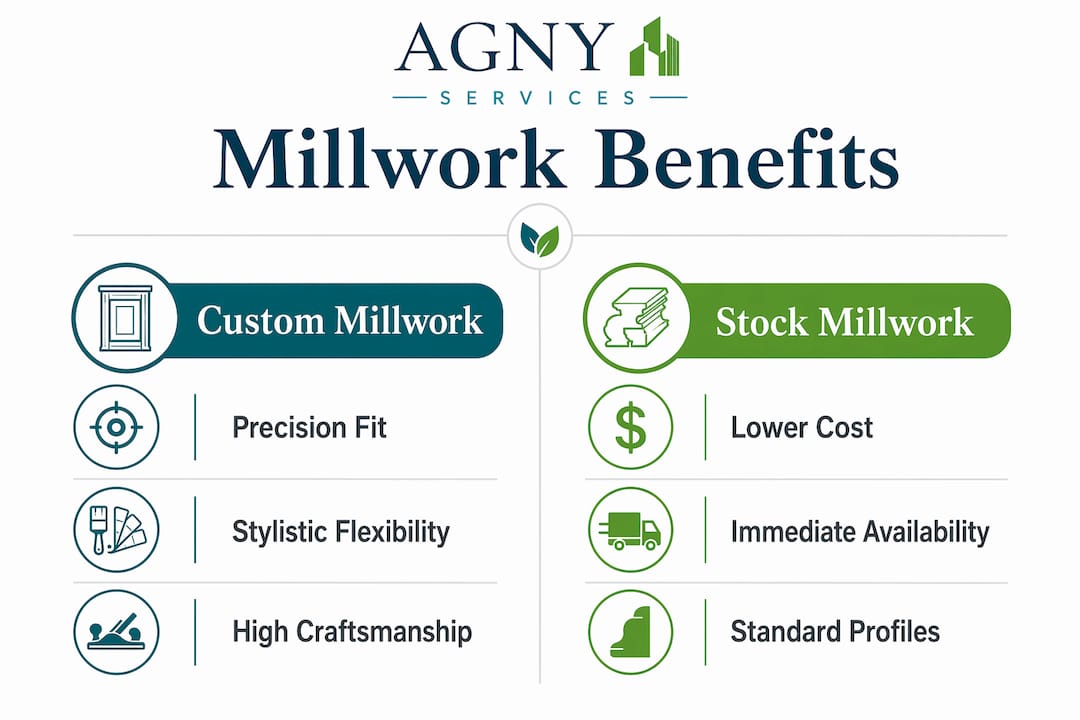
The core difference between custom and stock millwork is precision. Custom millwork is fabricated to exact measurements for a specific space, meaning every corner, reveal, and profile aligns with the existing architecture without filler strips or visible compromises. Stock cabinetry and off-the-shelf trim are built to standard dimensions that rarely match real-world conditions perfectly.
| Factor | Custom millwork | Stock or modular options |
|---|---|---|
| Fit and precision | Exact to the space, no filler needed | Standard sizes require adjustments |
| Style integration | Matches existing profiles and proportions | Limited profile options |
| Material quality | Artisan-selected, project-specific | Standardized, often lower grade |
| Durability | Built to last functionally and stylistically | Variable; may need replacement sooner |
| Design flexibility | Any style, finish, or configuration | Catalog-limited choices |
| Cost | Higher upfront investment | Lower initial cost |
Off-the-shelf millwork lacks the precision and stylistic integration that skilled artisans deliver with custom work. The result is a space that feels assembled rather than designed. For design professionals working on high-end residential or commercial projects, that distinction is not subtle. Clients notice it immediately, even when they cannot name what they are seeing.
Custom millwork also offers stylistic flexibility that stock options cannot match. You can specify a profile that echoes the original 1920s moldings in a pre-war Manhattan apartment, or design a completely flat, shadow-line detail for a minimalist loft. Stock trim forces you to choose from a catalog. Custom work starts with your drawing.
Pro Tip: When deciding between custom and modular millwork, ask one question first: does the space have non-standard dimensions, unusual angles, or existing architectural profiles that need to be matched? If yes, custom is not a luxury. It is the only option that will look right.
Which millwork elements have the most impact by room?
Millwork design impact varies significantly by space type. Choosing the right element for each room is what separates a thoughtful design from one that feels generic.
Living rooms. Paneled walls and coffered ceilings are the highest-impact choices. Full-height paneling creates a sense of permanence and formality. Coffered ceilings add depth and make the room feel intentionally designed rather than finished. Built-in shelving flanking a fireplace creates a focal point while solving storage.
Entryways and foyers. Wainscoting and detailed door casings set the tone for the entire home. The entry is the first architectural statement a visitor experiences. Millwork here communicates the design language that will repeat throughout the space.
Kitchens. Custom cabinetry is the dominant millwork element in kitchens, and it is where millwork defines spatial character most directly. Crown molding on upper cabinets integrates them with the ceiling. Integrated panels on appliances and islands create a unified, furniture-like appearance that stock cabinetry cannot achieve.
Bedrooms. Board-and-batten accent walls and built-in wardrobes are the most functional choices. A well-designed built-in wardrobe uses every inch of available height, something freestanding furniture never accomplishes.
Home offices and libraries. Millwork elements like built-ins and paneling define these rooms more than any other design decision. Floor-to-ceiling shelving with integrated lighting transforms a spare room into a purposeful, identity-rich space.
Bathrooms. Wainscoting and custom vanity millwork protect walls from moisture while adding material richness. Recessed medicine cabinets and built-in niches solve storage without consuming floor space.
Millwork also resolves specific design problems that furniture cannot fix. Awkward alcoves become built-in window seats. Low ceilings gain apparent height through vertical paneling. Transitions between flooring materials disappear under well-profiled thresholds. The quality of millwork installation determines whether these solutions look intentional or like afterthoughts.
How do you integrate millwork into modern and traditional styles?
Millwork in interior design is not locked to any single aesthetic. The same structural logic applies across styles. What changes is the profile, the finish, and the level of ornamentation.
- Modern and minimalist interiors call for flat-panel cabinetry, shadow-line reveals, and minimal baseboards with a square profile. The goal is geometry without decoration. Millwork here works through proportion and material rather than detail.
- Traditional and classical interiors use layered profiles, raised panel doors, dentil molding, and pilasters. The richness comes from accumulated detail. Each element references a historical vocabulary that gives the space weight and permanence.
- Transitional interiors blend both approaches. A shaker-style cabinet door with a simple crown molding and clean hardware sits comfortably between modern restraint and traditional warmth. This is the most common residential choice in 2026 because it ages well and appeals broadly.
- Eclectic interiors use millwork as an anchor. When furniture and décor span multiple periods or styles, consistent millwork profiles throughout the space create the visual order that holds everything together.
Millwork style adapts to modern, traditional, or eclectic interiors through finish, material, and detailing choices. White-painted millwork reads as classic. Natural wood reads as warm and organic. Lacquered millwork in a deep color reads as contemporary and bold. The same profile in three different finishes produces three completely different design statements.
The key to successful integration is consistency of scale. A heavy, deeply profiled crown molding in a room with eight-foot ceilings creates visual compression. The same molding in a twelve-foot room feels correct. Matching millwork scale to ceiling height and room volume is the technical skill that separates experienced designers from beginners.
Pro Tip: When blending millwork with existing furniture, match the visual weight rather than the style. A substantial oak dining table pairs better with substantial millwork profiles, regardless of whether the profiles are modern or traditional in character.
Key Takeaways
Millwork is the architectural framework that defines spatial quality, and custom fabrication delivers the precision and longevity that stock options cannot match.
| Point | Details |
|---|---|
| Millwork is structural, not decorative | It establishes spatial proportions and architectural order before furniture enters a room. |
| Custom millwork fits without compromise | Precise fabrication eliminates filler strips and aligns with existing architecture exactly. |
| Each room has a priority element | Kitchens need custom cabinetry; living rooms benefit most from paneling and coffered ceilings. |
| Style is determined by profile and finish | The same millwork logic applies across modern, traditional, and transitional aesthetics. |
| Millwork increases perceived and market value | Buyers recognize quality millwork as a hallmark of premium, well-designed homes. |
Why millwork is the detail I never let clients skip
Most clients come to a project thinking millwork is the finishing touch. They want to choose paint colors and furniture first, then add trim at the end if the budget allows. That approach produces spaces that feel unresolved, no matter how good the furniture is.
Millwork is often misunderstood as purely decorative, but it is actually the architectural language of a home. You cannot add it as an afterthought and expect it to look right. The profiles need to be drawn before the walls go up. The cabinet depths need to be coordinated with the mechanical rough-in. The paneling scale needs to be set before the lighting layout is finalized. This is early-stage work, and skipping it creates problems that are expensive to fix later.
What I have observed over years of working on interior projects is that the spaces clients remember are always the ones with strong millwork. Not the ones with the most expensive furniture or the most dramatic paint color. The rooms that feel genuinely designed have a quality of permanence that comes from the architecture, not the décor. That quality is millwork.
The other misconception I encounter regularly is that custom millwork is only for large budgets. The reality is that targeted custom millwork in one or two key areas, a built-in bookcase, a paneled entry wall, a custom kitchen hood surround, delivers more design impact per dollar than almost any other investment. You do not need to panel every room. You need to panel the right room.
— Grzegorz
Agny’s millwork and renovation services for your next project
Agny specializes in custom millwork, kitchen renovations, and full interior renovations across New York City. Every project starts with detailed design consultation and precise measurement, so the millwork integrates with your space the way it was always meant to.

Whether you are planning a kitchen renovation that adds real value or a complete interior overhaul, Agny’s team handles fabrication, finishing, and installation with the craftsmanship that makes the difference between a space that looks finished and one that looks designed. Agny also offers custom millwork guidance for property owners who want to understand their options before committing to a scope. Contact Agny to discuss your project.
FAQ
What is millwork in interior design?
Millwork refers to wood-based architectural elements, including crown molding, paneling, cabinetry, built-ins, and trim, that are fabricated and installed as permanent parts of a building’s interior structure. It functions as both a structural framework and an aesthetic system that defines spatial character.
What is the difference between millwork and trim?
Trim is a subset of millwork. Millwork encompasses all wood-based architectural elements, including cabinetry and built-ins, while trim refers specifically to the moldings and profiles used to finish edges, transitions, and openings.
Why is custom millwork worth the higher cost?
Custom millwork is fabricated to exact dimensions for a specific space, eliminating the gaps and filler strips that stock options require. It also integrates with existing architectural profiles and is built by skilled artisans to last both functionally and stylistically.
Which rooms benefit most from millwork?
Kitchens, living rooms, and entryways show the highest return from millwork investment. Custom cabinetry defines kitchens, paneling and coffered ceilings anchor living rooms, and detailed casings and wainscoting set the design tone in entryways.
Does millwork work in modern minimalist interiors?
Millwork adapts to any style through profile and finish choices. Modern interiors use flat-panel details and shadow-line reveals rather than ornate moldings, achieving architectural depth through geometry and proportion rather than decoration.