TL;DR:
- Kitchen layout choices greatly influence flow, storage, and overall space perception, making them crucial during renovation. Selecting the appropriate configuration depends on room size, cooking habits, and social needs, with layouts like L-shape, U-shape, and islands offering diverse benefits. Effective design relies on proper work triangle placement, sufficient clearance, and zone organization rather than aesthetic appeal alone.
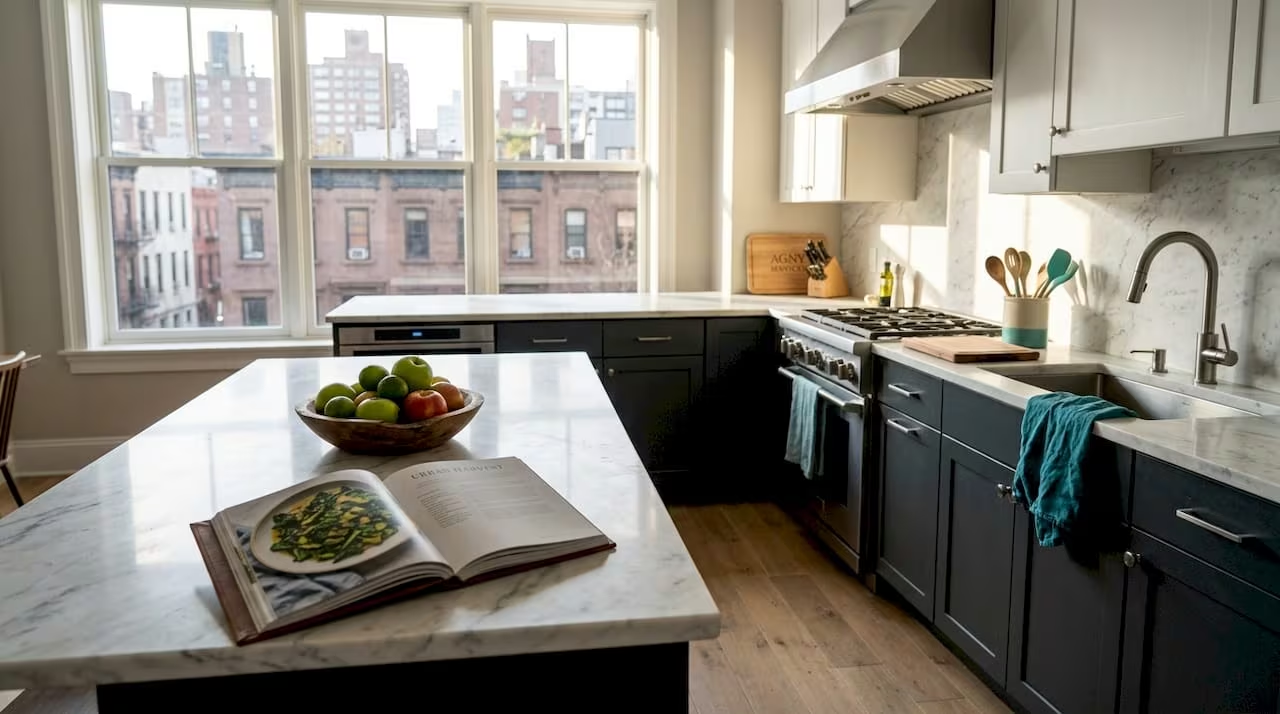
Kitchen layout examples are the foundational floor plan archetypes that determine how efficiently you move, cook, and live in your kitchen. The right layout does more than look good on a mood board from House Beautiful or Better Homes & Gardens. It controls your workflow, dictates storage capacity, and shapes whether your kitchen feels cramped or spacious. Whether you are renovating a 169-square-foot NYC apartment kitchen or planning a new build with an open concept kitchen, the layout you choose is the single most consequential design decision you will make.
1. The most common kitchen layout examples and their key features
Kitchen layout archetypes include six primary configurations: L-shape, U-shape, galley, one-wall, island-centric, and peninsula or G-shaped variants. Each one suits a different room size, household type, and cooking style. Understanding their core characteristics before you commit to a floor plan saves you from expensive mid-renovation corrections.
L-shaped layout
Two perpendicular walls form an open corner that works in almost any kitchen size. L-shaped layouts are the most popular and versatile configuration available, fitting small apartments and large open-plan homes equally well. The open corner naturally accommodates a dining table or a small island if clearance allows.
- Works in kitchens from 100 to 300+ sq ft
- Supports natural work triangle placement
- Leaves room for a dining area or island addition
U-shaped layout
Three walls of cabinetry and appliances wrap around the cook, maximizing storage and counter space. This layout suits medium to large kitchens and works best for single cooks who want everything within arm’s reach. The enclosed shape can feel tight in rooms under 150 square feet.
- Ideal for kitchens 150 sq ft and above
- Maximum storage and counter surface
- Can feel closed off in smaller rooms
Galley layout
Two parallel runs of cabinets face each other across a central aisle. Galley kitchens are the most space-efficient design for narrow rooms and are the preferred layout in professional restaurant kitchens for exactly that reason. The challenge is traffic flow when multiple people cook simultaneously.
- Best for narrow rooms under 8 feet wide
- Highly efficient for single-cook households
- Poor circulation for multi-cook households
One-wall layout
All appliances and cabinets sit along a single wall. This is the default layout for studio apartments and open-plan lofts where the kitchen shares space with living areas. Storage is limited, so vertical cabinet runs and overhead shelving become critical.
- Suits studios and very small apartments
- Minimal footprint, maximum open floor space
- Storage requires creative vertical solutions
Island-centric layout
An island is added to an L-shaped or U-shaped base to create a secondary prep zone and social gathering point. Islands work best only when adequate clearance is maintained around all sides, which requires a minimum kitchen width of roughly 13 feet. This is the defining feature of most modern kitchen plans featured in design publications.
Peninsula or G-shaped layout
A peninsula extends from a wall or cabinet run to create a partial island that does not require clearance on all four sides. This is the smarter choice for kitchens that are too narrow for a freestanding island but still need extra counter space and seating.
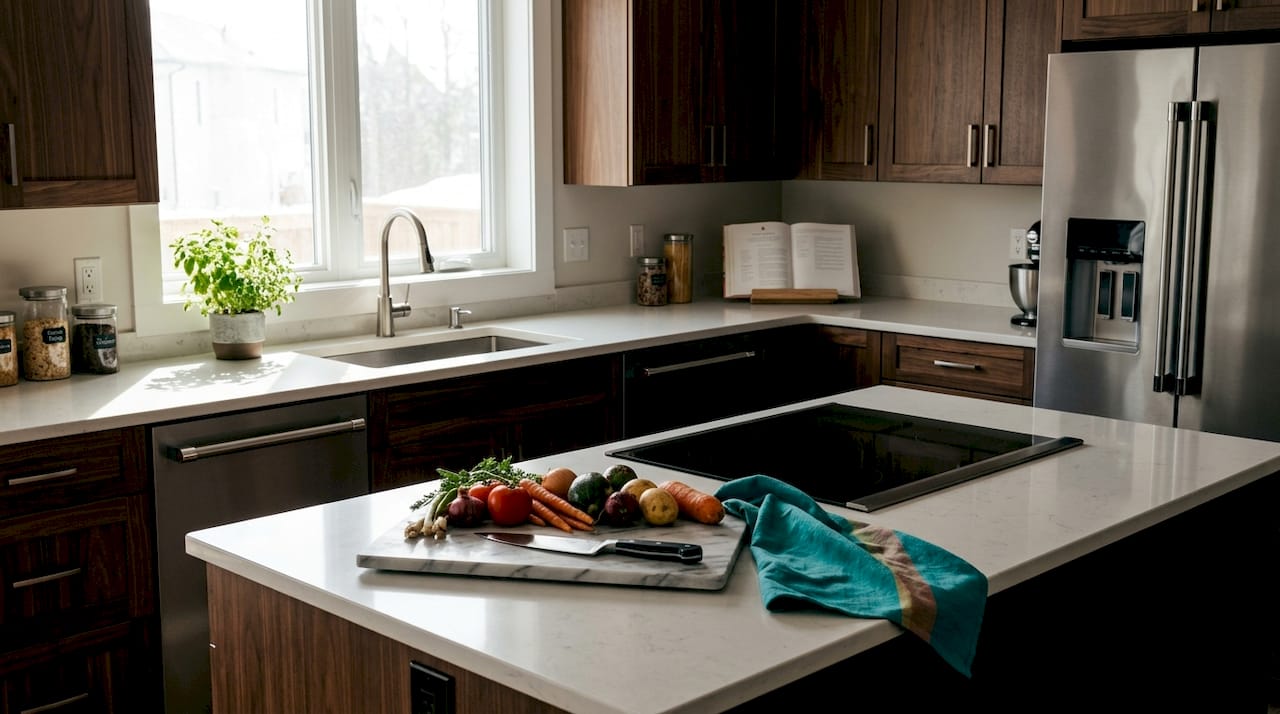
2. How clearance space and the work triangle affect your layout
The work triangle is the design principle that connects your sink, stove, and refrigerator in a triangular path. Each side of the triangle should measure between 4 and 9 feet, with a total perimeter between 13 and 26 feet for optimal movement. A triangle that is too tight creates congestion; one that is too large wastes steps and energy during cooking.
Clearance around islands and walkways matters just as much as the triangle itself. Recommended clearance around kitchen islands ranges from 42 to 48 inches, with 36 inches as the minimum acceptable only in low-traffic areas. The 42-inch standard suits a single-cook household; 48 inches is the target for multi-cook households where two people regularly work side by side.
Modern kitchens have largely moved beyond the strict triangle toward a zoning model. Multiple work zones covering prep, cooking, cleaning, and beverage stations now complement or replace the triangle in open-plan and multi-cook setups. This shift matters for open concept kitchen designs where the kitchen flows into a living or dining area and traffic patterns are less predictable.
Pro Tip: If your island feels too large for the room, the problem is almost never the island itself. It is the clearance on the traffic side. Reduce island depth by 6 inches before you reduce its length, and you preserve prep surface while opening the walkway.
In tight small kitchen layouts, the priority shifts from achieving a perfect triangle to preventing main traffic paths from cutting through the prep and cooking zones. A galley kitchen where the aisle doubles as a hallway to the back door is a classic example of this problem. Repositioning the entry point or adding a pocket door resolves the conflict without touching the cabinet layout.
3. Real-world renovation examples that prove layout optimization works
The most instructive kitchen floor plan examples come from renovations that improved function without expanding the footprint. A Baltimore kitchen renovation documented by House Beautiful transformed a 169-square-foot kitchen by rearranging work zones, increasing usable countertop space by roughly 50% and cabinet space by roughly 60%, all without moving a single wall. The lesson is that layout rearrangement delivers more usable space than square footage alone suggests.
The specific changes that drove those gains are replicable in most kitchens:
- Moving the refrigerator out of the primary work zone to a secondary wall freed a full run of counter space between the sink and stove
- Redesigning the sink placement to face the room rather than a wall improved sightlines and social interaction during meal prep
- Relocating the refrigerator and optimizing underused corners with pullout pantries and full-height cabinet runs dramatically increased storage without adding square footage
You can see similar results in apartment remodel before and after projects where layout changes, not expansions, deliver the most visible transformation. The refrigerator is the most commonly misplaced appliance in residential kitchens. Placing it at the end of a run rather than in the middle of the work triangle removes a major traffic conflict and opens the most valuable counter real estate next to the stove.
Corner cabinets are the second most underused asset in residential kitchens. Lazy Susans, magic corner pullouts, and full-height pantry towers convert dead corner space into active storage. These changes cost a fraction of an addition and deliver immediate functional gains.
4. How to choose the best kitchen layout for your home and lifestyle
Choosing among kitchen layout examples requires matching the floor plan to three variables: room size, cooking habits, and social priorities. The table below maps the most common scenarios to the layout that performs best.
| Kitchen size | Best layout | Ideal for |
|---|---|---|
| Under 100 sq ft | One-wall or galley | Studio apartments, single cooks |
| 100 to 150 sq ft | L-shaped | Small households, occasional entertaining |
| 150 to 250 sq ft | U-shaped or L-shaped with island | Multi-cook households, frequent cooking |
| 250 sq ft and above | Island-centric or G-shaped | Open-plan homes, social kitchens |
Single cooks who prioritize efficiency benefit most from a galley or U-shaped layout where every appliance sits within a compact triangle. Multi-cook households need either an island layout with 48-inch clearance on both sides or a G-shaped peninsula that creates two parallel work zones without requiring the full clearance of a freestanding island.
For open-plan homes, the L-shaped layout with an island is the most flexible functional kitchen arrangement available. The island defines the kitchen zone visually without closing it off, and it doubles as a social counter for guests. Understanding kitchen remodeling costs in NYC before you commit to an island addition helps you budget realistically for the structural and plumbing implications.
Pro Tip: Before adding an island to an existing L-shaped kitchen, tape out the island footprint on the floor and walk around it for a full day of cooking. If you bump the tape more than twice, reduce the island dimensions before ordering cabinets.
Budget-conscious renovations should prioritize layout changes over material upgrades. Repositioning the sink, stove, or refrigerator delivers more functional improvement per dollar than new cabinet doors or countertop materials. The small kitchen trends for ADUs in 2026 confirm this: vertical storage and zone optimization consistently outperform cosmetic upgrades in compact spaces.
Key takeaways
The efficiency of any kitchen layout depends more on work triangle placement, clearance standards, and zone organization than on aesthetics or room size alone.
| Point | Details |
|---|---|
| Layout type drives function | Choose L-shaped, U-shaped, galley, or island layouts based on room size and cooking habits, not trends. |
| Clearance is non-negotiable | Maintain 42 to 48 inches around islands; 36 inches is the minimum only in low-traffic zones. |
| Work triangle still matters | Keep each triangle side between 4 and 9 feet and total perimeter between 13 and 26 feet. |
| Rearrangement beats expansion | A 169 sq ft kitchen gained 50% more counter space through layout changes alone, without moving walls. |
| Zones beat strict triangles | Multi-cook and open-plan kitchens perform better with prep, cooking, clean, and beverage zones than with a single triangle. |
What I have learned from years of kitchen renovation projects
The most common mistake I see homeowners make is choosing a layout based on a photo rather than a floor plan. A kitchen that looks stunning in a magazine shoot was photographed with a wide-angle lens in a room that is probably 30% larger than yours. The layout that works in that photo may not work in your space at all.
The second mistake is treating the work triangle as a rigid rule rather than a starting point. In kitchens with more than one regular cook, a single triangle creates conflict. Two overlapping zones, one for the primary cook and one for a secondary prep station, solve the problem better than any single-triangle layout ever will. I have seen this approach transform galley kitchens that felt unusable into genuinely functional spaces by simply assigning one wall to prep and the other to cooking and cleanup.
What I tell every client at Agny is this: your cooking habits matter more than your square footage. A serious home cook in a 120-square-foot kitchen needs a different layout than a casual cook in the same space. One needs a tight, efficient triangle with maximum counter space near the stove. The other needs easy access to the refrigerator and a clear path to the dining table. Neither answer comes from a template. It comes from watching how you actually move in your kitchen before a single cabinet is ordered.
The best kitchen designs I have worked on always start with a conversation about lifestyle, not aesthetics. Style follows function. When the layout is right, the kitchen looks good almost automatically.
— Grzegorz
Ready to bring your kitchen layout ideas to life with Agny
Choosing the right layout on paper is one thing. Executing it in a real kitchen with real constraints, plumbing locations, load-bearing walls, and building codes, is where professional expertise pays for itself.

Agny specializes in kitchen renovations that add real value to New York homes and apartments, handling everything from initial layout planning and clearance compliance to cabinet installation and finish selection. The team works with your existing footprint to maximize function before recommending any structural changes. If you are ready to move from inspiration to a finished kitchen, schedule a consultation with Agny to get a layout plan built around how you actually cook and live.
FAQ
What are the most functional kitchen layout examples?
The L-shaped and U-shaped layouts are the most functional for the widest range of kitchens, offering strong work triangle placement and ample storage. Island-centric layouts add the most flexibility in larger rooms where 42 to 48 inches of clearance is achievable.
How much clearance does a kitchen island need?
A kitchen island requires a minimum of 36 inches of clearance in low-traffic areas, with 42 inches recommended for single-cook households and 48 inches for multi-cook households. Falling below these targets creates circulation problems that no amount of good design can fix.
Can I improve a small kitchen without moving walls?
Yes. Rearranging work zones, relocating the refrigerator to a secondary wall, and converting corner cabinets to pullout storage can increase usable counter and cabinet space by 50% or more without structural changes, as demonstrated in documented renovation cases.
What is the work triangle rule in kitchen design?
The work triangle connects the sink, stove, and refrigerator in a triangular path where each side measures 4 to 9 feet and the total perimeter stays between 13 and 26 feet. Modern kitchens often supplement this with dedicated prep, cooking, and cleanup zones for multi-cook households.
Which kitchen layout works best for open-plan homes?
The L-shaped layout with a freestanding island is the best choice for open-plan homes. It defines the kitchen zone without closing it off, supports social interaction, and allows traffic to flow naturally between the kitchen and living areas.