
A construction punch list is the official record of incomplete or deficient work that must be corrected before a project reaches final completion. If you own property, manage buildings, or oversee construction projects, understanding punch lists is the difference between a clean handover and months of disputes, withheld payments, and unresolved defects.
What is a punch list in construction?
A punch list documents every item of work that falls short of contract specifications at or near the end of a project. Under AIA Document A201-2017, the contractor prepares the initial comprehensive list when the work reaches substantial completion, and the architect reviews it before final completion is certified.
Two milestones define the process:
- Substantial completion: The space is ready for its intended use, even if minor corrections remain. This triggers the formal punch list process and typically starts the warranty period.
- Final completion: Every punch list item has been resolved, verified, and all required paperwork submitted. Final payment and retainage release follow.
A punch list is not a wish list or a vehicle for new requests. It covers only deficiencies within the original contract scope. Each item on the list should meet three criteria: the work was included in the contract, it was substantially attempted, and it does not meet the contract specification or quality standard.
Every well-structured punch list item includes:
- Exact location (building, floor, room, wall)
- Specific description of the deficiency
- The responsible trade or subcontractor
- Photographic documentation with timestamps
- A deadline for correction
- Status tracking (open or completed)
How punch lists fit into project closeout
The punch list process is the final quality gate between construction and owner handover. It does not happen in isolation; it is woven into a sequence of closeout activities that determine when you get your certificate of occupancy and when money changes hands.
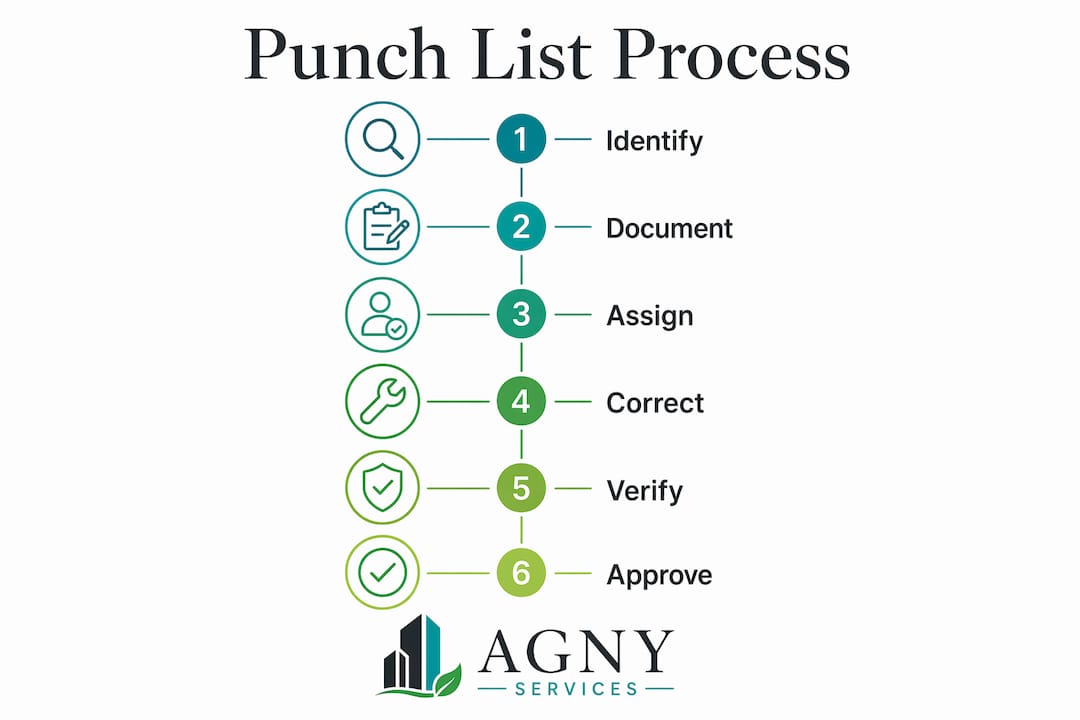
Here is how the workflow typically unfolds:
- The general contractor (GC) conducts an initial walkthrough and prepares the master punch list, often with input from the architect and owner.
- The GC assigns each item to the responsible subcontractor, grouped by trade and location.
- Subcontractors receive only their items, with photos, clear descriptions, and a documented deadline, usually set as 5–10 business days.
- The superintendent re-walks to verify corrections physically. No verbal confirmations.
- Once all items are verified, the GC generates closeout reports for the owner.
- The certificate of occupancy, retainage release, and final payment follow.
Tracking everything on a single master list matters more than most owners realize. Multiple disconnected lists, one per trade, one per walkthrough, one in someone’s email, create confusion, duplicate items, and missed defects that surface after handover.
What kinds of items end up on a punch list?
Typical punch list items fall into five categories, and knowing them helps you conduct a sharper walkthrough.
- Incomplete or incorrect installations: Doors that do not latch, cabinet hardware installed at the wrong height, windows that do not seal properly.
- Cosmetic defects: Paint scuffs, scratched countertops, drywall dings, caulking gaps, flooring transition strips not seated correctly.
- Mechanical, electrical, and plumbing issues: Plumbing fixture leaks, HVAC balancing problems, thermostat programming errors, missing electrical cover plates, exit sign or emergency lighting failures.
- Missing items: Hardware, fixtures, accessories, or equipment specified in the contract but not yet installed.
- Documentation gaps: Missing warranties, operation and maintenance manuals, as-built drawings, or other closeout submittals required by the contract.
One distinction that causes real problems: a punch list item is a correction to meet the existing contract scope. A change order modifies scope, budget, or schedule. If an owner decides mid-project to upgrade finishes or add outlets, that is a change order requiring formal approval and pricing. Slipping scope changes onto a punch list creates disputes and delays payment for everyone.
Pro Tip: Prioritize punch list items by impact. Safety and life-safety items (exit signs, fire alarm testing, emergency lighting) must be resolved before substantial completion is certified. Functional defects that affect occupancy come next. Cosmetic items can often be scheduled after move-in, provided the contract and owner agree on timelines in writing.
How to conduct an effective punch list walkthrough
The walkthrough, often called the “punch walk,” is where the list gets built. A thorough walk produces a clean, actionable document. A rushed one produces vague descriptions, missing assignments, and items that get disputed for months.

Start the punch walk near substantial completion, but not before. Beginning too early fills the list with incomplete work rather than actual defects, and trades are still on-site making changes that will generate new items anyway.
Follow these steps for a disciplined walkthrough:
- Move room by room in a consistent path. Most experienced superintendents follow a clockwise route through each space so nothing gets skipped.
- Document every item in real time. Do not rely on memory or rough notes you plan to clean up later.
- Record four things for each item: what is wrong (specific description), where it is (building, floor, room, exact wall or surface), who is responsible (which trade), and what it looks like (photo with markup).
- Write descriptions as instructions, not observations. “Touch up paint, scuff mark on east wall, 4 feet from floor, adjacent to bedroom door frame” is useful. “Paint” is not.
- Maintain one master list. Add items to it in real time rather than keeping separate notes that need to be merged later.
- Notify subcontractors in writing with documented deadlines. The notification should be timestamped.
- Re-walk to verify. Never accept a subcontractor’s verbal confirmation that items are complete. Every item requires a physical superintendent re-walk.
Pro Tip: Start an internal pre-punch walkthrough two to three weeks before the formal owner walk. The GC identifies and resolves what they can independently, so the owner’s inspection list is shorter and less contentious. This is one of the most effective ways to compress closeout.
The rolling punch list approach takes this further. Instead of saving all deficiency documentation for the end, the project team flags and assigns issues throughout construction, verifying each task at completion rather than revisiting it weeks later. Projects that use rolling punch lists are more likely to reach zero punch list status at closeout, meaning no outstanding items at the time of the final walkthrough.
Good photographic documentation with markups and timestamps eliminates ambiguity, reduces callbacks, and speeds up acceptance of completed work. When a dispute arises, photos with timestamps are the most reliable evidence you have.
How punch list completion affects final payment
Unresolved punch list items directly delay the certificate of occupancy, final payment, and retainage release. Most construction contracts withhold a portion of payment as retainage until the punch list is closed and final completion is certified. For specialty contractors, that means cash tied up until corrections are verified, often on work completed weeks or months earlier.
Here is what the payment chain looks like in practice:
- Owners and lenders rely on punch list clearance before accepting the project and releasing funds.
- The certificate of occupancy typically cannot be issued until life-safety and functional punch items are resolved.
- Retainage, typically withheld as 5–10% of the contract value, stays withheld until all items are verified complete and closeout documents are submitted.
- If a subcontractor fails to complete corrections by the deadline, the GC can issue a backcharge notice, hire another contractor at the original sub’s expense, or withhold the sub’s retainage.
For property owners, the punch list protects your investment by converting closeout into documented, enforceable tasks rather than handshake agreements. A well-maintained punch list gives you legal standing if defects surface after handover and payment has been released.
One common dispute: owners sometimes attempt to classify significant defects, or even new scope, as punch list items to avoid the change order process. Contractors push back, payment stalls, and both sides end up in litigation. Clear contract language defining what constitutes a punch list item versus a change order prevents most of these conflicts before they start.
Best practices for managing punch lists without delays
The difference between a punch list that closes in two weeks and one that drags for three months usually comes down to how it is managed, not how many items are on it.
- Start early. An internal pre-punch two to three weeks before the formal walk lets the GC resolve items while trades are still mobilized, which is far cheaper than calling them back.
- Document with photos every time. Vague descriptions create callbacks. A photo with a markup and a timestamp leaves no room for interpretation.
- Assign items only to the responsible subcontractor. Sending the full project list to every trade is overwhelming and unprofessional. Filter by subcontractor, group by location, attach photos, and include a deadline.
- Set firm, written deadlines. A verbal deadline is not a deadline. The notification must be timestamped and documented.
- Enforce superintendent re-walks. A subcontractor who says “we got everything in Building A” may have completed 90% and missed three units. Physical verification catches the gap before the owner walk does.
- Keep the status workflow simple. Open or completed. Overengineered status systems slow field operations and add no value.
Pro Tip: Digital punch list tools let you assign items, attach photos, track status, and notify subcontractors from a mobile device on-site. Real-time updates eliminate the communication gaps that cause most closeout delays. For complex projects, this is worth adopting before the first punch walk, not after.
Embedding quality control throughout construction, rather than treating the punch list as a reactive end-of-project exercise, drastically reduces the volume of items at closeout. A 400-item punch list at the end of a project is rarely a closeout problem. It is a documentation problem that accumulated over months. For guidance on how construction project management workflow affects punch list outcomes, the connection between early quality tracking and shorter closeout lists is well established.
Who is responsible for what on a punch list?
Every party in a construction project has a defined role, and confusion about those roles is one of the most common sources of punch list disputes.
General contractor: Prepares the initial punch list, coordinates subcontractor assignments, tracks progress, manages documentation, and drives the process through final acceptance. The GC owns the master list and is responsible for communicating status to the owner.

Subcontractors: Complete corrections within their scope and provide evidence of resolved items. Each sub is responsible only for their assigned items. A plumber does not need to see the painter’s list, and sending them the full document wastes everyone’s time.
Architect or designer: Verifies that finished work meets contract specifications and design intent. The architect reviews the contractor’s initial list for completeness and can add missing items, though they are not responsible for the list’s completeness under AIA Document A201-2017.
Owner or property manager: Reviews completed corrections and gives final sign-off before approving final payment. Owners can conduct their own walkthrough and add items, but those items must fall within the original contract scope. Asking for upgrades or changes during the punch walk is a change order, not a punch list item.
Maintaining a collaborative but firm approach during walkthroughs keeps the process moving. Hostility slows corrections. Vagueness creates disputes. The most productive punch list relationships are built on clear documentation and consistent follow-through from all parties.
How to resolve punch list disputes
Punch list disputes arise most often when items become confused with additional scope, when documentation is incomplete, or when one party believes the work meets the standard and the other does not.
The first line of defense is the contract itself. Review the language governing substantial completion, final completion, and what constitutes a punch list item versus a change order. If the contract is ambiguous, that ambiguity will be exploited at closeout.
When a dispute arises, follow this sequence:
- Document everything in writing. Inspection reports, communications, photos, and correction records are your evidence. Verbal agreements about disputed items are worthless.
- Reference the contract specifications directly. “The door does not latch” is an opinion. “The door hardware does not meet the latching force requirement in Section 08 71 00 of the specifications” is a contract claim.
- Separate punch list items from change order requests. If an owner is trying to add new scope to the punch list, address it formally as a change order. Do not let it sit in the punch list unresolved.
- Escalate through the contract’s dispute resolution process. AIA Document A201-2017 provides a structured path: initial decision by the architect, then mediation, then arbitration or litigation depending on the contract.
- Engage legal counsel early for significant disputes. Detailed records of inspections, communications, and resolutions mitigate payment and warranty disputes before they reach litigation.
For owners, the punch list is not just a checklist. It is a legally binding document that protects your investment and enforces contract compliance. Treat it that way from the first walkthrough.
If you are planning a renovation in New York and want a contractor who manages closeout with the same discipline as the build itself, Agny’s renovation services are built around exactly that standard.

Key Takeaways
A construction punch list is the formal record that bridges substantial completion and final payment, and how you manage it determines whether closeout takes weeks or months.
| Point | Details |
|---|---|
| Punch list vs. change order | Punch list items correct existing contract scope; change orders modify scope and require formal approval. |
| Payment is tied to closure | Retainage, typically 5–10% of contract value, stays withheld until all punch list items are verified complete. |
| Documentation drives resolution | Photos with timestamps, written deadlines, and a single master list prevent disputes and speed corrections. |
| Rolling punch lists reduce closeout risk | Documenting deficiencies throughout construction cuts the volume of final punch work and compresses closeout timelines. |
| Every party has a defined role | The GC owns the list, subcontractors correct their items, the architect verifies quality, and the owner gives final sign-off. |