
TL;DR:
- Bathroom ventilation removes excess moisture, odors, and pollutants to prevent mold and structural damage. Properly sized, installed, and maintained systems ensure effective moisture control, safeguarding home health and value.
Bathroom ventilation is the system that removes excess moisture, odors, and airborne pollutants from your bathroom before they damage your home or harm your health. The role of ventilation in bathrooms goes far beyond comfort. Without it, a single 10-minute shower produces roughly 0.5 pints of water vapor that has nowhere to go. That moisture soaks into drywall, feeds mold colonies, warps cabinetry, and eventually spreads through your HVAC system to the rest of the house. The good news is that the right mechanical ventilation system, properly sized and installed, solves all of this reliably.
How does bathroom ventilation control moisture and prevent mold?
Every shower, bath, and even a running sink pushes warm, humid air into a small, enclosed space. That humidity clings to walls, mirrors, and grout lines. Left unchecked, mold colonization begins within 24 to 48 hours of moisture exposure. That timeline is faster than most homeowners realize, and it means a bathroom that fogs up every morning is already at risk.
The EPA recommends keeping indoor relative humidity below 50% to prevent mold growth. Mechanical exhaust fans achieve this by pulling humid air out of the room and ducting it outside, replacing it with drier air drawn from adjacent spaces. The result is a bathroom that returns to safe humidity levels within 20 to 30 minutes of use, rather than staying damp for hours.
The importance of bathroom ventilation becomes clearest when you consider what mold actually does to a home. It degrades drywall, stains grout, and triggers respiratory problems, particularly in people with asthma or allergies. Mold remediation in a single bathroom can cost thousands of dollars, all of which is preventable with a properly functioning exhaust fan.
Here is what happens inside a bathroom without adequate airflow:
- Humidity spikes above 70% during and after showers
- Condensation forms on walls, ceilings, and window frames
- Paint peels and drywall softens within months
- Grout lines darken with mold growth
- Wood framing inside walls begins to absorb moisture and weaken
Pro Tip: Run your exhaust fan for 20 to 30 minutes after every shower, not just during it. Most of the moisture lingers in the air after the water stops.
What are the common ventilation systems for bathrooms?
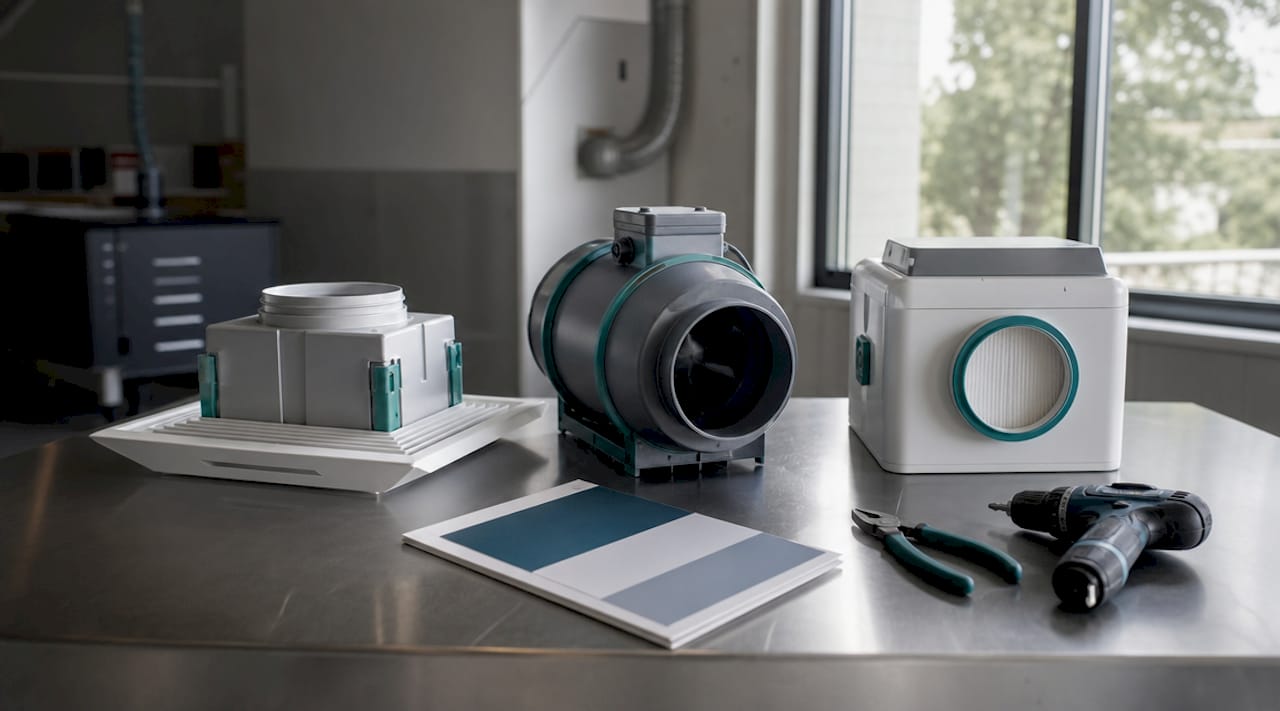
Mechanical exhaust fans are the standard solution for bathroom air quality control in American homes. They are rated in CFM, which stands for cubic feet per minute, and that number tells you how much air the fan moves per minute. A higher CFM rating means faster moisture removal. Most residential fans range from 50 CFM to 150 CFM, with larger or high-use bathrooms requiring the upper end of that range.
Natural ventilation through windows is the oldest method, but it has serious limitations. Windows are unreliable as sole bathroom ventilation because their effectiveness depends entirely on user behavior and outdoor weather conditions. On a cold or rainy day, no one opens the bathroom window. That inconsistency makes windows a supplement to mechanical ventilation, not a replacement for it.
The table below compares the most common ventilation systems for bathrooms:
| System | How it works | Best for | Key limitation |
|---|---|---|---|
| Ceiling exhaust fan | Pulls air up and ducts it outside | Most bathrooms | Requires proper duct routing |
| Inline fan | Mounted in duct run, quieter operation | Long duct runs or multiple bathrooms | Higher installation cost |
| Recirculating fan | Filters air and returns it to the room | Apartments with no exterior duct access | Does not remove humidity |
| Window ventilation | Relies on open window and airflow | Mild climates, supplemental use | Inconsistent, weather dependent |
Inline fans deserve more attention from homeowners. They sit inside the duct run rather than at the ceiling, which makes them significantly quieter at the grille. Quieter fans encourage consistent operation, which directly improves ventilation effectiveness. A fan that no one turns off because it sounds like a jet engine is not doing its job.
Recirculating fans are worth understanding because they are often sold as ventilation solutions, but they do not remove humidity. They filter odors through a charcoal filter and push the air back into the room. For moisture control, they are ineffective. If you live in an apartment and a recirculating fan is your only option, supplementing with a portable dehumidifier is the practical workaround.
Pro Tip: When comparing fans, look for models rated at 1.0 sones or lower for near-silent operation. Brands like Panasonic and Broan both offer quiet, high-performance options in the 80 to 110 CFM range.
How to properly install and maintain bathroom ventilation systems
Sizing and placement are the two factors that determine whether a ventilation system actually works. The standard sizing rule is 1 CFM per square foot of bathroom floor space. A 60-square-foot bathroom needs at least a 60 CFM fan. Bathrooms with high ceilings, jetted tubs, or steam showers need more capacity, typically 20 to 30% above the baseline calculation.
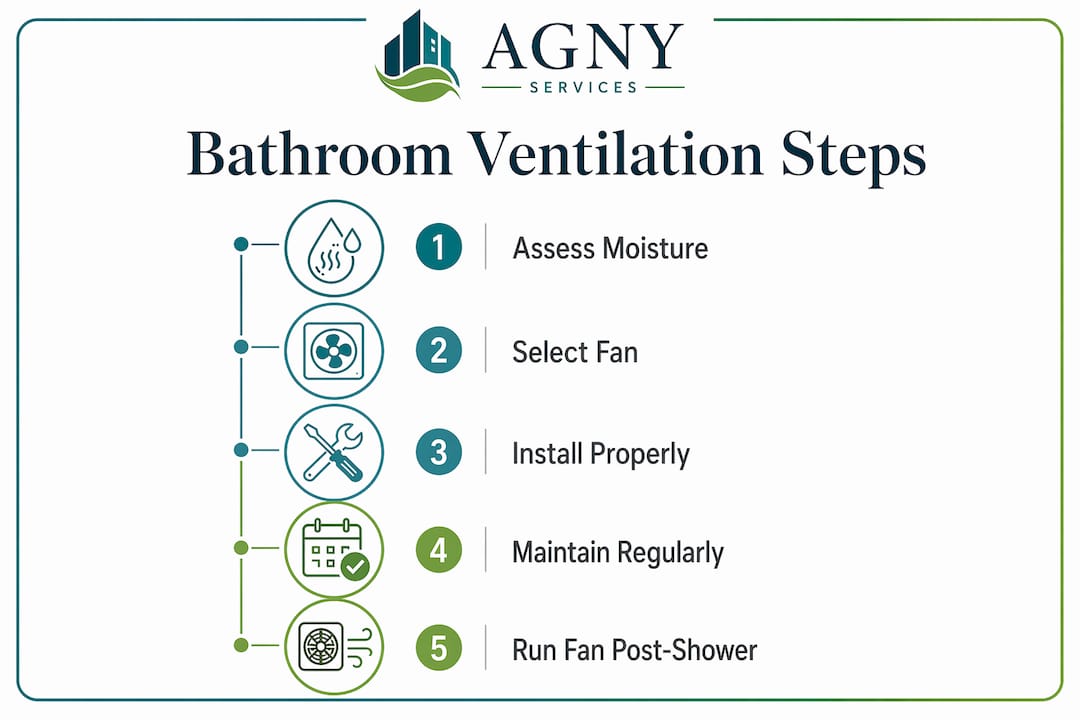
Follow these steps for a properly functioning installation:
- Position the fan near the moisture source. Place the exhaust grille directly above or adjacent to the shower or tub, not across the room near the door. Vent placement near showers captures humidity at the source before it spreads.
- Use rigid ducting wherever possible. Flexible duct is easier to install but creates friction and sags over time, reducing airflow. Rigid metal duct with smooth interior walls moves air more efficiently.
- Duct to the outside only. Ducting bathroom exhaust outdoors, not into an attic or crawl space, is non-negotiable. Venting into an attic pushes moisture directly into insulation and roof framing, creating hidden mold problems that are expensive to fix.
- Keep duct runs short and straight. Every 90-degree elbow in a duct run reduces effective CFM. Add 10 CFM of fan capacity for each elbow in the run.
- Install a timer switch or humidity sensor. Timer switches and humidity sensors remove the reliance on manual operation. A humidity-sensing switch automatically activates the fan when moisture rises and shuts it off when levels normalize.
Maintenance is straightforward but frequently skipped. Cleaning the fan intake every six months can increase airflow efficiency by up to 20%. Dust buildup on the grille and blades restricts airflow the same way a clogged air filter restricts an HVAC system. Remove the grille, vacuum the blades, and wipe down the housing. It takes ten minutes and extends the life of the motor significantly.
For electrical planning during a renovation, coordinating fan installation with your electrical upgrade planning is the right time to add dedicated circuits for timer switches and humidity controls.
What happens when bathroom ventilation is inadequate?
Poor ventilation does not just create a damp bathroom. It creates a cascade of structural and health problems that spread well beyond the bathroom walls. Unvented moisture causes peeling paint, warped cabinetry, and mold growth inside wall cavities where you cannot see it until the damage is severe.
The health consequences are equally serious. Mold spores and VOCs from bathrooms can travel through HVAC returns and spread to bedrooms, living rooms, and kitchens. A bathroom with poor air quality is not a contained problem. It is a source of contamination for the entire home.
Watch for these warning signs that your ventilation is failing:
- Persistent foggy mirrors more than 30 minutes after a shower
- Black or gray staining along grout lines or ceiling corners
- Paint bubbling or peeling near the shower or tub
- A musty odor that lingers even after cleaning
- Visible condensation on walls or window frames regularly
“A bathroom without a ventilating fan is like a fireplace without a chimney.” This comparison from This Old House captures the problem precisely. Moisture has to go somewhere, and without a dedicated exhaust path, it goes into your walls.
Moisture that migrates into adjacent rooms can also damage bathroom doors and their frames, causing swelling, warping, and seal failure over time. Proper ventilation protects every surface in and around the bathroom, not just the tile and grout.
Key takeaways
Proper bathroom ventilation requires mechanical exhaust, correct fan sizing, outdoor ducting, and consistent operation to protect both home structure and indoor air quality.
| Point | Details |
|---|---|
| Mold risk is fast | Mold growth starts within 24 to 48 hours of moisture exposure without ventilation. |
| Size fans correctly | Use 1 CFM per square foot of bathroom space as your baseline fan capacity. |
| Duct only to the outside | Venting into an attic creates hidden mold damage in insulation and framing. |
| Automate for consistency | Humidity sensors and timer switches remove reliance on manual fan operation. |
| Maintain every six months | Cleaning fan intakes restores up to 20% of lost airflow efficiency. |
Why I think most homeowners underestimate this completely
I have walked through hundreds of bathrooms during renovations at Agny, and the pattern is consistent. Homeowners spend serious money on tile, fixtures, and lighting, then accept whatever exhaust fan came with the house or install the cheapest 50 CFM unit from the hardware store. Six months later, they are calling about grout staining or paint peeling, and the answer is almost always the same: the ventilation was never adequate.
The window argument comes up constantly. People genuinely believe that cracking a window during a shower is equivalent to a mechanical exhaust fan. It is not. A window depends on wind direction, outdoor temperature, and whether someone actually opens it. A properly installed exhaust fan removes a fixed volume of air per minute, every time, regardless of weather. There is no comparison.
What I have found works best in practice is pairing a properly sized fan with a humidity-sensing switch. Homeowners do not have to think about it. The fan activates when the shower starts and shuts off automatically once humidity drops. The behavior problem disappears entirely. For anyone doing a bathroom renovation in NYC, this combination should be a baseline requirement, not an upgrade.
The other thing I want to push back on is the idea that ventilation is purely a functional concern. A bathroom that stays dry, smells clean, and shows no mold or moisture damage holds its value. A bathroom with visible moisture damage loses it fast. Ventilation is as much a value protection investment as it is a health measure.
— Grzegorz
How Agny approaches ventilation in bathroom renovations

At Agny, every bathroom renovation includes a ventilation assessment before a single tile is selected. The benefits of bathroom airflow are only realized when the system is sized, placed, and ducted correctly from the start. Retrofitting ventilation into a finished bathroom costs significantly more than building it in during a renovation.
Agny’s team handles fan selection, duct routing, and electrical coordination as part of the full renovation scope. If you are planning a bathroom remodel and want ventilation that actually works, explore bathroom renovations that add real value and see how proper system design fits into the full project. Working with experienced bathroom remodeling contractors means the ventilation is right the first time.
FAQ
What is the role of ventilation in bathrooms?
Bathroom ventilation removes excess moisture, odors, and airborne pollutants to protect home structure and indoor air quality. Without it, humidity from showers and baths causes mold growth, structural damage, and poor air quality throughout the home.
How many CFM does a bathroom exhaust fan need?
The standard rule is 1 CFM per square foot of bathroom floor space. A 70-square-foot bathroom needs at least a 70 CFM fan, with additional capacity for high ceilings or steam showers.
Can a window replace a bathroom exhaust fan?
No. Windows are unreliable as sole bathroom ventilation because their effectiveness depends on weather conditions and user behavior. Mechanical exhaust fans provide consistent, measurable airflow that windows cannot replicate.
How often should a bathroom exhaust fan be cleaned?
Clean the fan intake and grille every six months. Regular cleaning can restore up to 20% of lost airflow efficiency by removing dust buildup that restricts the motor and blades.
Where should a bathroom exhaust fan be installed?
Place the fan directly above or adjacent to the shower or tub, not near the door. Positioning the grille close to the moisture source captures humid air before it spreads to walls and ceilings.