TL;DR:
- Custom millwork is bespoke woodwork crafted to exact specifications, enhancing architectural detail beyond stock options. It covers moldings, cabinetry, paneling, and staircases, requiring early design, thorough documentation, and coordinated execution. Investing in custom millwork ensures superior fit, finish, and long-term value, especially in high-end renovations.
Custom millwork is bespoke woodwork fabricated to exact dimensional and design specifications, giving buildings architectural details that no stock product can replicate. Where standard millwork ships in fixed sizes and profiles from a factory catalog, custom millwork is built around your space, your style, and your structural requirements. The Architectural Woodwork Institute (AWI) classifies woodwork quality into Economy, Custom, and Premium grades, and most high-end renovation projects target the upper two tiers. For property owners and developers, understanding what custom millwork includes, how it is made, and what it costs in time and money is the foundation for any serious renovation or construction decision.
What is custom millwork, and what does it include?
Custom millwork is the category of finish woodwork that is designed, drawn, and fabricated specifically for one project. The term covers a wide range of products: mouldings, baseboards, door and window casings, crown moulding, wainscoting, wall paneling, built-in cabinetry, staircases, coffered ceilings, decorative beams, and specialty architectural elements. Each piece is produced to a set of approved drawings rather than pulled from a warehouse shelf.
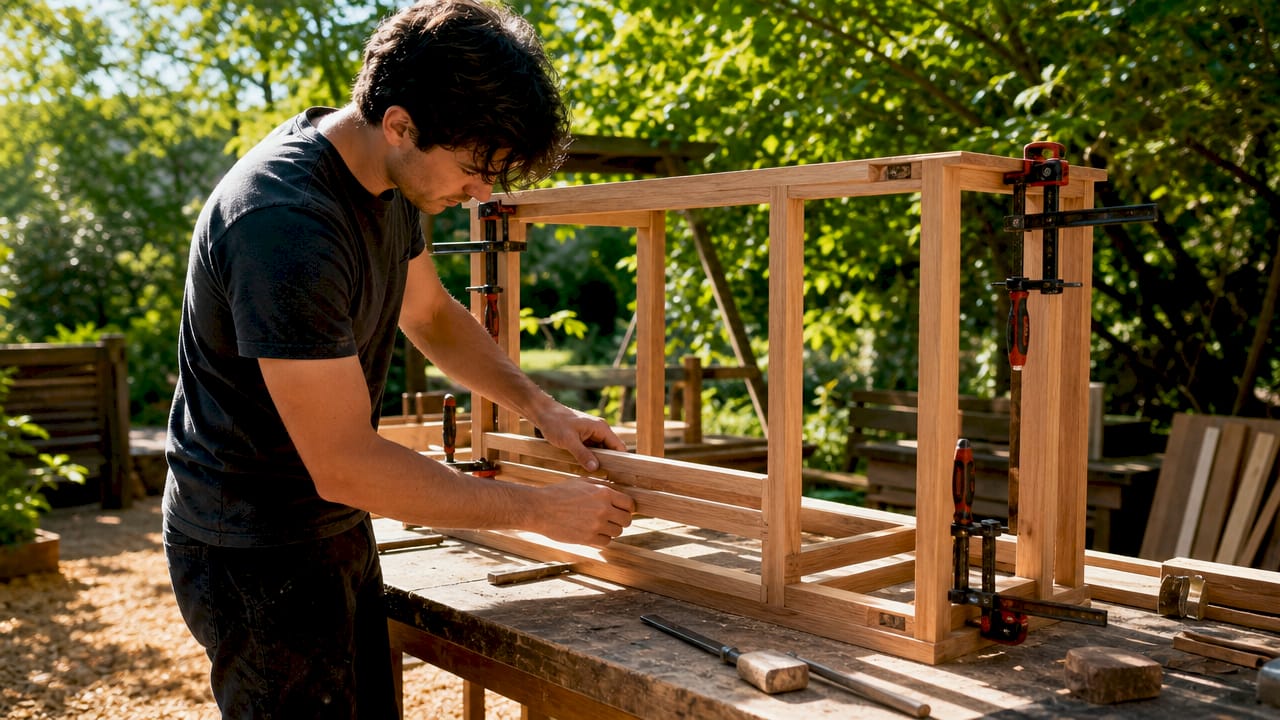
The custom woodwork definition used by fabricators and architects draws a clear line between “millwork” and “casework.” Millwork refers to site-finished or prefinished wood products with visible architectural profiles. Casework refers to box-based storage units. In practice, a luxury kitchen renovation will involve both: custom cabinetry boxes (casework) wrapped in custom millwork profiles, panels, and trim that tie the room together visually.
What does custom millwork include in a typical residential project? The list is longer than most owners expect. Crown moulding, base moulding, chair rails, picture rails, window stools and aprons, door surrounds, built-in bookshelves, fireplace surrounds, coffered or beamed ceilings, and custom stair railings all fall under the millwork umbrella. In commercial projects, the scope expands to reception desks, conference room paneling, retail display millwork, and tenant improvement trim packages.
What are common custom millwork examples in real projects?
Projects by Horner Millwork and Woodmeister Master Builders show the full range of what custom millwork applications look like in practice. Woodmeister, for example, has executed French-inspired interiors with layered moulding profiles, curved staircases, and hand-finished paneling that reads as a single cohesive architectural statement rather than a collection of separate products.
Common custom millwork examples by category include:
- Mouldings and trim: Crown moulding built up from three or more profiles, coffered ceiling grids, picture frame moulding on walls, and decorative corbels
- Cabinetry and built-ins: Floor-to-ceiling library shelving, window seats with integrated storage, custom kitchen cabinetry with inset doors and furniture-grade finishes
- Architectural panels: Raised panel wainscoting, full-height wall paneling, board-and-batten accent walls, and reception area feature walls
- Staircases and railings: Curved or straight custom staircases with turned or square balusters, newel posts, and handrails in species-matched wood
- Specialty elements: Curved trim around arched openings, decorative ceiling medallions, custom fireplace mantels, and coffered or barrel-vaulted ceiling systems
Pro Tip: When reviewing custom millwork design ideas with your architect, ask for a “millwork schedule” that lists every piece by room and profile. This single document prevents the most common source of scope confusion between designer, fabricator, and contractor.
The distinction between custom and standard millwork becomes most visible at corners, transitions, and intersections. Stock profiles are cut to length and butted together. Custom profiles are designed so that every return, cope, and miter resolves cleanly at the specific angles your building actually has, which in older NYC properties are rarely 90 degrees.
How is custom millwork designed and made?
The production of custom millwork follows a defined sequence. Skipping or rushing any phase creates problems that are expensive to fix after fabrication begins.
- Design drawings: Your architect or interior designer produces drawings that show the intent: profiles, proportions, materials, and how the millwork relates to the room. These are not fabrication documents.
- Millwork shop drawings: The fabricator converts design drawings into production documents. Shop drawings show fabrication intent with precise dimensions, joinery details, material callouts, hardware locations, and assembly sequences. This is the document the shop floor uses to cut wood.
- Submittal and review: The fabricator submits the shop drawing package to the general contractor (GC). The GC reviews it, logs it, and forwards it to the architect of record. Millwork submittals go to the GC first, not directly to the architect. This coordination step is where most delays occur.
- Approval and revision: The architect returns the package with comments, stamps it “approved,” “approved as noted,” or “revise and resubmit.” Revisions restart the review clock.
- Fabrication: Once the package is approved for fabrication, the shop begins cutting, assembling, finishing, and packaging the millwork for delivery.
- Delivery and installation: Finish carpenters install the millwork on site, scribing and fitting pieces to actual field conditions.
From initial drawing start to approved-for-fabrication status, the process typically takes 6 to 8 weeks for a standard commercial scope. Complex residential projects with curved elements or specialty species can run longer.
Millwork detailing connects design concepts to craftsman execution by specifying dimensions, joinery, materials, hardware, and assembly sequences. When that documentation is thorough and consistent with AWI standards, rework drops by 30% to 50%. That is not a small number on a project where custom millwork represents $50,000 to $500,000 of the budget.
Pro Tip: Request a copy of the approved shop drawing package before fabrication begins. As the property owner or developer, you have the right to review it. Catching a profile error or hardware conflict at this stage costs nothing. Catching it after installation costs everything.
Late design changes are the single biggest threat to a custom millwork budget. Formal revision processes are required for any change after shop drawing approval, and each revision adds time and often cost. Lock your design before the submittal phase begins.
What are the key benefits of custom millwork vs. standard options?
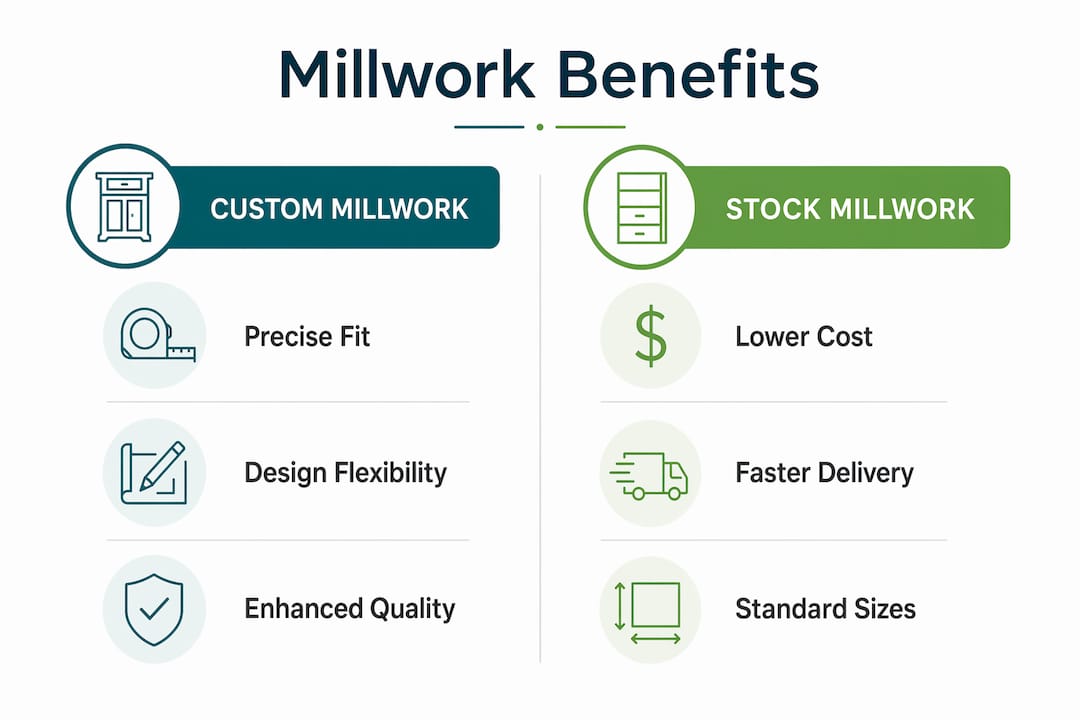
The core argument for custom millwork over stock is fit, finish, and design coherence. Custom millwork offers superior fit and design flexibility compared to stock options, but it involves higher costs and longer lead times. The question is whether the trade-off is worth it for your project.
| Feature | Custom millwork | Stock millwork |
|---|---|---|
| Fit to space | Exact to field dimensions | Fixed sizes, requires filler strips |
| Profile options | Unlimited, designed to spec | Limited to manufacturer catalog |
| Material selection | Any species, grade, or composite | Typically MDF, pine, or poplar |
| Finish quality | AWI Custom or Premium grade | Economy to Custom grade |
| Lead time | 6 to 12 weeks | 1 to 4 weeks |
| Cost | Higher per unit | Lower per unit |
| Design coherence | Full control across all elements | Dependent on catalog coordination |
For a property owner renovating a pre-war Manhattan apartment, stock millwork is almost never the right answer. The ceiling heights, room proportions, and existing architectural details demand profiles that match what is already there. A stock 3.5-inch colonial casing next to a restored 6-inch original casing reads as a mistake, not a renovation.
The long-term value argument for custom millwork is also real. Expert craftsmanship and close collaboration among builders, designers, and millworkers produces spaces that appraisers and buyers recognize as high quality. In competitive real estate markets, that recognition translates to price.
For developers, custom millwork in common areas, lobbies, and amenity spaces signals building quality to prospective tenants and buyers. It is one of the few finish categories where the investment is visible every day and depreciates slowly.
What should you consider before commissioning custom millwork?
Planning for custom millwork requires decisions in four areas: budget, schedule, team, and scope.
Budget: Custom millwork costs more per linear foot than stock, but the gap varies widely by species, profile complexity, and finish. Simple painted MDF mouldings are far less expensive than hand-carved walnut panels. Get a detailed scope and a line-item quote before committing. Coordinating millwork with multiple trades adds indirect costs that owners often miss: painter prep, touch-up after installation, and protection during other trades’ work.
Schedule: Build the 6 to 8 week fabrication window into your project timeline before you need the millwork on site. Most renovation delays trace back to millwork that was ordered late because the design was not finalized early enough. Work with your general contractor to set a hard design freeze date and protect it.
Team: The fabricator, the GC, and the architect must communicate directly and frequently. Gaps in that triangle produce errors. Ask your GC how they manage millwork trade coordination before you hire them. A GC with no millwork experience will cost you time and money regardless of how good the fabricator is.
Scope: Define every millwork element before the submittal package is prepared. Adding a piece after approval requires a revision, which restarts the review clock and may delay fabrication. A complete millwork schedule, room by room, is the most effective tool for scope control.
Pro Tip: Ask your fabricator for wood samples and finish samples before approving shop drawings. Species and stain combinations look very different on a 12-inch sample than they do on a digital rendering. Approve physical samples, not screens.
Material selection also affects installation complexity. Solid wood moves with humidity changes. MDF is stable but heavy and does not hold fasteners as well. Veneered panels offer a middle path for large flat surfaces. Your fabricator should recommend the right substrate for each application based on the environment and finish requirements.
Key takeaways
Custom millwork delivers architectural precision and design coherence that stock products cannot match, but it requires early planning, clear documentation, and experienced team coordination to succeed.
| Point | Details |
|---|---|
| Definition and scope | Custom millwork is bespoke woodwork fabricated to exact specs, covering mouldings, cabinetry, paneling, and staircases. |
| Production timeline | Expect 6 to 8 weeks from design drawings to approved fabrication, not counting installation. |
| Submittal process | Shop drawings go to the GC first, then the architect. Skipping this sequence causes delays. |
| Custom vs. stock | Custom offers exact fit and unlimited profiles; stock is faster and cheaper but limited in design range. |
| Planning priority | Lock design before submittal. Late changes require formal revisions and add cost and time. |
Why the details are where the money goes
I have watched renovation projects where the owner spent $800,000 on a gut renovation and then tried to save $15,000 by substituting stock mouldings for the custom profiles the architect specified. The result looked like a nice apartment with a cheap finish. The mouldings were the first thing every visitor noticed, and not in a good way.
Custom millwork is not a luxury add-on. In buildings with strong architectural character, it is the mechanism that holds the design together. The crown moulding, the door casings, the built-in cabinetry. These are the elements that make a room feel resolved rather than assembled. When they are right, nobody comments on them. When they are wrong, nobody can stop looking at them.
What I have learned from working on projects across New York is that the fabricator relationship matters as much as the design. A great shop with a mediocre set of drawings will produce mediocre millwork. A mediocre shop with perfect drawings will produce the same. The combination of a thorough shop drawing package, a GC who understands the submittal process, and a fabricator with the right equipment for the profiles specified is what produces work worth photographing.
The owners who get the best results are the ones who treat millwork as a design and construction discipline, not a finish item to be value-engineered at the end. They lock the design early, they review samples in person, and they give the fabricator the lead time the work actually requires.
— Grzegorz
How Agny can help with your millwork project

Agny works with property owners and developers across New York City on renovation projects where custom millwork is central to the design. From kitchen and bathroom renovations to full commercial tenant improvements, Agny manages the full coordination chain: design review, GC oversight, fabricator selection, submittal management, and installation supervision. If you are weighing your options, the custom vs. stock cabinetry comparison is a strong starting point for understanding cost and timeline trade-offs specific to NYC projects. For projects where budget is a factor, Agny also connects clients with renovation financing options that make high-quality millwork accessible without compromising the design. Contact Agny to discuss your project scope and get a realistic picture of what custom millwork will require.
FAQ
What is the difference between custom and stock millwork?
Custom millwork is fabricated to exact project specifications, offering unlimited profiles, species, and dimensions. Stock millwork ships in fixed sizes from a manufacturer catalog and requires filler strips or compromises to fit non-standard spaces.
How long does custom millwork take to fabricate?
From initial design drawings to approved-for-fabrication status, the process takes 6 to 8 weeks for a typical scope. Complex projects with curved elements or specialty materials run longer.
What does a millwork shop drawing include?
Shop drawings show fabrication intent with precise dimensions, joinery details, material specifications, hardware locations, and assembly sequences. They are the production documents the fabricator uses on the shop floor.
Who approves millwork shop drawings?
The general contractor reviews the submittal package first, then forwards it to the architect of record for approval. Property owners do not typically sign off on shop drawings, but reviewing them before fabrication begins is strongly advisable.
Is custom millwork worth the cost for a renovation?
For properties with strong architectural character or high-end design requirements, custom millwork is the only way to achieve precise fit and design coherence. The investment holds value over time and is visible in every room, every day.