TL;DR:
- Choosing building materials involves evaluating their performance, cost, durability, and sustainability to meet project and code requirements. The selection process requires understanding material categories, verifying compliance with standards, and considering climate and lifecycle factors from the earliest design stages. Proper documentation and early integration prevent costly failures, code violations, and maintenance issues later.
Building material selection is the process of evaluating structural, envelope, and finish components against performance, cost, durability, and sustainability criteria to meet project goals and code requirements. Knowing how to select building materials correctly prevents costly failures, code violations, and premature deterioration. The International Building Code (IBC), ASTM standards, and ASHRAE guidelines all shape which materials qualify for a given project. This guide gives property developers and DIY homeowners a clear, step-by-step framework for choosing construction materials with confidence.
How to classify building materials based on function and code requirements
Building materials fall into three functional categories: structural, envelope, and interior finish. Each category carries different performance demands and code obligations.
Structural materials carry loads. Concrete, structural steel, engineered lumber, and masonry are the primary options. Concrete excels in compression but requires steel reinforcement for tension. Structural steel handles both, but needs fireproofing in most occupancy types.
Envelope materials separate interior from exterior. They include roofing assemblies, exterior cladding, insulation, and fenestration. Their job is to control heat, moisture, and air movement. ASHRAE 90.1 sets minimum thermal performance thresholds that envelope assemblies must meet.
Interior finish materials cover walls, floors, and ceilings. They affect fire spread, acoustics, and appearance. The IBC rates finishes by flame spread index under ASTM E84, which directly limits which products you can legally install in corridors, stairwells, and occupied spaces.
The IBC organizes all construction into five fire-resistance types, labeled Type I through Type V. Type I requires fully noncombustible construction. Type V allows wood framing throughout. The type assigned to your building determines which materials are permitted at every layer.
| Material category | Common examples | Key standard |
|---|---|---|
| Structural | Concrete, steel, engineered lumber | ACI 318, AISC 360, ASCE 7 |
| Envelope | Roofing, cladding, insulation, windows | ASHRAE 90.1, ASTM E1677 |
| Interior finish | Drywall, flooring, paint, millwork | ASTM E84, IBC Chapter 8 |
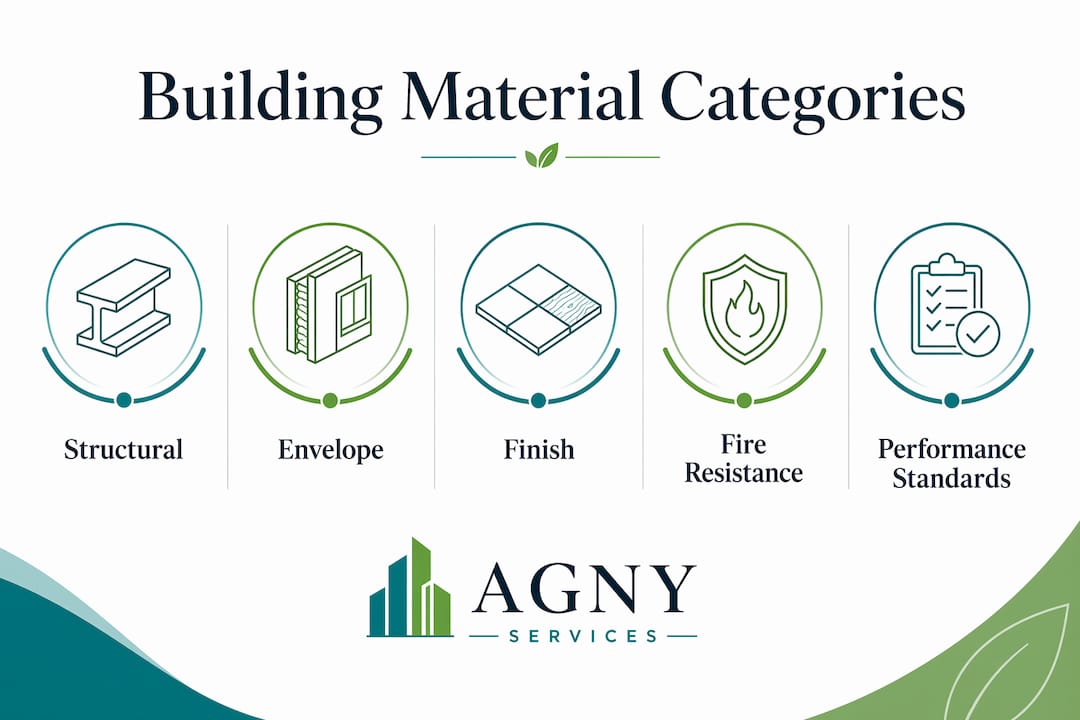
Performance standards from organizations like ACI, ASTM, and ASHRAE are not optional references. They define the minimum bar a material must clear before it belongs on your project.
What key factors should you consider when choosing building materials?
No single material wins on every dimension. Success comes from scoring candidates across six dimensions: performance, cost, durability, maintenance, aesthetics, and environmental impact. Skipping any one of them creates gaps that show up as failures later.
Technical and structural factors
Strength, stiffness, moisture resistance, and thermal performance are non-negotiable starting points. A study of 115 construction professionals confirmed that technical factors are the most critical in selecting sustainable construction materials, with strong interactions across economic, social, and environmental dimensions. That finding matters because it means you cannot treat technical performance as separate from cost or sustainability. They move together.

Economic factors
Total cost of ownership includes purchase price, labor, installation complexity, and long-term maintenance. A cheaper material that requires repainting every two years or fails in ten costs more than a premium option that lasts thirty. Factor in lead times too. A material with a 16-week lead time can stall an entire project schedule.
Environmental and sustainability factors
Embodied carbon, recyclability, and sourcing distance all affect a material’s environmental footprint. Selecting eco-friendly materials like recycled steel, reclaimed wood, or low-VOC finishes reduces both environmental impact and occupant health risks. Many jurisdictions now require LEED or similar documentation, making sustainability a compliance issue, not just a preference.
Climate compatibility
Materials must match local environmental stressors including freeze-thaw cycles, humidity, salinity, and UV exposure. Ignoring climate compatibility causes premature deterioration. In New York City, for example, exterior masonry must handle repeated freeze-thaw stress. A material that performs well in Miami may crack or spall within five years in a northern climate.
Pro Tip: Request the manufacturer’s technical data sheet for every candidate material before finalizing your spec. Marketing brochures describe ideal conditions. Data sheets describe real performance limits.
How can decision-making methods like Analytical Hierarchy Process improve material selection?
Multi-Criteria Decision Making (MCDM) is a structured method for ranking alternatives when multiple competing factors apply. Analytical Hierarchy Process (AHP) is the most widely used MCDM tool in construction material selection. It breaks a complex decision into paired comparisons, assigns weights to each criterion, and produces a ranked score for each candidate material.
You do not need specialist software to apply AHP on a typical residential or light commercial project. A spreadsheet works. Here is a practical five-step process:
- List your criteria. Start with the six dimensions: performance, cost, durability, maintenance, aesthetics, and environmental impact.
- Assign weights. Decide how much each criterion matters for your specific project. A high-traffic commercial floor weights durability heavily. A residential bedroom weights aesthetics more.
- Score each material. Rate every candidate from 1 to 5 on each criterion using manufacturer data sheets and independent test results.
- Multiply and sum. Multiply each score by its criterion weight, then add the totals. The highest score wins on paper.
- Sense-check the result. If the top scorer has a 20-week lead time or exceeds budget, adjust weights and re-run. The matrix is a decision aid, not a final answer.
Hybrid MCDM approaches combine AHP with other methods like TOPSIS or VIKOR to handle recycled and composite materials where data is less standardized. For most DIY homeowners, a simple weighted matrix is enough. For developers managing multiple material categories across a large project, a hybrid approach reduces the risk of overlooking a critical trade-off.
Pro Tip: Build your criteria matrix before you talk to suppliers. Suppliers will emphasize the dimensions where their product scores highest. A pre-built matrix keeps the conversation objective.
What are the practical steps and common mistakes in selecting building materials?
A clear workflow prevents the two most expensive errors in material selection: choosing too late and choosing without verification.
The five-step selection workflow
- Define project requirements. Start with occupancy classification and structural load requirements. Material selection must begin here to avoid costly redesigns later. Identify the IBC construction type, the applicable ASCE 7 load combinations, and any local amendments.
- Assess candidate materials. Use your weighted criteria matrix. Pull technical data sheets, not product brochures. Cross-reference with ASTM and ACI standards for structural materials.
- Confirm code compliance. Verify compliance by reviewing the manufacturer’s technical data sheet directly. Do not rely on visual similarity to a previously approved product or a salesperson’s assurance.
- Evaluate costs and lead times. Get firm quotes and confirmed lead times before locking in a spec. A material that arrives late or over budget forces last-minute substitutions, which often means starting the compliance check over.
- Document your decisions. Record the rationale for every material choice, including the climate stressors considered and the standards verified. This documentation speeds up inspections and makes future renovations far easier to plan.
Common mistakes that cost money
- Underspecification. Choosing cheaper products without verifying suitability for specific environmental conditions is the leading cause of material failures. Experienced contractors call this the most avoidable mistake in construction.
- Late-stage selection. Integrating material decisions after design is complete forces expensive substitutions. Early selection aligns with structural and mechanical systems from the start.
- Ignoring maintenance costs. A beautiful stone floor that requires annual sealing and professional cleaning adds thousands of dollars over a ten-year period. For luxury bathroom materials, factor in cleaning requirements and surface sensitivity before specifying.
- Relying on appearance alone. Two products can look identical and perform completely differently under load, moisture, or fire conditions.
Integrating material selection early in the design process, aligned with occupancy and load criteria, is the single most effective way to avoid costly late-stage changes.
For NYC renovation projects specifically, the interior gut renovation guide from Agny covers how material classifications interact with local building department requirements, which adds another layer of compliance to manage.
Key Takeaways
Selecting building materials correctly requires matching functional category, technical performance, code compliance, and total cost of ownership to your specific project conditions from the earliest design stage.
| Point | Details |
|---|---|
| Classify before specifying | Identify structural, envelope, or finish role before evaluating any candidate material. |
| Use total cost of ownership | Factor in labor, installation, and maintenance, not just the purchase price. |
| Verify with data sheets | Always confirm code compliance using the manufacturer’s technical data sheet, not marketing claims. |
| Match materials to climate | Specify materials based on local stressors like freeze-thaw cycles, humidity, and UV exposure. |
| Document every decision | Record rationale for material choices to simplify inspections and future renovations. |
What I have learned after years of renovation work in New York
The biggest mistake I see property owners make is treating material selection as a shopping decision rather than an engineering decision. They walk into a showroom, fall in love with a finish, and then work backward to justify it. That sequence causes problems every time.
The workflow that actually works starts with occupancy classification and structural demands, then moves to envelope performance, and only then considers aesthetics. When you reverse that order, you end up with beautiful materials that fail code, crack in winter, or cost twice as much to maintain as a better-specified alternative would have.
I also push back hard on the idea that budget constraints justify underspecification. Choosing a cheaper product without verifying its suitability for the actual conditions is not saving money. It is deferring a larger expense. I have seen exterior cladding fail within three years in New York because the spec ignored freeze-thaw ratings. The remediation cost was four times the original material savings.
Document everything. When a building inspector asks why you used a specific product, or when a future owner wants to renovate, a clear record of what was installed and why is worth more than people realize. It is one of the simplest habits in construction, and one of the least practiced.
— Grzegorz
How Agny can support your next renovation project
Material selection is only the first step. Turning a well-researched spec into a finished space requires skilled execution, reliable sourcing, and often, a financing plan that fits your timeline.

Agny works with property developers and homeowners across New York City on renovations that require both technical precision and quality craftsmanship. From custom millwork that matches your interior finish spec to full bathroom and kitchen renovations, Agny handles the build side of the decisions you make here. If budget is a constraint, the renovation financing options review covers the funding paths available for NYC projects. Getting the materials right matters. Getting the execution right matters just as much.
FAQ
What are the three main categories of building materials?
Building materials are classified as structural, envelope, and interior finish. Each category serves a distinct function and is governed by different performance standards under the IBC.
How do I verify that a building material meets code requirements?
Request the manufacturer’s technical data sheet and cross-reference it against the applicable IBC fire-resistance type and relevant ASTM or ACI standards. Marketing claims are not sufficient for compliance verification.
What is the most common mistake when selecting building materials?
Underspecification is the leading cause of material failures. Choosing a cheaper product without confirming its suitability for the specific environmental and structural conditions of the project leads to premature deterioration and costly repairs.
How does climate affect building material choice?
Local stressors like freeze-thaw cycles, humidity, salinity, and UV exposure degrade materials at different rates. A material rated for mild climates may fail within a few years in a northern region like New York if its thermal and moisture resistance ratings are not verified.
When should material selection happen in a project?
Material selection should begin at the earliest design stage, once occupancy classification and structural load requirements are defined. Late-stage selection forces substitutions that can trigger compliance reviews and increase costs significantly.