TL;DR:
- Custom cabinetry provides a perfect fit, improving space efficiency and long-term home value. It offers full design control, uses durable materials, and enhances daily functionality, making it a worthwhile investment. The project typically takes 8 to 12 weeks, with a high resale return and strategic budgeting options.
Custom cabinetry is defined as cabinetry built from scratch to a homeowner’s exact measurements, material preferences, and functional requirements. Unlike stock or semi-custom options, bespoke cabinetry fits the room rather than the other way around. The advantages of custom cabinetry cover every dimension of a renovation: space efficiency, design freedom, material quality, and long-term home value. The National Kitchen and Bath Association (NKBA) consistently ranks cabinetry as the single largest cost driver in kitchen renovations, which makes the choice between custom and stock one of the most consequential decisions a homeowner can make.
1. How custom cabinetry optimizes space in any room
Custom cabinetry eliminates wasted space by fitting irregular layouts exactly, enhancing both storage capacity and visual harmony. Stock cabinets come in fixed widths, typically in 3-inch increments, which means filler strips and awkward gaps are almost unavoidable in real rooms with real walls.
Rooms where custom cabinetry outperforms stock options by a wide margin include:
- Sloped or vaulted ceilings: Custom units follow the ceiling line, turning dead space into usable storage.
- Galley kitchens: Every inch counts. Custom cabinets can be built shallower or deeper than standard to match the corridor width.
- Bathroom niches: Recessed shelving built between wall studs requires exact framing dimensions that only custom fabrication can meet.
- Corner configurations: Blind corners and L-shaped layouts benefit from purpose-built lazy Susans or diagonal drawer units sized to the actual corner.
- Appliance integration: Custom surrounds for refrigerators, ovens, and dishwashers eliminate the gaps that make kitchens look unfinished.
Pro Tip: Before finalizing your cabinet layout, have your contractor check for uneven floors and hidden plumbing runs. Renovation experts recommend a 10–15% contingency budget for custom projects specifically because these surprises are common and expensive to fix mid-installation.
2. What design freedoms do custom cabinets offer?
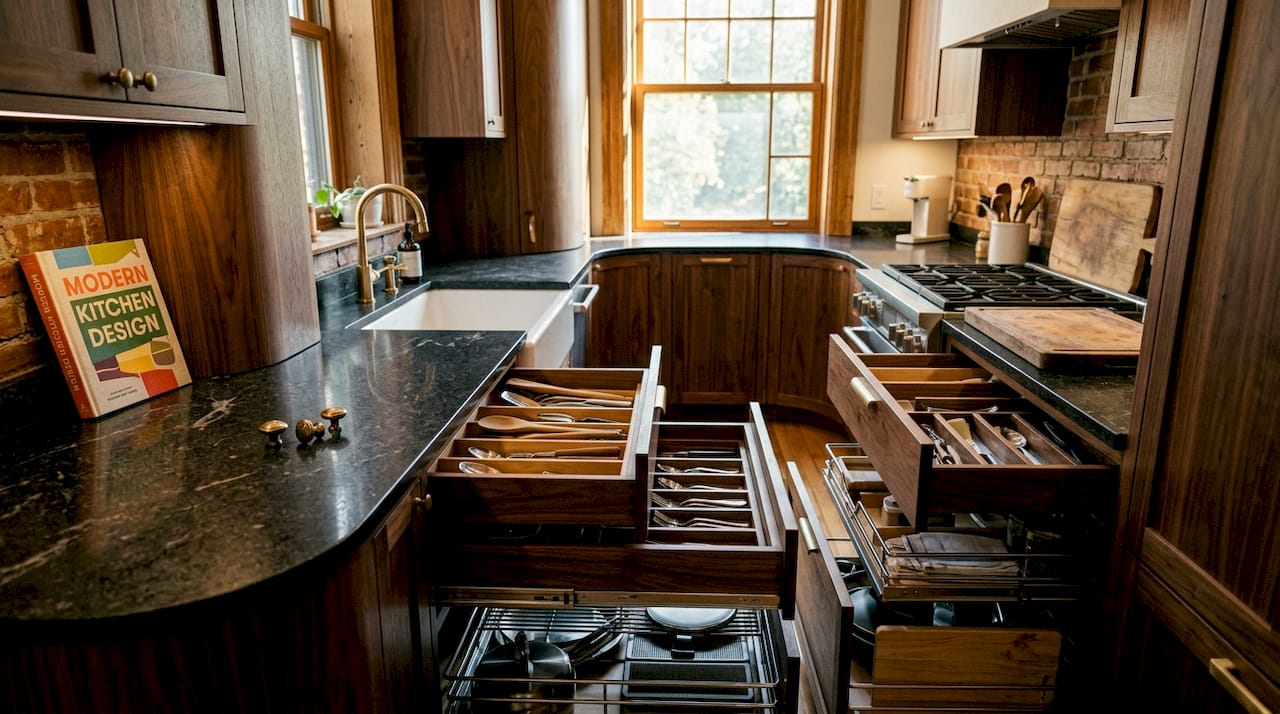
Custom cabinets give homeowners full control over every visible and tactile element of their cabinetry. Wood species, panel profiles, finish techniques, hardware, and interior organization are all chosen by the homeowner rather than a manufacturer’s catalog.
The range of choices available includes:
- Wood species: Quarter-sawn white oak, walnut, maple, cherry, and painted MDF are all viable options with distinct grain and color characteristics.
- Door styles: Shaker, raised panel, flat slab, beadboard, and glass-front doors each create a different visual weight and period feel.
- Finish techniques: Painted lacquer, hand-rubbed oil, wire-brushed stain, and two-tone combinations are all achievable with custom fabrication.
- Specialty interiors: Integrated LED lighting, pull-out spice racks, appliance garages, and built-in charging stations are designed in from the start.
- Hardware: Concealed hinges, cup pulls, bar handles, and touch-latch systems each affect both aesthetics and daily usability.
This level of control lets homeowners coordinate cabinetry with their home’s existing architectural style, whether that is a pre-war Manhattan apartment or a contemporary open-plan renovation. For guidance on matching cabinet style to kitchen design, Agny’s resource on classic vs. modern kitchens is a practical starting point.
Pro Tip: Changing design decisions after production starts can cost 20–50% of material costs. Use 3D modeling software to lock in your design before the shop drawings are approved. Most quality fabricators offer this as part of their design process.
3. Why craftsmanship and material quality matter
The structural difference between custom and stock cabinetry comes down to joinery and substrate. High-quality joinery methods such as dovetail or doweled joints, combined with cabinet-grade hardwood plywood, produce cabinets that last 30–50 years. Stock cabinets built on particleboard with stapled joints typically last 10–15 years before the carcass begins to fail.
| Feature | Custom cabinetry | Stock cabinetry |
|---|---|---|
| Box material | Cabinet-grade hardwood plywood | Particleboard or MDF |
| Joinery | Dovetail, dado, or doweled joints | Stapled or cam-lock assembly |
| Door fronts | Solid wood or premium MDF | Thermofoil or thin veneer |
| Hardware | Full-extension soft-close slides | Basic slides, often partial-extension |
| Expected lifespan | 30–50 years | 10–15 years |
| Finish durability | Catalyzed lacquer or conversion varnish | Pre-applied foil or thin paint |
Full-extension soft-close drawer slides, when properly installed, handle 100,000+ cycles before showing wear. That figure puts the hardware durability of a well-built custom cabinet in a different category from anything available off the shelf.
The substrate choice also affects moisture resistance. Hardwood plywood holds screws better and resists humidity-driven swelling, which matters in kitchens and bathrooms where steam and water exposure are daily realities.
4. How custom features improve daily functionality
Custom cabinetry is not just about looks. The interior organization of a cabinet determines how useful it is every single day. Custom interiors with pull-out shelves, built-in lighting, and drawer dividers enhance daily use and accessibility in ways that standard interiors cannot replicate.
Functional features worth specifying in a custom build include:
- Roll-out trays in base cabinets: Eliminate the need to crouch and reach to the back of deep lower cabinets.
- Drawer dividers and peg systems: Keep plates, utensils, and cookware organized without secondary organizers.
- Tray slots and vertical dividers: Store baking sheets and cutting boards upright, saving horizontal shelf space.
- Appliance garages with outlets: Keep countertop appliances accessible but hidden, reducing visual clutter.
- Built-in charging stations: Integrate USB and power outlets directly into a drawer or cabinet interior.
- Soft-close hinges on all doors: Reduce noise and prevent door damage over years of daily use.
Designers recommend personalized consultation to align cabinet interiors with actual lifestyle patterns, such as accommodating left-hand dominance or the specific appliances a household uses most. That level of attention to workflow is what separates a functional kitchen from one that merely looks good.
5. What is the return on investment for custom cabinetry?
Custom kitchen remodels that include cabinetry typically recoup 60–80% of their cost at resale. That return is strong for a renovation category, and it reflects how much buyers value high-quality cabinetry when evaluating a home.
Custom cabinetry costs $500–$1,500 per linear foot installed, with full kitchen projects typically ranging from $15,000 to $35,000. Stock cabinetry runs $75–$150 per linear foot. The gap is real, but so is the difference in lifespan, finish quality, and buyer perception.
For homeowners who want the benefits of bespoke cabinetry without the full custom price tag, a hybrid approach works well. Spend the custom budget on high-traffic zones like the sink base and stove-adjacent drawers. Use stock modules for low-use areas such as upper pantry cabinets or corner uppers. This approach captures most of the functional and visual benefit at a lower total cost.
Pro Tip: Focusing 80% of your cabinetry budget on high-use areas optimizes perceived quality without overspending on sections of the kitchen that rarely get opened. This is a standard budget strategy used by experienced renovation contractors.
For homeowners weighing the full investment case, Agny’s guide on millwork investment value covers the broader financial picture in detail. The custom millwork specialists at Gepetto Millworks also publish useful industry perspectives on how professionals approach irregular layouts and material selection.
6. How long does a custom cabinetry project take?
High-end custom cabinetry projects typically take 8–12 weeks from design approval to installation. That timeline is longer than stock, which can ship in days, but it reflects the fabrication process rather than any inefficiency.
Planning around this lead time is the single most common mistake homeowners make. Ordering cabinets after demolition has started creates weeks of downtime. The correct sequence is to finalize cabinet design, approve shop drawings, and place the fabrication order before any demolition begins. Agny’s resource on kitchen cabinet replacement steps walks through the full sequencing in practical terms.
After installation, living with the cabinets for 3–5 days before paying the final balance is a recommended practice. Door alignment, drawer slide tension, and hardware function all reveal themselves under daily use in ways that a one-hour walkthrough cannot catch.
Key Takeaways
Custom cabinetry is the strongest single upgrade a homeowner can make to kitchen or bathroom storage because it combines precise fit, durable materials, and personalized function that stock options cannot replicate.
| Point | Details |
|---|---|
| Perfect fit every time | Custom cabinets are built to exact room dimensions, eliminating filler strips and wasted corners. |
| Material quality drives lifespan | Hardwood plywood and dovetail joinery produce cabinets that last 30–50 years versus 10–15 for stock. |
| Functionality is fully designed in | Pull-outs, dividers, and soft-close hardware are specified from the start, not retrofitted. |
| Strong resale return | Custom kitchen cabinetry recoups 60–80% of its cost at resale in competitive housing markets. |
| Budget strategically | Concentrate custom spend on high-use zones and use stock for low-traffic areas to control total cost. |
What I’ve learned from years of custom cabinetry projects
The homeowners who get the most from custom cabinetry are the ones who treat the design phase as seriously as the installation phase. I’ve seen projects where the fabrication was flawless but the design was rushed, and the result was beautiful cabinets that didn’t actually fit how the family cooked. A drawer in the wrong place is still a drawer in the wrong place, no matter how well it’s built.
The material conversation is where I push back on clients most often. Everyone wants the look of solid wood, but solid wood doors on a painted cabinet will telegraph every humidity cycle through the finish within a few years. Painted MDF door fronts on a hardwood plywood box is the technically correct choice for most kitchens, and it’s the combination I recommend without hesitation.
Budget contingency is non-negotiable in my experience. The 10–15% buffer isn’t pessimism. It’s what covers the plumbing stack that’s two inches off from the drawing, or the floor that’s out of level by more than the toe kick can hide. Projects that skip the contingency end up with compromises in the finished product.
The post-installation inspection period matters more than most homeowners expect. Soft-close hinges can be adjusted. Door gaps can be corrected. But you only catch these things if you actually use the kitchen for a few days before signing off. That final walkthrough with your contractor is worth protecting.
— Grzegorz
Agny’s approach to custom cabinetry and kitchen renovation
Agny specializes in kitchen and bathroom renovations where custom cabinetry is the centerpiece of the design. The team manages the full process from initial space planning through fabrication coordination and final installation, with quality control built into every phase.
For homeowners in New York who want cabinetry that fits the room, matches the home’s style, and holds up for decades, Agny’s kitchen renovations service covers the complete scope. The team also works with property managers on multi-unit projects where consistent quality and timeline reliability are priorities. If you’re still mapping out your layout, the kitchen layout examples page is a useful next step before committing to a design direction.
FAQ
What are the main advantages of custom cabinetry over stock?
Custom cabinetry fits exact room dimensions, uses superior materials like hardwood plywood and dovetail joinery, and allows full control over interior organization and finish. Stock cabinets come in fixed sizes and use lower-grade substrates that wear out faster.
Is custom cabinetry worth the higher cost?
Custom kitchen cabinetry recoups 60–80% of its cost at resale and lasts 30–50 years, compared to 10–15 years for stock options. For homeowners planning to stay in a property long-term, the investment is justified by durability and daily functionality alone.
How long does custom cabinetry take to install?
High-end custom cabinetry projects typically take 8–12 weeks from design approval to installation. Homeowners should finalize their design and place the fabrication order before demolition begins to avoid costly downtime.
Can I mix custom and stock cabinets to save money?
Focusing 80% of the cabinetry budget on high-use areas like sink bases and stove-adjacent drawers, while using stock modules for low-traffic zones, captures most of the functional benefit at a lower total cost. This hybrid approach is a standard strategy used by experienced renovation contractors.
What joinery methods make custom cabinets more durable?
Dovetail and doweled joints, combined with cabinet-grade hardwood plywood, produce a structurally superior box compared to the stapled or cam-lock assembly used in stock cabinetry. Full-extension soft-close drawer slides installed correctly handle 100,000+ cycles before showing wear.