TL;DR:
- A well-structured facility maintenance workflow consisting of six stages reduces unplanned downtime and streamlines operations. Proper data entry, asset classification, and review processes are essential to prevent repeat failures and optimize costs. Implementing and maintaining a live risk register alongside a disciplined maintenance system enhances asset performance and compliance.
A facility maintenance workflow is a structured sequence of tasks designed to identify, assign, execute, and review maintenance activities efficiently. Facilities that shift from reactive to structured, automated programs boost operational efficiency by 50% and reduce unplanned downtime by 71%. That gap between reactive and structured operations represents real money: the US Department of Energy and IFMA both recognize that disciplined, planned maintenance costs roughly 20 times less than capital replacements for equivalent energy savings. A well-built facility maintenance workflow is not a nice-to-have. It is the operating system behind every high-performing building.
What are the essential stages of a facility maintenance workflow?
Every effective building maintenance process follows six standardized stages: Request, Triage, Assign, Execute, Close, and Review. Each stage has a distinct purpose, and skipping any one of them creates gaps that compound over time.
1. Request
Every maintenance activity starts with a request. Requests arrive from tenants, automated sensors, scheduled inspections, or staff reports. The quality of the request determines how fast the rest of the workflow moves. A vague request (“something smells weird in HVAC”) wastes triage time. A structured request form with asset ID, location, and symptom description cuts that waste immediately.
2. Triage
Triage is where priority gets assigned. A leaking roof drain and a burned-out hallway bulb both arrive as requests. Triage separates life-safety issues from cosmetic ones. Facilities that skip formal triage default to whoever shouts loudest, which is not a maintenance strategy.
3. Assign
Assignment matches the right technician to the right task based on skill, availability, and location. AI-assisted dispatch in modern CMMS platforms reduces this decision from hours to seconds for 73% of routine work orders. That speed matters when a chiller fails on a Friday afternoon.
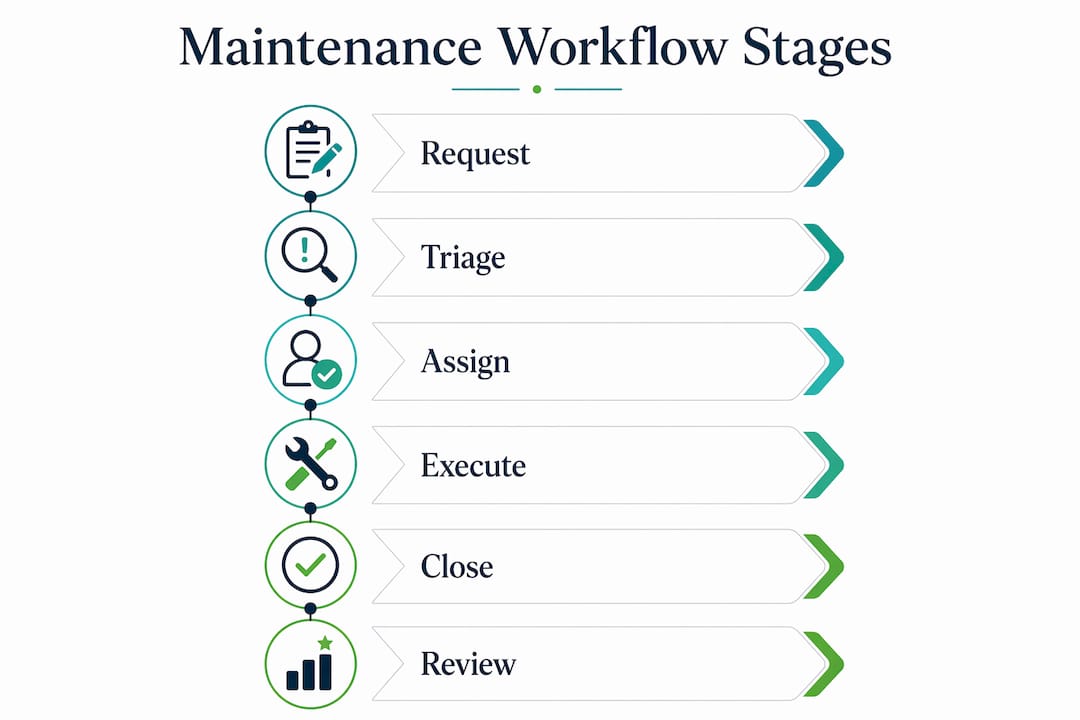
4. Execute
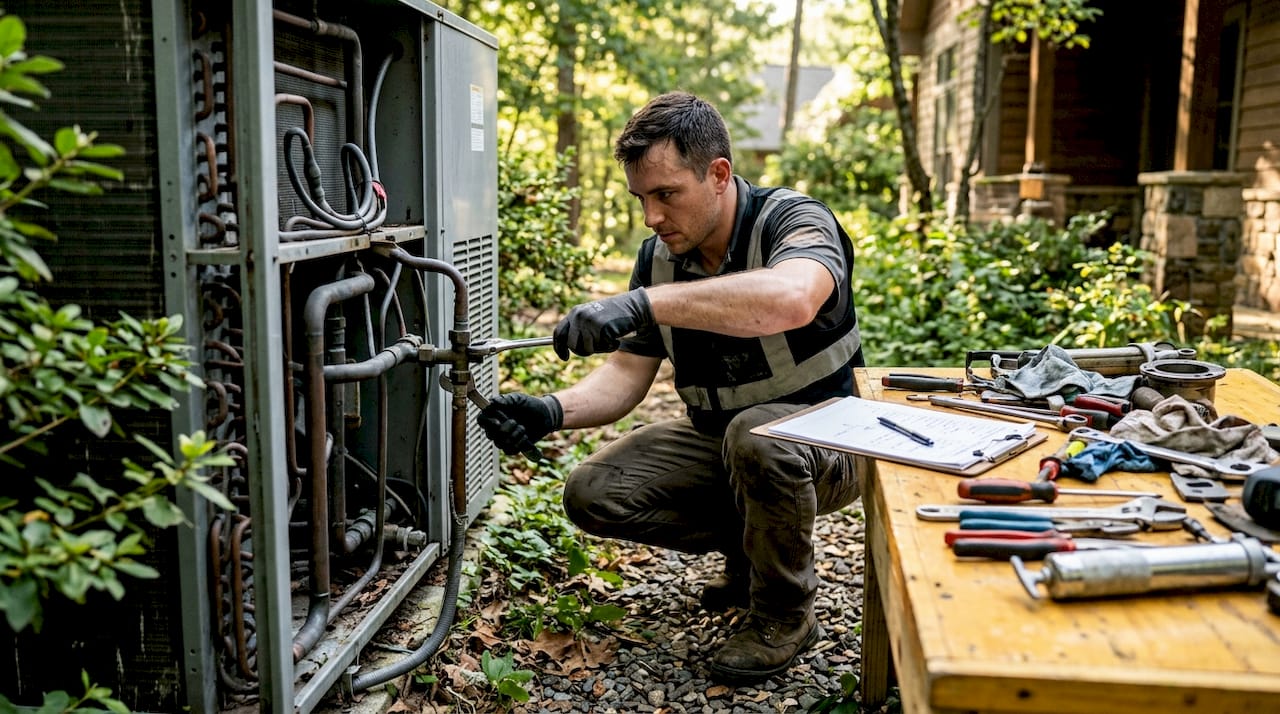
Execution is where the physical work happens. Technicians follow documented procedures, record parts used, log labor hours, and note any unexpected findings. Discipline at this stage feeds every downstream report and audit.
5. Close
Closing a work order is not just clicking “done.” It means confirming the asset is back in service, attaching photos or readings, and flagging any follow-up work. Facilities with structured CMMS reduce audit preparation time by 84% compared to manual methods, and that advantage starts at the close stage.
6. Review
The Review stage is the most skipped and the most valuable. Skipping Review leads directly to repeated failures and reactive maintenance loops. Analyzing failure data tells you whether a new PM task, a design change, or a root cause reassessment is needed. Without Review, you fix the same pump bearing every six months forever.
What tools and technologies support maintenance workflow optimization?
The right tools turn a paper-based process into a data-driven operation. The table below maps the core technology categories to their primary function in a maintenance workflow.
| Tool category | Primary function | Key benefit |
|---|---|---|
| CMMS (Computerized Maintenance Management System) | Work order creation, scheduling, and tracking | Centralizes all maintenance data in one system |
| EAM (Enterprise Asset Management) | Full asset lifecycle management | Links maintenance costs to asset depreciation |
| Mobile work order apps | Field execution and real-time updates | 74% of work orders completed via mobile, eliminating paper |
| IoT sensor integration | Condition monitoring and automated alerts | Triggers work orders before failures occur |
| AI-assisted dispatching | Technician assignment by skill, location, and workload | Cuts dispatch time from hours to seconds |
Leading facilities treat CMMS and EAM not as record-keeping tools but as strategic operational assets by enforcing standardized data entry at every stage. That discipline is what separates a system with useful reports from one full of garbage data.
IoT integration deserves specific attention. Sensors on HVAC units, elevators, and electrical panels generate condition data continuously. When a vibration sensor on a pump motor crosses a threshold, the system creates a work order automatically. The technician arrives with context, not just a complaint.
Pro Tip: Set mandatory fields in your CMMS for asset ID, failure code, and parts used before a work order can be closed. Teams that skip this step lose the data that would have prevented the next failure.
For facility managers tracking construction cost tracking alongside maintenance budgets, integrating cost data from both systems gives a complete picture of total facility spend.
How to implement preventive maintenance strategies within your workflow?
Preventive maintenance (PM) is the practice of servicing assets on a schedule before they fail, rather than after. The goal is not to maintain everything equally. The goal is to maintain the right things at the right frequency.
Classify assets by criticality first
The 20% of assets classified as Critical drive 80% of maintenance risk and resource allocation. This is the Pareto principle applied directly to facility management. Before building a PM schedule, every asset needs a criticality rating: Critical, Important, or Standard. Critical assets get the most frequent attention and the tightest compliance tracking.
Choose the right PM trigger type
Three scheduling methods exist, and the best programs use all three:
- Calendar-based PM: Tasks triggered by time intervals (monthly filter changes, annual fire suppression inspections). Simple to schedule, easy to track.
- Usage-based PM: Tasks triggered by run hours or cycles (elevator door mechanism service at 50,000 cycles). More accurate than calendar scheduling for high-use assets.
- Condition-based PM: Tasks triggered by sensor readings or inspection findings (replace belt when vibration exceeds threshold). The most efficient method because it eliminates unnecessary service.
Link FMEA to your PM task definitions
Failure Mode and Effects Analysis (FMEA) maps every failure mode of an asset to its consequence and probability. FMEA analysis links those failure modes directly to PM task definitions, giving each task a risk-based justification. Without that link, PM schedules are guesses dressed up as plans.
Target the right compliance range
World-class PM compliance for critical systems falls between 85% and 95%. Hitting below 85% signals under-maintenance. Exceeding 95% often signals over-maintenance, where teams are servicing assets more than necessary and wasting labor. IFMA standards confirm that most compliance failures trace back to poor asset categorization, not lack of effort.
Pro Tip: Run a quarterly PM audit: pull every work order closed as “completed” and verify that the asset ID, technician notes, and parts data are all present. Missing fields are the earliest warning sign of a compliance problem.
What are common mistakes in facility maintenance workflows?
Even well-intentioned teams fall into predictable traps. Recognizing these patterns is the first step toward breaking them.
Skipping the Review stage. The “broken-fixed-broken-again” loop is almost always a Review failure. Without root cause analysis after each corrective event, the same failure repeats. Analyzing failure data after every significant repair is what separates a reactive team from a reliable one.
Treating work orders as simple task tickets. Work orders are lifecycle records. They capture labor hours, parts used, costs, and compliance data. Facilities that treat them as checkboxes lose the audit trail that regulators and insurers require.
Using a static risk register. A risk register that gets updated once a year is already outdated by february. Embedding a living risk register in daily workflows improves contractor selection and inspection prioritization based on current conditions, not last year’s assumptions.
Ignoring asset classification. Teams that apply the same PM frequency to a critical chiller and a storage room light fixture waste resources on one and under-protect the other. Asset criticality classification is the foundation of every efficient PM program.
Poor documentation at the close stage. Incomplete work orders reduce reliability data, hurt audit readiness, and make it impossible to calculate true asset lifecycle costs. Facilities with structured CMMS reduce audit prep time by 84% compared to manual methods. That advantage disappears the moment technicians start closing work orders without filling in required fields.
The contractor invoicing process creates similar documentation risks when external vendors are involved. Requiring vendors to submit structured invoices tied to specific work order numbers closes that gap.
Key Takeaways
A structured facility maintenance workflow, built on six defined stages and supported by CMMS automation, reduces unplanned downtime by 71% and cuts audit preparation time by 84%.
| Point | Details |
|---|---|
| Six-stage workflow is the standard | Request, Triage, Assign, Execute, Close, and Review each serve a distinct function. |
| Review stage prevents repeat failures | Skipping Review creates reactive loops; root cause analysis breaks them. |
| Focus PM on critical assets | The top 20% of assets drive 80% of maintenance risk; prioritize them first. |
| Work orders are compliance records | Structured CMMS data entry reduces audit prep time by 84% versus manual methods. |
| Living risk registers outperform static ones | Embedding risk assessment in daily workflows keeps contractor and inspection decisions current. |
What I’ve learned from watching facilities skip the basics
After years of working on renovation and construction projects across commercial and residential properties, I’ve seen the same pattern repeat: facilities with the most expensive equipment and the worst outcomes share one trait. They treat maintenance as a cost center to minimize rather than a system to manage.
The teams that perform best are not the ones with the most sophisticated software. They are the ones with the most disciplined data entry. A CMMS with incomplete work order records is worse than a paper binder, because it creates false confidence. You think you have data. You do not.
The other thing I’ve observed is that PM compliance failures almost never come from lazy technicians. They come from asset lists that were built once and never updated. A chiller gets replaced, but the old asset ID stays in the system. New equipment gets installed without being added to the register. Within two years, the PM schedule is running against a ghost fleet.
My advice to any facility manager starting a workflow improvement project: begin with the asset register, not the software. Clean data in a simple system beats dirty data in an expensive one. Build the six-stage workflow on paper first, run it for 30 days, and identify where work orders stall. That map tells you exactly where to invest in automation next.
— Grzegorz
How Agny supports your next facility upgrade
Facility maintenance workflows reveal where a building is aging faster than it should. When the data consistently points to the same systems, the answer shifts from maintenance to renovation.
Agny brings structured project management to renovation and construction work across New York, covering everything from kitchen and bathroom renovations to commercial buildouts and millwork installations. If your maintenance data is telling you a space needs more than a repair, Agny’s team can translate that signal into a planned project with clear scope and budget. Explore renovation financing options to understand how facility upgrades can be funded without disrupting operations. For projects that involve structural or interior changes, Agny’s construction management services keep timelines and compliance on track from permit to punch list.
FAQ
What is a facility maintenance workflow?
A facility maintenance workflow is a structured sequence of six stages: Request, Triage, Assign, Execute, Close, and Review. It governs how maintenance tasks are identified, prioritized, completed, and analyzed to prevent repeat failures.
How does preventive maintenance reduce costs?
Planned preventive maintenance costs roughly 20 times less than capital replacement for equivalent performance outcomes. Focusing PM resources on the critical 20% of assets that drive 80% of maintenance risk maximizes that cost advantage.
What is a CMMS and why does it matter?
A CMMS (Computerized Maintenance Management System) centralizes work order creation, scheduling, asset records, and compliance data. Facilities using structured CMMS reduce audit preparation time by 84% compared to manual tracking methods.
Why do PM compliance programs fail?
PM compliance failures trace primarily to poor asset categorization, not lack of technician effort. IFMA standards confirm that world-class compliance targets of 85%–95% are achievable only when every asset has an accurate criticality rating.
How often should a risk register be updated?
A risk register should function as a living document updated continuously within daily workflows, not as an annual review exercise. Static risk registers produce outdated assessments that lead to poor contractor selection and missed inspection priorities.