
TL;DR:
- Industry standards like AWI, NKBA, and AWMAC set quality, material, and tolerance guidelines for millwork projects. Assigning grades per item and documenting compliance reduces costs, avoids disputes, and ensures project quality. Referencing current standards early and verifying standards compliance streamline approvals and prevent costly rework.
Industry standards for millwork are the benchmark guidelines that govern design, fabrication, and installation quality to ensure consistent results in architectural woodwork projects. The Architectural Woodwork Institute (AWI), the National Kitchen and Bath Association (NKBA), and the Architectural Woodwork Manufacturers Association of Canada (AWMAC) are the three primary bodies that define these requirements. Together, they set measurable tolerances, material requirements, and workmanship expectations that align architects, builders, and contractors around a shared quality baseline. Getting these standards right from the start prevents costly rework, protects all parties legally, and keeps projects on budget.
What are the AWI standards and how do they impact millwork projects?
AWI is the primary U.S. standards body for architectural woodwork. The AWI Standards 2026 consolidates all 14 industry standards, including 10 ANSI-accredited standards, into a single 433-page resource covering factory finishing, cabinetry, countertops, and paneling. That consolidation matters because it gives every project team one authoritative reference instead of hunting across multiple documents.
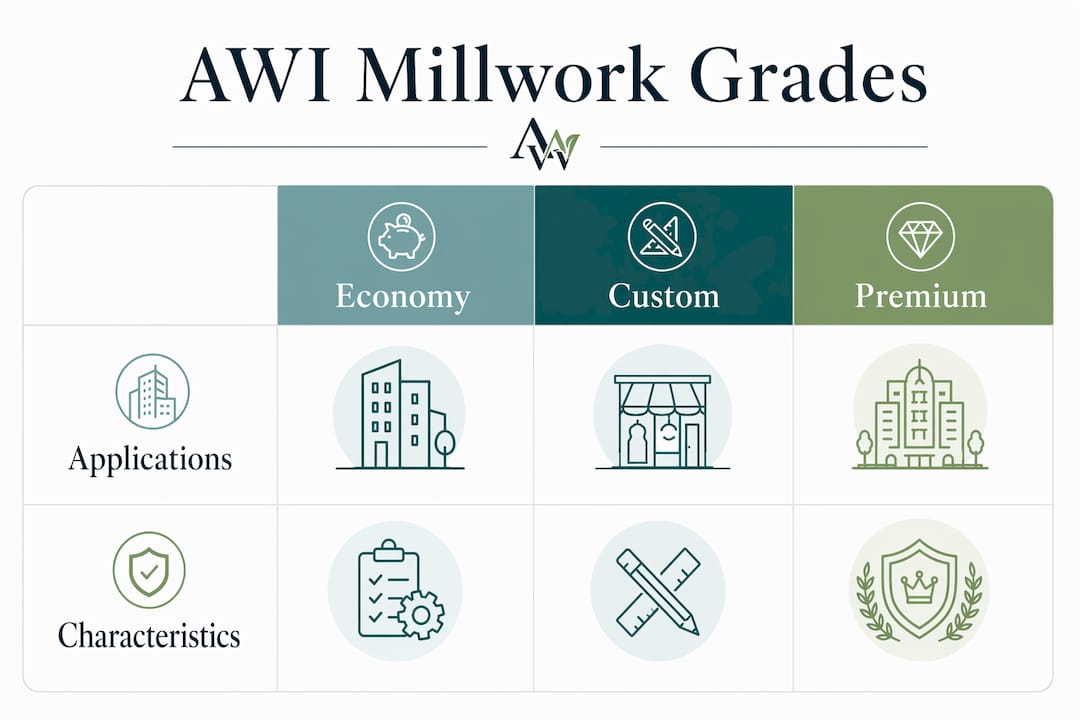
AWI organizes millwork quality into three grades. Each grade bundles tolerances, material requirements, and workmanship expectations together, not just appearance criteria.
- Economy grade covers utility spaces where function matters more than finish. Think storage rooms, mechanical areas, and back-of-house service corridors. Tolerances are wider, and material options are more basic.
- Custom grade is the standard for most commercial and residential applications. It covers general offices, retail interiors, and mid-range residential projects. Custom grade balances cost with quality and represents the majority of millwork specifications.
- Premium grade applies to high-visibility, high-touch areas: executive offices, hotel lobbies, reception areas, and luxury residential spaces. Premium grade adds 20–30% cost over Custom. That premium delivers no value in non-public or utility areas.
The most common specification mistake is applying a single grade across an entire project. Applying AWI grades per item rather than project-wide maximizes budget efficiency and meets aesthetic expectations where they actually count. A lobby reception desk warrants Premium. The janitor’s closet shelving does not.
Pro Tip: Assign grades item by item in your specifications. List each millwork element with its designated AWI grade in the specification table. This one practice prevents grade disputes at punch-list and protects the general contractor from liability.
AWI standards also carry legal weight. AWI standards provide a nationally accepted, legally defensible benchmark for millwork quality. That means when a dispute arises over finish quality or dimensional tolerances, the AWI document is the reference a court or arbitrator will use. Specifying the edition year matters too. The 2026 edition reflects current material and fabrication practices, so referencing an outdated edition can create gaps between what you specify and what fabricators actually produce.
How do NKBA and AWMAC guidelines complement AWI millwork standards?

AWI covers the broad field of architectural woodwork, but two other bodies fill important gaps depending on project type and location.
The NKBA governs kitchen and bath design through minimum clearances, accessibility requirements, and functional planning rules. NKBA guidelines are critical for avoiding expensive late-stage design revisions in residential and hospitality projects. A kitchen layout that violates NKBA clearance minimums, for example, requires redesign after shop drawings are already approved. That is an expensive problem. Architects and designers working on kitchen and bath projects should reference NKBA alongside AWI from the earliest design phase, not as an afterthought during submittal review.
AWMAC is the Canadian counterpart to AWI. Its standards align closely with AWI but include differences in material sourcing, finishing requirements, and regional building code integration. For cross-border projects or Canadian builds, AWMAC compliance is the expected standard. Specifying AWI on a Canadian project without acknowledging AWMAC can create friction with local fabricators and inspectors.
Here is a practical sequence for applying complementary standards on a typical project:
- Identify project type and location first. Residential kitchen or bath projects trigger NKBA. Canadian projects trigger AWMAC. Commercial interiors default to AWI.
- List all millwork elements and assign the applicable standard to each. Some elements may fall under multiple standards simultaneously.
- Reference the applicable standard edition on every shop drawing submittal. Include the edition year, not just the standard name.
- Coordinate with the millwork fabricator early to confirm they are familiar with the referenced standards. Fabricators unfamiliar with NKBA clearance rules are a common source of late revisions.
- Build a submittal checklist that cross-references each standard requirement against the shop drawing content before submission.
Pro Tip: On hospitality projects with kitchen and bath components, require the millwork fabricator to submit a standards compliance matrix alongside shop drawings. This one document surfaces conflicts before fabrication begins.
Common pitfalls in applying millwork industry guidelines
The gap between specifying standards and actually meeting them is where most project problems originate. These are the failure points that consistently drive cost overruns and disputes.
Field measurements are non-negotiable. Mismatch between architectural drawings and actual field conditions is one of the most common sources of costly millwork rework. Assign field measurement responsibility explicitly to the millwork subcontractor in the contract. Never allow fabrication to begin from architectural drawings alone. The cost of a field measurement visit is trivial compared to the cost of scribing, rework, or rejected installations.
NIC hardware is a budget trap. Hardware items designated “Not In Contract” create serious financial exposure. NIC hardware can generate $80,000–$150,000 in unaccounted costs on a mid-size commercial project. That number reflects the real cost of pulls, hinges, drawer slides, and closers that nobody budgeted because ownership was never clearly assigned. The fix is straightforward: itemize every hardware component with an allowance figure in the millwork contract.
Shop drawing documentation protects everyone. Adding a Standards Compliance block to shop drawing title sheets, listing the applicable grade, edition year, and any approved deviations, reduces RFI rates by 30–40%. Fewer RFIs means faster approvals and fewer revision cycles. That is a direct schedule benefit.
“Standards provide a neutral, documented baseline that protects manufacturers, designers, and general contractors by establishing measurable quality and fabrication expectations.” — Wood Industry
Grade compliance carries liability. Approving subpar grades at submittal, such as accepting Economy when Custom was specified, places liability squarely on the general contractor. Punch-list disputes over finish quality become much harder to resolve when the approved submittal already shows a lower grade. Review grade compliance at submittal, not at installation.
Pro Tip: Create a millwork scope checklist that includes field measurement sign-off, hardware itemization, and standards compliance block verification. Attach it to every millwork subcontract as a required deliverable.
How to specify millwork standards effectively for project success
Effective specification starts with a tiered approach that matches grade to function. The role of millwork in design directly informs which grade is appropriate for each element. High-visibility areas justify Premium. General applications use Custom. Utility spaces use Economy. Applying this logic consistently across a project prevents both over-specification and under-specification.
The table below shows how AWI grades map to typical applications, characteristics, and cost implications.
| AWI grade | Typical application | Key characteristics | Cost implication |
|---|---|---|---|
| Economy | Utility rooms, storage, back-of-house | Wider tolerances, basic materials, functional finish | Lowest cost per unit |
| Custom | Offices, retail, mid-range residential | Balanced tolerances, standard material options, clean finish | Mid-range cost |
| Premium | Lobbies, executive spaces, luxury residential | Tight tolerances, premium materials, high-quality finish | 20–30% above Custom |
Integrating standards into shop drawings is the next step. Every shop drawing submittal should reference the AWI edition year, the assigned grade for each item, and any approved deviations from the standard. This documentation practice reduces back-and-forth with the architect of record and speeds up approval cycles.
Coordination between the architect, general contractor, and millwork fabricator needs to happen before shop drawings are issued, not during review. A pre-submittal meeting that walks through grade assignments, hardware scope, and field measurement responsibilities eliminates the most common sources of revision requests. For projects involving custom versus stock millwork decisions, grade selection also informs whether custom fabrication is justified or whether stock cabinetry meets the specification at lower cost.
Pro Tip: Include a millwork standards reference table in your project specification section, listing each millwork element, its AWI grade, and the applicable standard edition. This table becomes the single source of truth for fabricators, inspectors, and the owner.
Key Takeaways
Meeting millwork quality standards requires assigning AWI grades per item, documenting compliance on shop drawings, and resolving hardware scope before fabrication begins.
| Point | Details |
|---|---|
| AWI grades drive cost and quality | Assign Economy, Custom, or Premium per item, not project-wide, to control budget and meet quality expectations. |
| NKBA and AWMAC fill critical gaps | Reference NKBA for kitchen and bath clearances and AWMAC for Canadian projects alongside AWI. |
| Field measurements prevent rework | Assign field measurement responsibility to the millwork subcontractor before any fabrication begins. |
| NIC hardware creates budget risk | Itemize all hardware with allowance figures in the contract to avoid six-figure unaccounted costs. |
| Standards compliance blocks speed approvals | Adding grade, edition, and deviations to shop drawing title sheets reduces RFI rates by 30–40%. |
Why I treat millwork standards as a project management tool, not paperwork
After years of managing millwork scopes on renovation and new-build projects in New York, I have come to see AWI, NKBA, and AWMAC standards as the most underused project management tools in the industry. Most teams treat them as a compliance checkbox. The teams that use them well treat them as a communication framework.
The clearest sign of a well-run millwork project is a submittal package where every item has a named grade, a referenced edition, and a hardware allowance. When that documentation exists, approval meetings are short. When it does not, every meeting becomes a negotiation about what was actually meant. Standards as a business tool reduce disputes because they replace subjective quality judgments with documented, measurable benchmarks.
The 2026 AWI edition update is worth the attention of every project team. Annual updates reflect changes in materials, fabrication technology, and finishing methods. Referencing an outdated edition is not just a technical error. It creates a gap between what the specification says and what current fabricators actually produce. That gap shows up as change orders.
My advice to architects and builders is to invest one hour per project in a pre-submittal standards alignment meeting. Walk through grade assignments, confirm hardware scope, and verify that the fabricator has the current edition. That one hour consistently prevents weeks of revision cycles later. The quality control process for millwork is only as strong as the standards documentation behind it.
— Grzegorz
Agny’s approach to millwork standards compliance
Millwork specifications that reference the wrong grade, miss hardware scope, or skip field measurements create problems that show up late and cost a lot to fix. Agny brings AWI, NKBA, and AWMAC standards compliance into every millwork project from the specification phase through final inspection.
Agny’s team reviews shop drawings for grade compliance, coordinates hardware allowances, and manages fabricator submittals on kitchen, bath, and interior millwork projects across New York. Whether you are planning a New York kitchen renovation or a full interior millwork scope, Agny handles the standards documentation that keeps projects on schedule and on budget. Contact Agny to discuss your next millwork project.
FAQ
What are the three AWI quality grades for millwork?
AWI defines Economy, Custom, and Premium grades. Each grade bundles material requirements, dimensional tolerances, and workmanship standards, not just appearance criteria.
When should I reference NKBA standards on a millwork project?
Reference NKBA guidelines on any project with kitchen or bath components. NKBA governs minimum clearances, accessibility, and functional planning requirements that AWI does not cover.
How do I avoid NIC hardware budget surprises?
Itemize every hardware component with a specific allowance figure in the millwork contract. NIC hardware designations can generate $80,000–$150,000 in unaccounted costs on mid-size commercial projects.
What is a Standards Compliance block on a shop drawing?
A Standards Compliance block is a section on the shop drawing title sheet that lists the applicable AWI grade, edition year, and any approved deviations. Including it reduces RFI rates by 30–40%.
Is AWI or AWMAC the right standard for Canadian millwork projects?
AWMAC is the recognized standard for Canadian architectural woodwork projects. AWI applies to U.S. projects. Cross-border projects should reference both and confirm which standard the local fabricator and inspector expect.