TL;DR:
- Noise ordinances limit commercial sound levels at property lines to prevent disturbances and enforceable through calibrated meters. Violations can lead to heavy fines, license revocations, and legal actions, emphasizing proactive noise management. Using acoustic barriers, scheduling high-noise activities, and documenting mitigation efforts help businesses comply and avoid enforcement penalties.
Noise ordinances for businesses are legal frameworks that cap the sound levels a commercial property can emit, measured at the receiving property line during defined hours. Most U.S. cities enforce these rules through calibrated sound meters, zoning classifications, and tiered penalty systems. Violating them can cost you far more than a fine. Repeat offenses can trigger license revocation and equipment seizure, putting your entire operation at risk. This guide breaks down exactly what the rules require, how enforcement works, and what you can do to stay on the right side of your local code.
What are the noise ordinances for businesses in most U.S. cities?
Commercial noise regulations set legal decibel ceilings that vary by time of day and zone type. Daytime limits near residential zones generally run 60–68 dB(A), while nighttime limits drop to 50–58 dB(A). That 5–10 dB(A) reduction matters because the decibel scale is logarithmic. A drop of 10 dB(A) cuts perceived loudness roughly in half.
The term “dB(A)” refers to A-weighted decibels, a measurement scale calibrated to match how human ears perceive sound. It filters out very low and very high frequencies that humans barely notice, making it the standard unit in virtually every municipal noise code.
Most ordinances also define quiet hours, the periods when stricter limits apply. These windows commonly run from 10:00 PM to 7:00 AM, though some cities push them earlier or extend them on weekends. Limits also shift depending on your zoning classification.
| Zone type | Typical daytime limit | Typical nighttime limit |
|---|---|---|
| Commercial near residential | 60–65 dB(A) | 50–55 dB(A) |
| Pure commercial district | 65–68 dB(A) | 55–58 dB(A) |
| Industrial adjacent to residential | 65–70 dB(A) | 55–60 dB(A) |
| Residential zone | 55–60 dB(A) | 45–50 dB(A) |
Key factors that determine which limit applies to your business:
- Your zoning classification and the classification of adjacent parcels
- Whether your property shares a boundary with a residential zone
- The specific hour of day when noise is generated
- Whether your city uses a single citywide code or neighborhood-specific overlays
How is noise measured and enforced under these ordinances?
Enforcement agencies measure noise at the receiving property line, not at your equipment. Compliance is determined by what a neighbor experiences on their property, not what your rooftop HVAC unit produces at the source. This distinction catches many business owners off guard. You can be fully within what feels like a reasonable operating range and still receive a citation if sound carries across the property line above the legal threshold.
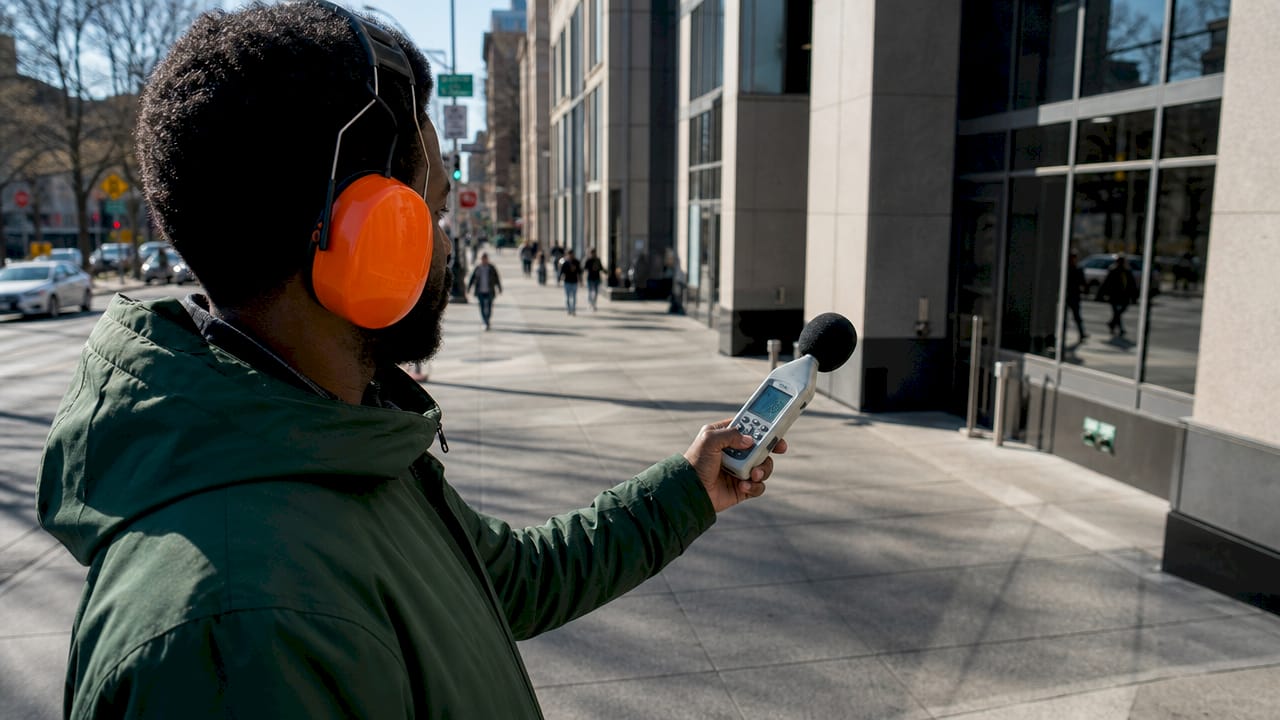
Calibrated instruments used in formal enforcement are ANSI-spec Type 1 or Type 2 sound level meters with A-weighting. Type 1 meters deliver the highest precision and are the standard for legal proceedings. Type 2 meters are acceptable for most municipal enforcement actions.
The enforcement picture gets more complicated when officers lack calibrated equipment. In those cases, many jurisdictions apply a “plainly audible” standard, meaning a citation can be issued based on human perception alone. That standard is entirely subjective. A sound that reads 58 dB(A) on a meter might still generate a citation if an officer can clearly hear it from the property line.
Key enforcement realities every business owner should know:
- Measurements are always taken at the complainant’s property line, not at your building
- Officers may cite you without a meter if sound is plainly audible from the boundary
- Wind, terrain, and building reflections can amplify sound at the property line unexpectedly
- Enforcement can be triggered by a single complaint, not just repeat incidents
Pro Tip: Commission your own baseline sound level reading from a licensed acoustical consultant before a complaint is filed. Having documented dB(A) readings at your property line gives you a defensible record if enforcement action begins.
What are the penalties for violating business noise ordinances?
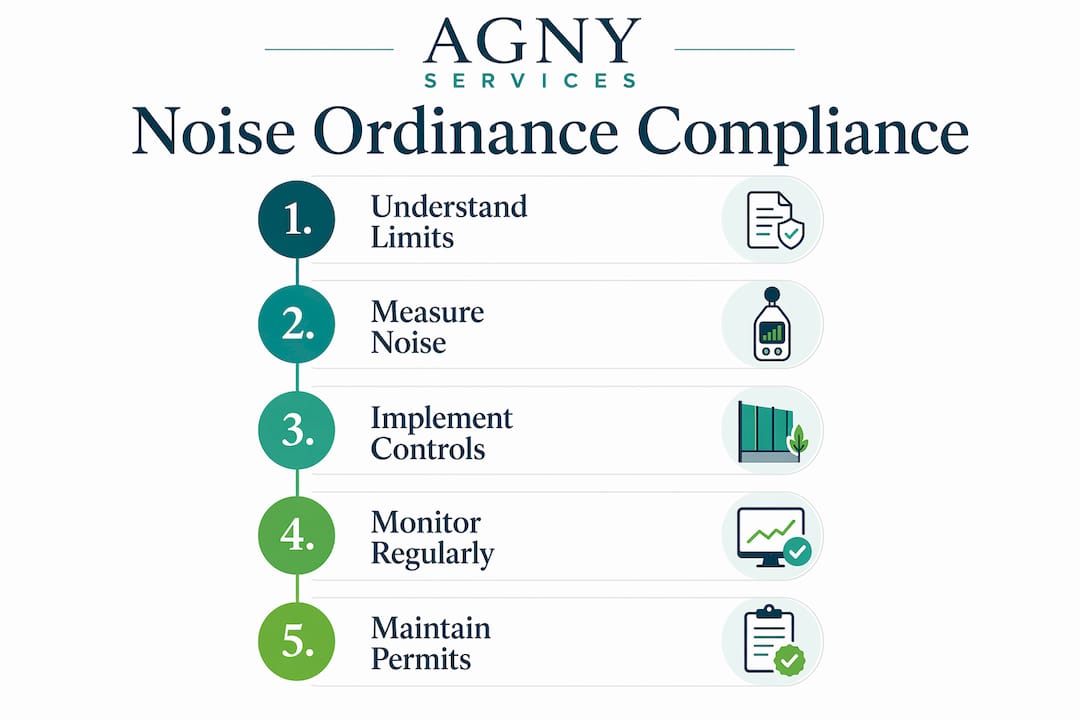
Financial penalties for commercial noise violations escalate fast. First offense fines typically start between $50 and $525. Persistent violations can reach $2,000 to $8,000 per incident. Each day of a continuing violation is treated as a separate offense, which means a week of non-compliance can multiply a single fine into a five-figure liability.
The financial exposure is serious, but the operational risks are worse. Chronic violations can lead to equipment seizure and license revocation. Losing your operating license does not just cost money. It shuts your business down entirely until the matter is resolved, which can take months.
Here is what the penalty ladder typically looks like:
- First offense: Warning or fine in the $50–$525 range
- Second offense: Fine escalates, often doubling or tripling the initial amount
- Third and subsequent offenses: Fines in the $2,000–$8,000 range per incident
- Chronic violations: Equipment confiscation, conditional use permit suspension, or full license revocation
- Civil liability: Neighbors can also pursue nuisance lawsuits independent of municipal enforcement
The civil liability angle is underappreciated. A neighbor who documents a pattern of noise complaints has strong grounds for a nuisance claim. Documented complaint histories are key evidence in both enforcement proceedings and civil suits. That means every unresolved complaint is a potential legal record building against you.
What noise control measures actually work for businesses?
Mechanical equipment is the primary enforcement trigger for most commercial properties. HVAC chillers, refrigeration units, and delivery docks generate the complaints that lead to citations. Acoustic shielding and operational scheduling are the two most effective responses.
Acoustic barriers and sound dampening
Acoustic barriers are solid walls or panels placed between a noise source and the property line. They work by blocking the direct sound path. For rooftop HVAC units, purpose-built equipment screens reduce sound transmission significantly. For ground-level mechanical rooms, dense masonry walls or mass-loaded vinyl panels are standard solutions. The key is placing the barrier between the source and the receiving property, not just around the equipment itself.
Sound dampening materials inside mechanical rooms, such as acoustic foam panels, fiberglass insulation boards, and vibration isolation mounts under compressors, reduce the energy that reaches exterior walls. Combining interior dampening with exterior barriers produces the best results.
Operational scheduling
Scheduling loud activities during permissible daytime hours is the lowest-cost compliance tool available. Deliveries, compactor runs, and outdoor equipment maintenance should all be completed before quiet hours begin. For businesses that run 24 hours, this requires mapping which operations generate the most noise and restricting them to the 7:00 AM to 10:00 PM window.
Scheduling HVAC servicing during off-peak hours also reduces the chance that maintenance noise triggers a complaint. A unit running rough during a service call at 11:00 PM is a citation risk that a daytime appointment eliminates entirely.
- Conduct a noise audit to identify your loudest equipment and its dB(A) output at the property line
- Install acoustic barriers around rooftop and ground-level mechanical systems
- Apply vibration isolation mounts to compressors, chillers, and refrigeration units
- Schedule all high-noise operations between 7:00 AM and 9:00 PM to build in buffer before quiet hours
- Upgrade aging HVAC and refrigeration units to current low-noise models when equipment reaches end of life
- Establish a direct communication channel with adjacent neighbors so they call you before they call the city
Pro Tip: When planning any renovation or buildout that involves mechanical systems, factor noise output into equipment selection from the start. Retrofitting acoustic solutions after installation costs two to three times more than specifying quiet equipment upfront. Agny’s commercial buildout planning process includes noise impact review as a standard step.
How do noise ordinances connect to your business permits?
Noise compliance is not just an operational issue. It is a licensing issue. Many local governments condition operating permits and conditional use permits directly on adherence to noise limits. A noise violation can trigger a permit review. A pattern of violations can result in suspension or revocation of the permit that allows you to operate.
This connection is especially consequential for businesses in mixed-use zones, where residential units sit above or adjacent to commercial spaces. In those environments, a single sustained complaint can initiate a formal review of your conditional use permit. The review process itself creates uncertainty, legal costs, and potential operational restrictions even before a final decision is made.
Proactive documentation protects you during any permit review:
- Keep a written log of all noise complaints received, including date, time, and your response
- Document every mitigation measure you implement, with dates and contractor records
- Request written confirmation from neighbors when you resolve a complaint
- Maintain service records for all mechanical equipment to show active maintenance
- Consult your renovation permit process when making physical changes that affect noise output
Permit renewals are the moment when a complaint history becomes most dangerous. Reviewers look at the record of violations and community feedback. A clean log of proactive responses and documented mitigation efforts is the strongest argument you can make for renewal approval.
Key Takeaways
Noise ordinances for businesses are permit-linked legal requirements that carry escalating financial and operational penalties, making proactive acoustic management a core part of running any commercial property.
| Point | Details |
|---|---|
| Limits vary by zone and time | Daytime limits run 60–68 dB(A); nighttime limits drop to 50–58 dB(A) near residential zones. |
| Measurement is at the property line | Compliance is judged at the neighbor’s boundary, not at your equipment or building. |
| Penalties escalate fast | First offenses start at $50–$525; chronic violations can reach $8,000 per day plus license risk. |
| Permits depend on compliance | Noise violations can trigger permit reviews and revocations that shut operations down. |
| Mitigation beats remediation | Acoustic barriers, scheduling, and equipment upgrades cost far less than fines and legal defense. |
What I’ve learned from watching businesses get this wrong
Most business owners I talk to assume noise compliance is a simple matter of keeping the volume down. The reality is more specific and more unforgiving than that.
The measurement-at-the-property-line rule is the detail that surprises people most. I have seen operators invest in expensive equipment enclosures, only to discover that sound was reflecting off an adjacent building wall and arriving at the neighbor’s property line louder than it left the source. The physics of sound propagation in urban environments are not intuitive. That is why a baseline acoustic survey, done before a complaint is filed, is worth every dollar.
The “plainly audible” enforcement standard is the second thing that catches people off guard. You can be technically within your decibel limit and still receive a citation because an officer standing at your property line can hear your equipment clearly. That standard puts neighbor relations at the center of your compliance strategy, not just your dB(A) readings.
The businesses that handle this best treat noise management the way they treat fire safety. They build it into their operations, document it consistently, and review it when they make physical changes to the space. When a renovation touches mechanical systems, that is the right moment to upgrade to quieter equipment and add acoustic treatment. Waiting until a complaint arrives means paying for both the fix and the fine.
Community communication is the cheapest insurance available. A neighbor who has your phone number and feels heard will call you before calling the city. That call gives you the chance to fix the problem without creating an enforcement record.
— Grzegorz
How Agny helps businesses meet noise compliance through renovation
Noise compliance often requires physical changes to a commercial space, and that is where the right contractor makes a measurable difference. Agny works with business owners in New York on renovations that address mechanical noise at the source, from acoustic treatment of mechanical rooms to full equipment replacement during commercial buildouts.

Whether you are upgrading an aging HVAC system, reconfiguring a delivery area, or planning a full commercial renovation that needs to meet local sound restrictions, Agny brings permit management and construction expertise to every project. The team understands how New York’s noise codes intersect with building permits, and that knowledge prevents costly surprises during inspections. If your space needs work that will hold up to enforcement scrutiny, talk to a general contractor who builds compliance into the plan from day one.
FAQ
What decibel level is too loud for a business?
Most U.S. cities set daytime commercial noise limits at 60–68 dB(A) near residential zones, dropping to 50–58 dB(A) at night. Limits are measured at the neighboring property line, not at your building.
What are quiet hours for businesses?
Quiet hours most commonly run from 10:00 PM to 7:00 AM, though specific windows vary by city and zoning district. During these hours, stricter decibel limits apply and noise complaints carry greater enforcement weight.
Can a business be cited without a sound meter reading?
Yes. Officers can issue citations under the “plainly audible” standard if they can clearly hear the noise from the property line, even without a calibrated meter. This makes neighbor relations as important as technical decibel compliance.
How do noise violations affect a business license?
Noise complaints can trigger permit reviews, and chronic violations can lead to suspension or revocation of operating or conditional use permits. Losing a permit can halt operations entirely until the issue is resolved.
What is the fastest way to reduce noise complaints from neighbors?
Contact adjacent neighbors directly, explain your operations, and give them a direct line to reach you before calling the city. Pair that with scheduling loud activities during daytime hours and installing acoustic barriers around your loudest equipment.