The first call usually comes in while the storm's still moving. A branch is hanging over the driveway, the roofline has been hit, or a tree is leaning in a way that wasn't there yesterday, and you're trying to figure out whether this is a real emergency or just a bad-looking mess that can wait until morning. The right answer matters, because emergency tree service is about safety first, not speed for its own sake.
When tree care turns urgent, the work is high-risk. A CDC review of tree-care deaths from 1992 through 2007 recorded 1,285 worker deaths, about 80 fatalities per year, with 44% happening during trimming or pruning and the main causes including struck-by incidents, falls, and electrocutions, while TCIA later reported 243 fatal occupational injuries from 2020 through 2023 and estimated a fatality rate of roughly 30.5 to 41.0 per 100,000 FTE workers, up to 11 times the all-industry average. Those numbers explain why the right crew, the right gear, and the right sequence matter once a tree stops being a landscaping issue and becomes a hazard response. (CDC review and TCIA safety summary)
When a Tree Becomes an Immediate Threat
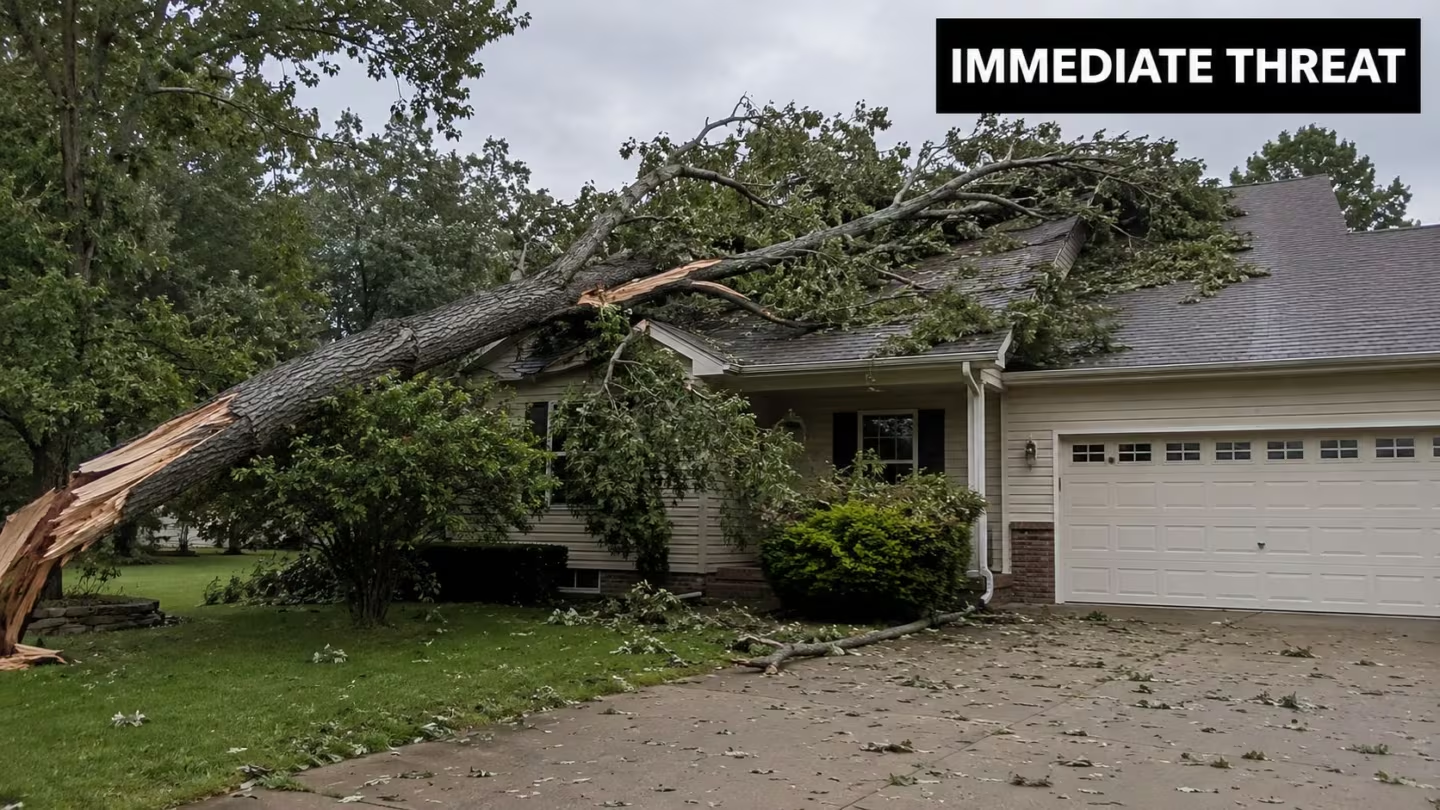
A storm usually makes the decision for you before the phone call does. A homeowner looks out and sees a large limb draped across a porch roof, or a trunk split and resting on a garage corner, and the instinct is to start cutting. That's the moment to stop moving toward the wood and start moving people away from it.
The first moves matter more than the saw
If there's injury, structural damage, or a tree is in active contact with a house, the safest move is to call 911 and keep everyone clear of the area. Downed or contacted utility lines change the situation immediately, because energized conductors turn the site into an electrical hazard, not a tree job. The same applies when a trunk is blocking an exit, a fire lane, or another access route that first responders might need.
A qualified crew won't rush straight into cutting. They'll classify the scene, confirm whether anyone is hurt, isolate the perimeter, check for utility involvement, and decide whether the job is removal, stabilization, or deferred pruning. That sequence is what keeps a bad storm call from becoming a second incident.
Practical rule: if you're debating whether to stand under the tree and “just take a look,” you're already too close.
Why the response has to be specialized
Storm-damaged trees behave differently from healthy trees. Weight shifts, tension releases unpredictably, and broken wood can move after the cut starts. That's why emergency tree work isn't routine landscaping, and it's why experienced crews arrive with the equipment to control the load, not just reduce it.
The urgency is real, but so is the need to avoid panic. A tree that has already struck the structure, or one that threatens to do so in a visible and immediate way, calls for a professional response with trained climbers, buckets, rigging, and often utility coordination. The reason isn't marketing language, it's the nature of the hazard itself.
Triage Checklist for a True Emergency or a Scheduled Hazard
The fastest way to save money is to classify the problem correctly. A lot of property owners hear “tree damage” and assume they need same-day response, but not every damaged tree belongs in emergency dispatch. The right triage question is simple, does the tree create an immediate threat, or is it a deferred hazard that can be scheduled safely?
The four true emergency triggers
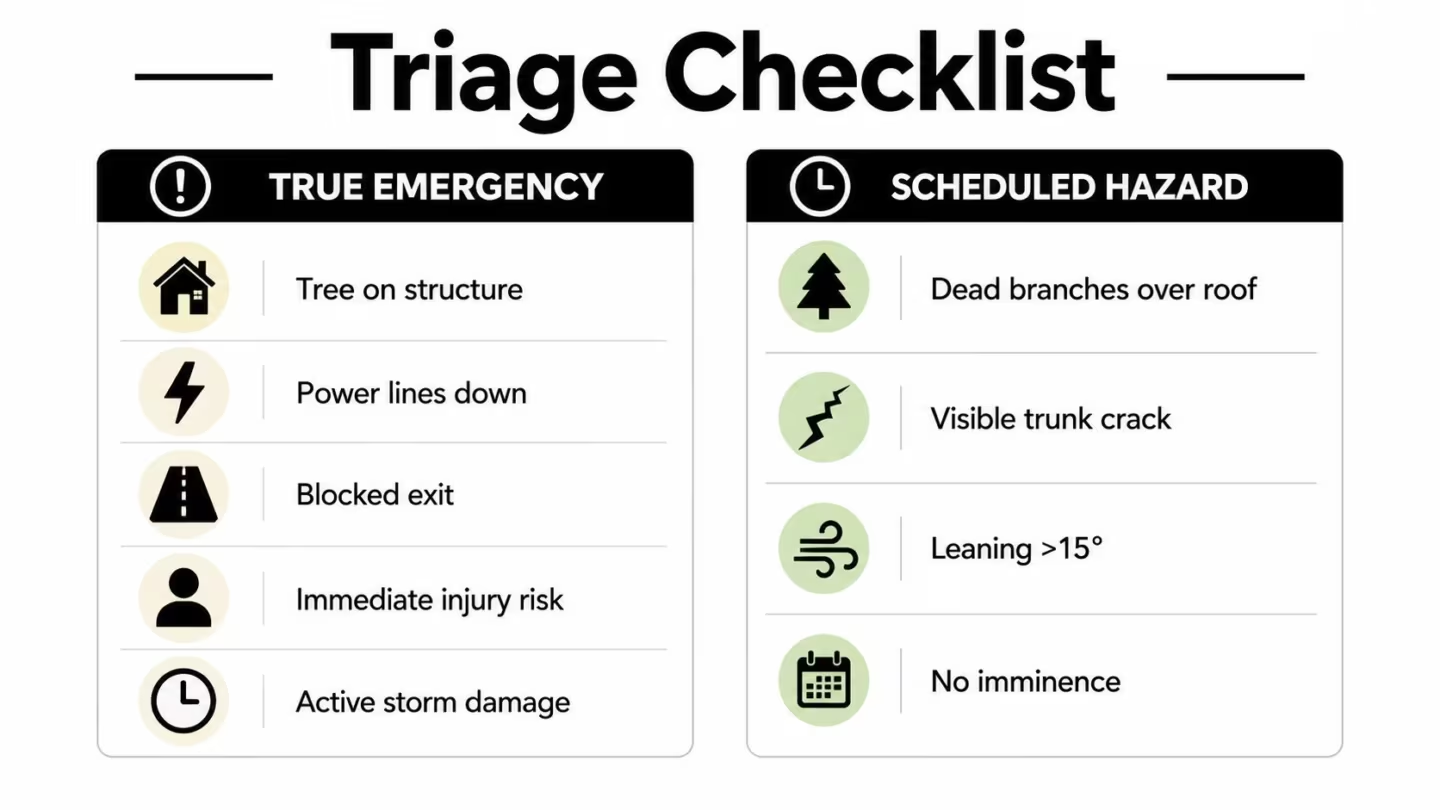
A tree belongs in emergency response when it has active contact with an occupied structure, blocks a fire lane or access route, is in energized utility contact, or meets imminent-failure criteria under a proper risk assessment. Those are the situations where delay can expose people or property to secondary failure.
Use this quick field check:
- Tree on a structure: the tree, large limb, or suspended section is loading the roof, wall, deck, or porch.
- Power lines down or contacted: treat it as an electrical hazard first, a tree issue second.
- Blocked exit or access: driveways, fire lanes, and other critical access points can't stay obstructed.
- Immediate injury risk: people, pets, or neighbors are close enough that failure could hurt them.
- Active storm damage: the tree is still moving, cracking, or shedding weighted limbs in real time.
What can usually wait
A different category of damage can often be scheduled. That includes contained failure potential, like a split limb that's hanging over unoccupied ground, storm-weakened roots without near-term weather risk, or a tree that's damaged but still stable enough to inspect later. A tree with major crown loss can still be salvageable in some cases, because 50% or less crown loss gives a tree a good chance of surviving, 50% to 75% means it may survive but be weakened, and over 75% generally means low survival probability, according to UMass Amherst's emergency guidance. (UMass Amherst emergency manual via National Tree Authority reference)
If the hazard is real but the target area is empty and the structure isn't loading, you may need an arborist inspection, not a storm premium.
This distinction matters because many unnecessary emergency calls happen when people confuse damage with danger. A bent limb over a vacant side yard looks ugly, but if it isn't threatening a building, a road, or utilities, it may not need a same-day crew. Getting that call right can save a homeowner from paying an emergency rate for a job that should have been a scheduled service.
Understanding Emergency Tree Service Costs
Emergency pricing feels steep because you are paying for risk, timing, and logistics at the same time. Published industry guides commonly place emergency work at about 20% to 100% above scheduled pricing, and many jobs run 1.5 to 3 times a standard removal. A planned $1,200 removal can move to $2,000 to $3,600 in an emergency, and extreme cases can go beyond $5,000. (IBISWorld industry report)
What actually drives the bill
The biggest cost driver is that emergency work is priced around crew-hour time, not a flat guess. A current pricing guide puts standard 2026 production at about $90 to $200 per crew-hour, with solo operators around $90 to $130, two-person crews at $150 to $220, and bucket-truck or crane crews at $300 to $700+ per hour depending on equipment and region. The calculation sequence is straightforward, estimate labor hours, multiply by the crew rate, then add equipment time, disposal, permits, traffic control, and markup. (TreeGuard Insurance pricing guide)
Emergency surcharges also stack quickly. Same-day response is often priced at +50%, after-hours at +75%, and storm response within 24 hours at +75% to +100%. A call made late at night, during active weather, or with crane support can jump far beyond a daytime scheduled removal.
A simple cost comparison
| Service Type | Standard Cost | Emergency Cost | Premium |
|---|---|---|---|
| Planned removal | About $1,200 | About $2,000 to $3,600 | About 20% to 100% above scheduled pricing |
| Mid-size urgent removal | Varies by crew and access | Can exceed $5,000 in extreme cases | Higher when cranes, traffic control, or after-hours work are required |
The hidden risk for homeowners is undercounting mobilization and standby time. A quote can look reasonable until the crew spends half the night on access control, rigging, and machine staging, then the true labor cost shows up in the final invoice. That is also why many operators price dangerous-tree work by live response, not by a polished flat number over the phone.
One other market signal helps explain the scale here. One industry report estimates U.S. tree-trimming services at $39.5 billion in 2026. That same report is also used to describe emergency calls as a large share of tree-service jobs, with typical after-hours premiums of $150 to $300 per call. The Texas safety fact sheet cited in the same source also notes about 23,000 chainsaw-related emergency-room cases annually in the U.S., which is a reminder that emergency tree work is a recurring service line, not a rare one-off. (IBISWorld industry report)
What to Expect When the Crew Arrives
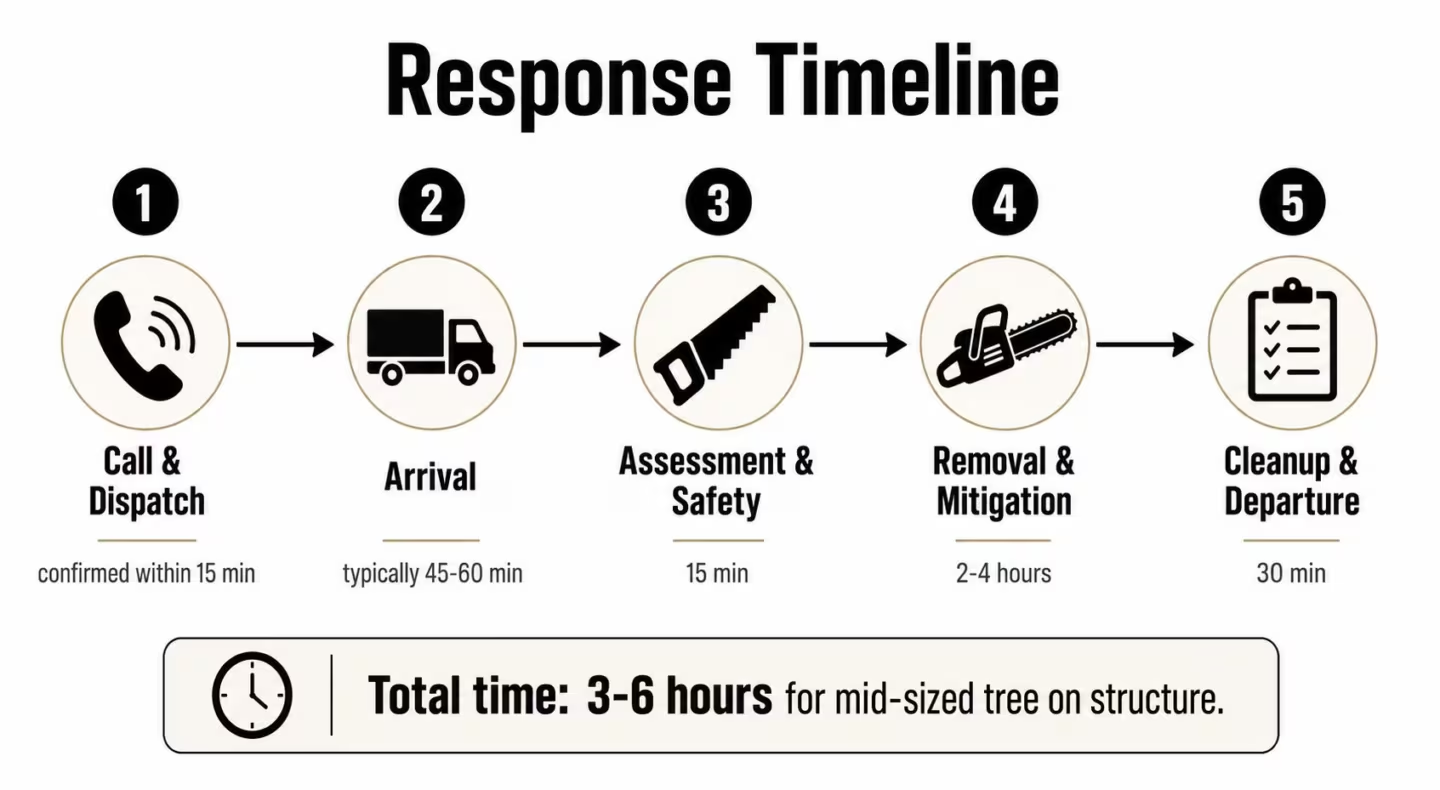
A professional emergency response starts with control, not cutting. On a typical mid-sized tree on a structure without power-line involvement, the full call-to-crew-departure cycle often runs 3 to 6 hours, and that is normal when the job is handled properly. Rapid dispatch and stabilization are benchmarks.
The first hour is assessment, not heroics
Once the crew arrives, the lead tech should classify the scene, confirm whether anyone is injured, and mark the hazard perimeter before touching the tree. Utility involvement gets checked immediately, because a line contact changes the work plan and the safety protocol. Only after that does the crew decide whether the tree is coming down, being stabilized, or being left for deferred pruning.
The sequence usually looks like this, even if the exact timing changes with access and weather:
- Call and dispatch.
- Arrival and scene control.
- Assessment and safety setup.
- Removal or mitigation.
- Cleanup and departure.
A short video can help homeowners understand how storm-response teams think about the site before the saw starts.
What drives the cost
The bill reflects more than cutting wood. Access to the tree, the amount of rigging needed, whether traffic control is required, and how much time the crew spends on site all shape the price. If the job happens after hours, during active weather, or with crane support, the cost can rise far beyond a daytime scheduled removal.
Construction access on a dense city block is a good example of why emergency pricing shifts fast. A tree that looks straightforward from the street may need extra labor for parking control, tight staging, and careful lowering of limbs around neighboring property. That is why some quotes stay vague until the crew sees the site.
What gets included in the work
A complete emergency job may involve stabilizing a leaning stem, removing the tree or failed sections, cutting back damaged limbs, and cleaning debris from the structure or driveway. Stump grinding is usually a separate request, not the first priority in a safety call. If the incident will be filed with insurance, photos, damage notes, and an itemized invoice matter more than a rushed verbal summary.
If the site is in a dense urban block, the work often includes more coordination than cutting. Shared access, parked cars, utility proximity, and neighbor concerns can slow the job down even when the tree itself is straightforward. A contractor who understands that reality will explain the sequence before the first cut and keep the property owner informed as conditions change.
Prevention and Maintenance Strategies
The cheapest emergency is the one that never becomes an emergency. Regular inspections catch weak unions, hidden decay, and failing limbs before a storm turns them into a roof repair. That's why preventive tree care usually costs far less than a panic call after the fact, even before you factor in property damage and downtime.
Warning signs that deserve a scheduled visit
Some conditions don't need an emergency crew, but they do need attention. Dead or hanging branches, fungal growth at the base, trunk cracks, worsening lean, and root damage from construction all belong on a scheduled arborist checklist. Those are the kinds of problems that tend to get worse during the first hard wind, which is why delaying them can be expensive.
A seasonal rhythm helps. Prune before heavy growth or weather stress builds up, inspect vulnerable trees after major storms, and review structural support on trees that have already shown weakness. If the canopy or root zone has changed because of recent construction, don't assume the tree will adjust on its own.
Practical takeaway: if a tree is still standing but looks wrong, that's the best time to inspect it. Waiting until it fails is how a maintenance bill turns into an emergency invoice.
Prevention saves more than money
I've seen plenty of cases where a scheduled visit removed the threat long before it became a callout. A split codominant stem, a declining maple over a garage, or a compromised limb over a walk path can often be stabilized or removed during daylight, with fewer crew hours and less equipment pressure. That isn't just cheaper, it's calmer, because nobody is trying to work around a live incident.
If you want one internal benchmark, use this: routine attention is the place for inspection, pruning, and structural planning, while the emergency call is for immediate danger. Property owners who keep that line clear usually spend less and make better decisions under stress.
For owners managing larger projects, AGNY Services LLC can coordinate related property work such as demolition, removals, permitting, and site coordination when storm damage overlaps with broader renovation or repair needs. That matters when a tree incident is only one part of a larger recovery job, especially on tight urban properties. AGNY Services LLC
Choosing a Licensed and Qualified Contractor
The wrong contractor turns a tree emergency into a second problem. After a storm, some operators show up fast, quote low, and disappear when the work gets complicated, which is why credentials matter as much as response time. A qualified crew should be able to prove insurance, explain the plan, and show that they understand both arboriculture and site safety.
What to verify before you say yes
Start with the basics. Ask whether the company is licensed and insured, including liability and workers' compensation, and whether the lead arborist is ISA certified. Then ask for a written estimate that describes the scope, not just a number, because emergency work often changes as the site is opened up.
A few red flags should make you pause immediately:
- Door-to-door solicitation after a storm: especially if the pitch feels rushed or pushy.
- Cash-only terms: a sign the operator may not be set up for proper documentation.
- No written contract: a bad fit for a high-risk job.
- Refusal to show insurance: walk away.
- No local references: especially risky in dense urban work.
Ask about the job, not just the price
The first call should answer how fast the crew can arrive, what equipment they're bringing, and how they handle utility coordination or access issues. In NYC and New Jersey, local permitting and site conditions can affect the schedule, so a contractor with real regional experience usually moves more cleanly through the work. The point isn't to find the cheapest ticket, it's to find the team that can finish safely and document the result.
One more practical check helps under pressure. Ask when payment is due and whether they expect anything upfront. In a legitimate emergency, the answer should fit the scope of work and the written agreement, not the other way around.
For property owners who want a contractor that can handle related repair and coordination work beyond the tree itself, AGNY Services LLC is one option in the broader NYC and New Jersey market, with services that include permitting, demolition, removals, and finish work. That kind of scope can help when storm damage is part of a larger property repair plan. AGNY Services LLC contractor services
If you're staring at storm damage and don't know whether it's a same-day danger or a job that can wait, treat the triage decision seriously and get a qualified set of eyes on it before you pay emergency rates unnecessarily. AGNY Services LLC works on the kinds of property repair and coordination problems that often follow damage events in NYC and New Jersey, including permitting, removals, and site restoration. Visit AGNY Services LLC to get help planning the next safe step.