TL;DR:
- Effective commercial playroom design combines safety, strategic zoning, and themed storytelling to maximize revenue and operational flow. Proper space allocation, age-specific safety zones, and cohesive branding are essential for creating a profitable and engaging environment. A unified design and build approach ensures compliance, reduces costs, and accelerates achieving profitability within 12 to 18 months.
Commercial playroom design is the specialized process of engineering safe, themed, and revenue-optimized play environments for businesses such as shopping malls, family entertainment centers, and hotels. Unlike residential playrooms, commercial play spaces must handle high daily visitor volumes, meet strict safety standards, and generate measurable returns. Companies like CY PLAY and Peach Prime have built entire practices around this discipline, treating every square foot as both a safety zone and a revenue asset. Understanding what commercial playroom design requires is the first step toward building a space that works as hard as you do.
What is commercial playroom design?
Commercial playroom design is the engineering of high-volume play environments specifically for business operations, contrasting sharply with residential play by prioritizing daily operational durability and revenue-driven visitor flow. The industry term used by specialists is “commercial indoor playground design,” and it covers everything from structural layout to equipment procurement and brand integration.
The core difference from a home playroom is scale and intent. A residential space serves one family. A commercial play venue serves hundreds of visitors per day, each interaction carrying liability, safety, and revenue implications. That shift in scale changes every design decision, from flooring material to ceiling height to the placement of a parent seating area.
Businesses that invest in this discipline include shopping centers, hotel chains, pediatric clinics, and standalone family entertainment centers (FECs). Each venue type has different traffic patterns, but all share the same foundational requirements: safety compliance, operational flow, and a design that keeps families coming back.
What elements are needed in a commercial playroom layout?
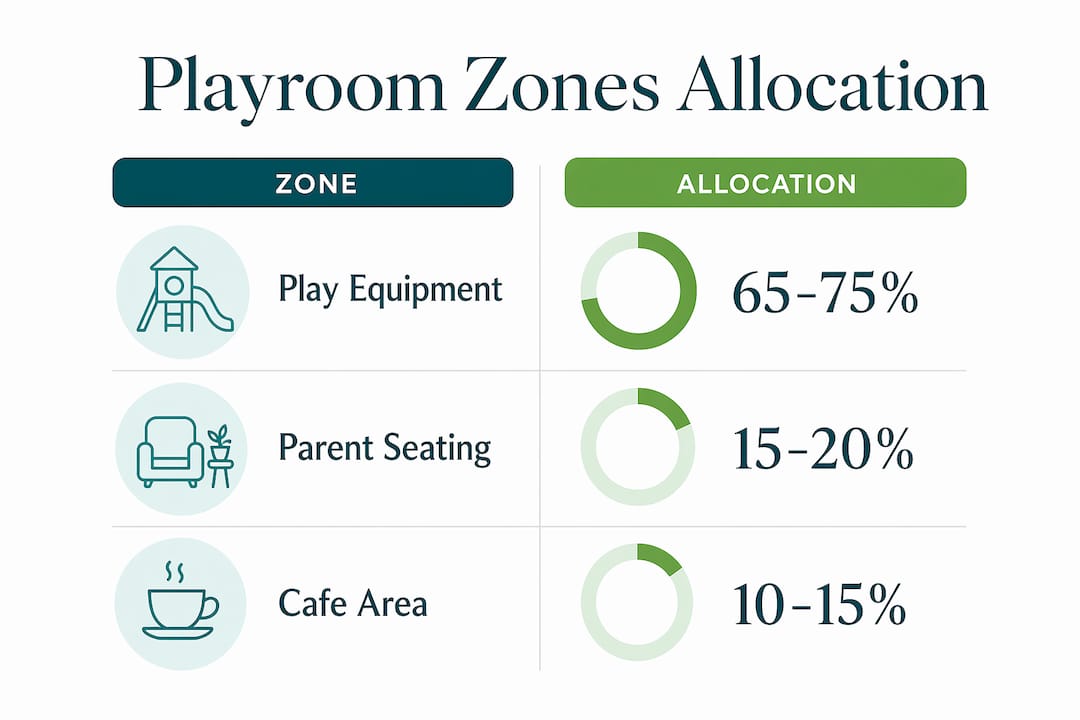
Space allocation is the foundation of any profitable commercial playroom layout. Industry standards for 2026 recommend dedicating 65–75% of total square footage to play equipment, with the remaining 25–35% split across operational zones: 10–15% for cafe seating, 8–12% for party rooms, and 5–10% for reception and entry. That ratio is not arbitrary. It reflects years of operator data showing where revenue is generated and where bottlenecks form.

| Zone | Recommended Allocation | Primary Function |
|---|---|---|
| Play Equipment Area | 65–75% | Core visitor experience and dwell time |
| Cafe / Parent Seating | 10–15% | High-margin food and beverage revenue |
| Party Rooms | 8–12% | Premium booking revenue stream |
| Reception / Entry | 5–10% | Ticketing, flow control, first impressions |
| Restrooms / Utility | 5–8% | Compliance and operational support |
Multi-level play structures add another layer of planning complexity. Clear height requirements are precise: 3.2 meters for two-level structures, 4.5 meters for three levels, and 6.0 meters for four levels. Insufficient vertical clearance makes structures unsafe or unusable, which is a costly mistake to fix after construction begins.
Sightlines are a non-negotiable design element. Parent seating must provide direct, unobstructed views of all active play areas. Designers at Hanlin Playground describe this as engineering a “viewing gallery,” not an incidental feature. It serves both regulatory compliance and customer trust.
Pro Tip: Map your customer flow from the entry point through ticketing, play areas, cafe, and exit before finalizing any floor plan. Bottlenecks at the reception zone are the single most common cause of negative first impressions in commercial play venues.
Soft play areas for medium-scale projects typically range from 200–500 square meters, while larger family entertainment centers exceed 1,000 square meters. Knowing your target size early determines which space allocation ratios apply and what equipment investment is realistic.
How does thematic design drive commercial playroom success?
Theming in commercial playrooms is not decoration. It is a business tool. Successful themes use structural storytelling through lighting, color language, and structural shape to drive brand recognition and customer retention, transforming a playroom into a premium destination that families choose over competitors.
The practical implication is significant. A cohesive theme increases perceived value, which supports premium pricing for memberships and party bookings. A space with a consistent jungle adventure theme, for example, commands higher birthday party rates than a generic soft play area because the experience feels intentional and exclusive.
Key elements of effective commercial theming include:
- Color palettes tied to age zones. Bright primaries for toddler areas, more complex color schemes for older children’s sections, and neutral tones for parent lounges.
- Lighting as a mood tool. Warm lighting in cafe areas encourages longer stays and higher food spend. Dynamic lighting in play zones increases energy and excitement.
- Structural shapes that reinforce the narrative. Arched entryways, themed climbing towers, and branded signage all contribute to the story without adding operational complexity.
- Brand integration at every touchpoint. From wristbands to wall graphics to staff uniforms, consistent branding builds recognition and repeat visitation.
Pro Tip: Commission your theme concept before selecting equipment. Equipment manufacturers like CY PLAY and Hanlin Playground offer custom fabrication, but only if the theme brief arrives early enough to influence structural design.
Theming also intersects with safety zoning. Age-specific areas can be themed differently to signal to parents and children which zone is appropriate. A toddler zone styled as a soft meadow communicates “gentle play” far more effectively than a sign alone.
What safety and compliance standards apply to commercial playrooms?
Safety in commercial playrooms is a regulatory and engineering discipline, not a checklist item. The primary standards governing commercial play equipment in the United States and internationally are ASTM F1487 (for outdoor play equipment) and EN1176 (the European standard widely referenced in international projects). Both frameworks address impact attenuation, entrapment hazards, and material toxicity.
Age-specific zoning is the most critical safety mechanism in any commercial play space. Experience zoning physically segments areas by age group and developmental need, forming the foundational framework that dictates both safety and revenue potential across the entire floor plan. Without it, toddlers and older children share equipment designed for different physical capabilities, creating injury risk and liability exposure.
The five compliance priorities every business owner must address are:
- Certified materials. All foam, fabric, and structural components must meet ASTM or EN1176 standards for impact absorption and non-toxicity. Request certification documentation from every supplier.
- Age-appropriate zoning with physical barriers. Low fencing, color coding, and signage are the minimum. Physical separation is the standard in well-designed venues.
- Sightline engineering. Sightlines must be engineered as a viewing gallery, not an afterthought. Regulatory inspectors check this specifically.
- Acoustic management. Failure to separate noisy play areas from parent lounges compromises repeat visitation and parent satisfaction. Acoustic barriers are a design requirement, not a luxury upgrade.
- Emergency egress and capacity planning. Commercial venues must comply with local fire codes, which dictate maximum occupancy, exit placement, and aisle widths throughout the play floor.
The most common safety design failure is treating compliance as a final-stage review rather than a first-phase constraint. When safety zoning is retrofitted onto an existing layout, it almost always compromises either revenue space or visitor flow.
What are the financial benefits of well-designed commercial playrooms?
A well-designed commercial playroom is a multi-revenue business. Well-managed soft play projects achieve a full return on investment within 12–18 months when strategic zoning integrates high-margin revenue streams including birthday parties, memberships, and premium food and beverage. That timeline assumes deliberate design, not a generic layout.
| Revenue Stream | Design Requirement | Margin Profile |
|---|---|---|
| Birthday Party Bookings | Dedicated party rooms (8–12% of floor) | High margin, bookable in advance |
| Memberships | Consistent experience quality, theming | Recurring, predictable revenue |
| Cafe and Food Beverage | Separate zone with parent sightlines | High margin per transaction |
| Drop-In Admissions | Efficient entry flow, capacity management | Volume-dependent |
The financial case for investing in professional design rather than a budget build is straightforward. Operational bottlenecks created by poor layout reduce throughput. Poor sightlines increase staffing costs because more supervisors are needed. Weak theming reduces perceived value and limits pricing power.
Modular design elements add long-term financial flexibility. Structures built with modular components from manufacturers like CY PLAY can be reconfigured as your business grows or as visitor demographics shift. That adaptability protects your initial investment over a longer operational life.
- Prioritize party room capacity early. Birthday party revenue is the highest-margin line item in most commercial play venues.
- Build cafe seating adjacent to sightline zones. Parents who can watch their children while seated spend more on food and beverages.
- Plan for membership infrastructure from day one. Access control, digital check-in, and CRM integration are far cheaper to build in than to retrofit.
How do you implement a commercial playroom design project?
The single most important decision in any commercial playroom project is choosing a unified design and build approach. Separating equipment procurement from design is the most critical mistake operators make. When theming, safety zoning, and visitor flow are integrated from the foundation, costly layout errors and operational bottlenecks are prevented before they occur.
Practical implementation follows a clear sequence:
- Phase 1: Strategic brief. Define your target visitor demographic, revenue model, and square footage before any design work begins. This brief drives every subsequent decision.
- Phase 2: Contractor selection. Choose a commercial renovation contractor with documented experience in commercial play environments, not just general retail fit-outs. Ask for references from completed FEC or soft play projects specifically.
- Phase 3: Integrated design. Engage your play equipment manufacturer during the design phase, not after. Manufacturers like CY PLAY and Hanlin Playground offer layout consultation services that prevent structural conflicts.
- Phase 4: Compliance review. Submit plans for local building permit review and ASTM/EN1176 compliance check before breaking ground. Understanding what permits remodeling requires early avoids costly delays mid-project.
- Phase 5: Phased build and quality control. Stage construction to allow for safety inspections at each structural phase. Do not wait until project completion for compliance sign-off.
The total equipment investment for a commercial soft play project typically ranges from $10,000 to $100,000 depending on scale and complexity. Financing options exist specifically for commercial renovation projects, and planning for them in Phase 1 prevents cash flow problems during construction.
Key takeaways
Commercial playroom design succeeds when safety engineering, spatial zoning, and revenue strategy are planned together from the first day of the project.
| Point | Details |
|---|---|
| Space allocation drives revenue | Dedicate 65–75% to play and allocate the rest to cafe, party rooms, and reception for maximum yield. |
| Theming is a business tool | Cohesive structural storytelling increases perceived value and supports premium pricing across all revenue streams. |
| Safety zoning is non-negotiable | Age-specific physical separation and certified materials are regulatory requirements, not optional upgrades. |
| Design and build must be unified | Separating equipment procurement from design creates layout errors and operational bottlenecks that are expensive to fix. |
| ROI is achievable within 18 months | Strategic zoning and high-margin revenue streams like birthday parties and memberships drive break-even within 12–18 months. |
What i’ve learned after working on commercial play spaces
Most business owners I work with arrive at the design table focused on aesthetics. They want a beautiful space. That instinct is not wrong, but it is incomplete. The venues that perform best financially are the ones where the floor plan was built around operational logic first and visual identity second.
The mistake I see repeatedly is treating the parent lounge as leftover space. In reality, the parent zone is where a significant portion of your revenue is generated. A parent who is comfortable, has clear sightlines to their child, and has easy access to food and beverage will stay longer and spend more. That is not a soft benefit. It shows up directly in your average transaction value.
The other pattern I have observed is underestimating acoustic design. A high-decibel play floor adjacent to an uninsulated parent seating area creates a fatigue experience that drives early departures. Families leave sooner, spend less, and are less likely to return. Acoustic barriers are one of the highest-return investments in the entire project budget.
My honest recommendation: treat your commercial playroom project as a hospitality design problem, not a construction problem. The families visiting your space are making a choice between your venue and a dozen alternatives. Every design decision either supports that choice or undermines it.
— Grzegorz
How Agny helps business owners build commercial play spaces
Agny brings together commercial renovation expertise, custom millwork, and integrated project management for business owners building or upgrading commercial play environments in New York City. From structural carpentry to compliance-ready layouts, Agny handles the full scope of a commercial playroom build under one roof.
For business owners who need flexible funding for a major build-out, Agny’s renovation financing options are structured specifically for commercial projects. If your space requires bespoke structural elements, Agny’s custom carpentry services deliver the precision millwork that commercial play environments demand. You can also review Agny’s completed Upper East Side playroom project to see the standard of work applied to commercial play construction in NYC.
FAQ
What is commercial playroom design?
Commercial playroom design is the process of engineering safe, themed, and revenue-optimized play environments for businesses such as family entertainment centers, hotels, and shopping malls. It differs from residential design by prioritizing high visitor volumes, daily durability, and measurable financial returns.
How much space does a commercial playroom need?
Medium-scale soft play areas typically range from 200–500 square meters, with larger family entertainment centers exceeding 1,000 square meters. Industry standards recommend allocating 65–75% of that space to play equipment.
What safety standards apply to commercial playrooms?
Commercial play equipment in the U.S. must meet ASTM F1487 standards, while internationally referenced projects often follow EN1176. Both cover impact attenuation, entrapment hazards, and material safety requirements.
How long does it take to break even on a commercial playroom investment?
Well-managed commercial soft play projects typically reach break-even within 12–18 months when strategic zoning integrates high-margin revenue streams including birthday parties, memberships, and food and beverage sales.
Why is a design and build approach better for commercial playrooms?
A unified design and build approach integrates theming, safety zoning, and visitor flow from the start of the project. Separating equipment procurement from design is the leading cause of costly layout errors and operational bottlenecks in commercial play venues.