
TL;DR:
- Effective subcontractor management involves thorough prequalification, clear contracts, and daily digital oversight to prevent delays and disputes. Building strong relationships with timely payments and proactive communication enhances project outcomes and vendor reliability. Using integrated digital tools and strict compliance tracking minimizes risks and improves overall project performance.
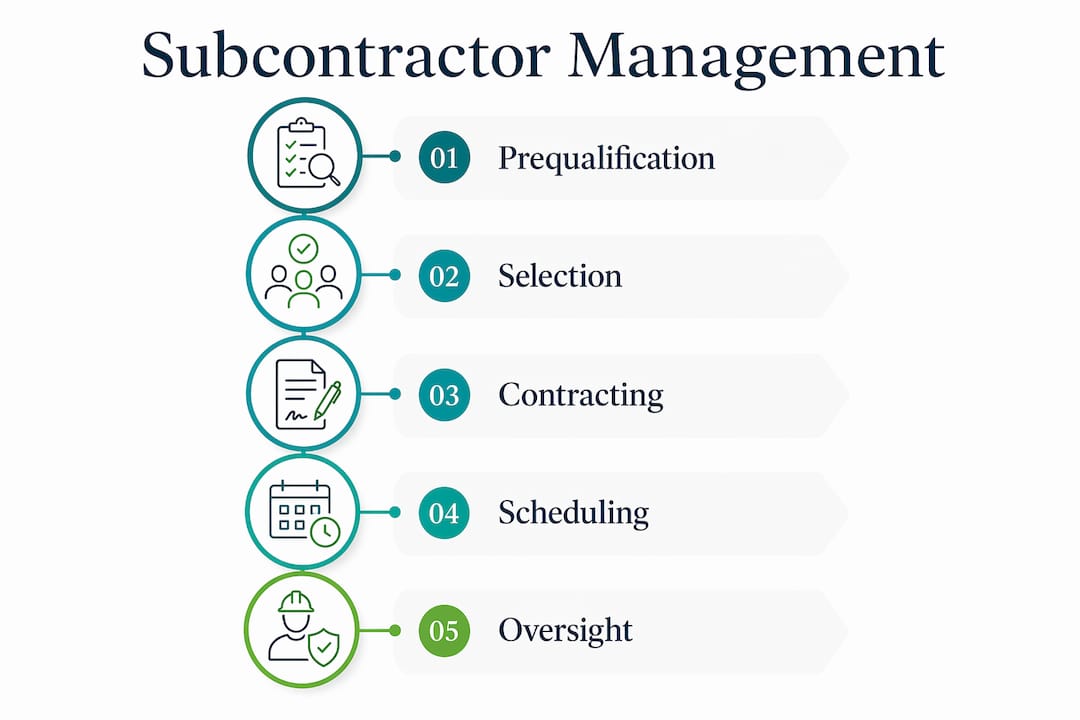
Commercial renovation subcontractor management is the process of selecting, contracting, scheduling, and overseeing specialized trade teams to deliver a project on time and within budget. Poor management of this process is the leading cause of cost overruns, scheduling failures, and legal disputes on commercial job sites. The industry term for this discipline is subcontractor oversight, and it covers everything from prequalification through final payment. Property managers who treat it as a formal system rather than an informal arrangement consistently achieve better cost control, fewer delays, and stronger trade relationships. This guide gives you a practical framework to do exactly that.
What does commercial renovation subcontractor management involve?
Effective subcontractor management starts before a single trade sets foot on site. The process covers four core phases: prequalification, contracting, daily oversight, and compliance closeout. Each phase carries distinct risks, and skipping any one of them compounds problems in the next. Property managers who choose a commercial contractor with a documented management system avoid most of the common failure points from the start.

The stakes are real. Replacing a non-performing subcontractor mid-project can cost 5–10 times more than thorough vetting before mobilization. That figure reflects not just the cost of finding a replacement, but lost schedule time, rework, and the ripple effect on every other trade on site.
How to prequalify and select subcontractors effectively
Prequalification is the filter that keeps unreliable trades off your project. Set minimum criteria before you issue a single invitation to bid. Those criteria should cover financial stability, active licensing, current general liability and workers’ compensation insurance, workforce capacity, and a documented safety record with an Experience Modification Rate at or below your threshold.
Once your criteria are set, follow these steps:
- Issue formal prequalification questionnaires to every candidate trade. Require financial statements, references from comparable commercial projects, and proof of insurance.
- Require at least three competitive bids per trade. Property managers should require three bids per trade and conduct annual formal prequalification with signed agreements to control risk and maintain pricing transparency.
- Score each submission against your criteria. Use a weighted scoring sheet so decisions are documented and defensible.
- Conduct annual renewals. Prequalification is not a one-time event. Financial conditions, insurance status, and workforce capacity change. Update your approved vendor list every year.
- Avoid awarding on price alone. The lowest bid often reflects missing scope, underinsured crews, or a subcontractor who cannot staff the project adequately.
Note that on complex commercial projects, subcontractors typically need 2–3 weeks to prepare accurate bids. Build that window into your procurement schedule. Rushing bids produces incomplete pricing and scope gaps that surface as change orders later.
Pro Tip: Maintain a tiered preferred vendor list. Tier one subs get first right of refusal on new projects. That status motivates performance and gives you reliable pricing without going back to open bid every time.
What should a subcontractor contract include?
A contract that leaves scope, schedule, or payment terms vague will generate disputes. Every subcontractor agreement on a commercial renovation project should contain these elements:
- Scope of work: Written in specific, measurable terms. Reference drawings and specifications by revision number.
- Schedule milestones: Tie each milestone to a calendar date, not a floating “approximately” window.
- Payment terms: Link payments to verified progress milestones, not calendar dates. Include a retention clause, typically 5–10%, held until final completion and compliance verification.
- Change order procedure: Require a written, signed change order before any out-of-scope work begins.
- Insurance requirements: Specify minimum coverage limits and require the property manager to be named as an additional insured.
- Indemnification and warranty: Define who bears liability for defective work and for how long.
- Termination clause: State the conditions and notice period for termination for cause or convenience.
Verbal agreements for change orders are the single largest source of subcontractor disputes on commercial projects. Best practice requires a written, signed change order before beginning any additional work. Surprises at closeout almost always trace back to a conversation that was never documented.
Informal verbal change orders are a significant source of disputes. The fix is procedural: no work starts without a signed document, period. Train your site superintendent to enforce this rule even when a sub says the change is “minor.”
How do digital tools improve project tracking and scheduling?
Digital platforms shift subcontractor oversight from reactive problem-solving to proactive coordination. Integrated digital platforms transform management by tracking KPIs such as schedule adherence, safety compliance, and task completion in real time. That shift matters because problems caught on day two cost a fraction of what they cost on day twenty.
The table below shows how daily digital logging compares to traditional weekly paper reports across the metrics that matter most to property managers.
| Management area | Weekly paper reports | Daily digital logging |
|---|---|---|
| Schedule visibility | Delayed by days | Updated same day |
| Cost tracking | Reconciled monthly | Tracked per shift |
| Defect identification | Found at inspection | Flagged in real time |
| Communication trail | Verbal or email | Centralized and timestamped |
| Insurance alert | Manual calendar check | Automated expiration alerts |
Digital daily logs updated by superintendents in under 10 minutes enable real-time cost and schedule tracking, which prevents cascading delays on commercial projects. That 10-minute investment per day eliminates hours of dispute resolution later.
Effective digital oversight also includes three-week lookahead schedules shared with every active trade. Early identification of subcontractor conflicts via three-week lookahead schedules reduces costly project disruptions and change orders. Share the lookahead every Monday morning so each trade knows exactly what space and resources they need for the next 21 days.
Pro Tip: Embed photo documentation into your daily log workflow. Require supers to attach timestamped photos of completed work at each milestone. Those photos resolve payment disputes faster than any written description.
Agny applies this same approach to construction management on commercial renovation projects, using coordinated scheduling and daily reporting to keep multiple trades aligned without adding administrative load to the property manager.
How do you protect against compliance and lien risks?
Compliance failures create financial exposure that no renovation budget accounts for. The two most common gaps are expired insurance certificates and missing lien waivers at closeout. Both are preventable with the right documentation system.
Follow this compliance sequence on every project:
- Collect certificates of insurance before mobilization. Require the certificate to name you as an additional insured. Verify coverage limits match your contract requirements.
- Maintain current W-9 forms and licensing verification for every subcontractor, updated per project.
- Set automated expiration alerts. Manual tracking of insurance certificates leads to lapses. Automated alerts set for 30, 14, and 7 days before expiration keep coverage continuous. An expired policy mid-project creates lien and liability exposure that can halt work entirely.
- Collect conditional lien waivers with each progress payment. Collect unconditional waivers before releasing final retention.
- Release final retention only after receiving unconditional final lien waivers from every subcontractor and supplier. Releasing final retention only after receiving unconditional lien waivers protects against mechanic’s liens and financial litigation.
- Store all compliance documents in a centralized digital repository. Paper files in a job trailer are not a compliance system. A searchable digital archive is.
NYC projects carry additional regulatory layers. The NYC renovation compliance guide covers permit requirements and documentation standards specific to commercial work in the five boroughs. A solid construction compliance checklist framework, adapted to your jurisdiction, gives you a repeatable process for every project.
What builds strong, lasting subcontractor relationships?
Operational discipline keeps projects on track. Relationships keep your best subcontractors coming back. The two work together, and neglecting either one costs you.
The practices that build reliable subcontractor partnerships are straightforward:
- Pay on time, every time. Subcontractors work harder for managers who pay promptly, provide clear schedules, and avoid blaming them for planning errors. Prompt payment is the single fastest way to move from a transactional relationship to a preferred-partner relationship.
- Share lookahead schedules proactively. Do not make subs ask for schedule updates. Push the three-week lookahead to every active trade at the start of each week.
- Run coordination meetings focused on planning, not status. Status updates belong in the daily log. Meetings should solve problems and align upcoming work.
- Give performance feedback constructively. Use a simple scorecard covering schedule adherence, quality, safety, and responsiveness. Share it with the sub after each project, not just when something goes wrong.
- Reward high performers with preferred status. Preferred subs get first access to new projects, which motivates them to prioritize your work over open-market bids.
- Never blame subcontractors for general contractor scheduling errors. If your sequencing created the conflict, own it. Subs remember how you handle mistakes, and that memory shapes their effort on the next project.
Relationship management, including prompt payment and clear communication, is as important as operational management for subcontractor performance and project success. A roster of trusted, preferred subcontractors also gives you better pricing over time, because subs factor relationship quality into their bid margins.
Key Takeaways
Effective commercial renovation subcontractor management requires rigorous prequalification, airtight contracts, daily digital oversight, and consistent relationship practices working together as a single system.
| Point | Details |
|---|---|
| Prequalify before bidding | Score every sub on financial stability, licensing, insurance, and safety record before issuing bid invitations. |
| Require three bids per trade | Competitive bidding prevents price inflation and reveals scope gaps before work begins. |
| Document every change order | A written, signed change order before work starts eliminates the disputes that derail closeout. |
| Automate compliance tracking | Set alerts at 30, 14, and 7 days before insurance expiration to prevent coverage gaps and lien exposure. |
| Pay on time and share schedules | Prompt payment and proactive lookahead schedules are the fastest way to build a reliable preferred-sub roster. |
What I’ve learned managing subcontractors on commercial renovations
The biggest mistake I see property managers make is treating subcontractor management as a construction problem rather than a business process problem. They hire a general contractor, hand over the keys, and assume the system runs itself. It does not.
The shift that changes everything is moving from monthly check-ins to daily digital logs. When you can see crew counts, work progress, and open defects every morning, you stop reacting to problems and start preventing them. That shift is not about technology for its own sake. It is about having information early enough to act on it.
Change orders are where I have seen the most damage. A superintendent approves a “small” verbal change on a Tuesday. By closeout, that change has grown into a six-figure dispute because no one wrote it down. The fix is cultural, not contractual. You have to make the written change order the path of least resistance, not the bureaucratic obstacle.
The other lesson I would share is this: the cost of removing a bad subcontractor mid-project is not just financial. It is the schedule disruption, the crew morale hit, and the trust damage with your client. Thorough vetting before mobilization is not overhead. It is risk management with a measurable return.
The property managers who build strong preferred-sub rosters over time consistently outperform those who rebid every project from scratch. Trusted relationships produce better pricing, faster mobilization, and crews who genuinely care about the outcome.
— Grzegorz
How Agny handles subcontractor coordination on commercial projects
Agny brings the same structured approach to every commercial renovation it manages, from millwork and kitchen renovations to full commercial fit-outs.

Agny coordinates multiple specialized trades under a single management system, covering scheduling, compliance tracking, daily progress reporting, and quality oversight. Property managers who work with Agny avoid the administrative burden of tracking insurance certificates, lien waivers, and change orders across a dozen subcontractors. The kitchen renovation services Agny delivers are a clear example of how coordinated subcontractor management produces finished spaces that hold their value. Contact Agny to discuss your next commercial renovation project and see how a structured subcontractor management process changes the outcome.
FAQ
What is subcontractor prequalification in commercial renovation?
Subcontractor prequalification is a formal vetting process that evaluates a trade contractor’s financial stability, licensing, insurance, workforce capacity, and safety record before they are invited to bid. Property managers should require at least three bids per trade and conduct annual prequalification renewals.
How do lien waivers protect property managers?
Lien waivers are signed documents in which a subcontractor waives the right to file a mechanic’s lien against the property in exchange for payment. Collecting unconditional final lien waivers from every subcontractor before releasing retention prevents costly legal disputes at project closeout.
Why do verbal change orders cause disputes?
Verbal change orders lack a documented scope, price, and approval trail. When the project closes out, the general contractor and subcontractor often have different recollections of what was agreed, which leads to payment disputes and potential litigation.
How often should subcontractor schedules be updated?
Schedules should be updated at least weekly, and daily on large or fast-moving commercial projects. Sharing a three-week lookahead schedule with every active trade at the start of each week gives subcontractors enough lead time to staff and sequence their work correctly.
What KPIs should property managers track for subcontractor performance?
Track 5–7 key metrics covering schedule adherence, quality defect rates, safety compliance, responsiveness to RFIs, and commercial performance such as change order accuracy. Embedding performance KPIs into daily digital workflows produces consistent data without adding administrative burden to site staff.