TL;DR:
- Millwork includes precisely manufactured wood or composite architectural elements like moldings and cabinetry used in buildings. It is fabricated in a controlled environment for high quality and consistency, unlike on-site carpentry. The Architectural Woodwork Institute establishes standards for grading, specifying, and installing millwork in residential and commercial projects.
Millwork is defined as wood or wood-composite architectural elements fabricated in a mill to precise specifications and installed as permanent fixtures in buildings. These elements include moldings, trim, casings, cabinetry, stair parts, doors, and wall paneling. Both residential and commercial buildings rely on millwork to define interior character and meet functional needs. The Architectural Woodwork Institute (AWI) sets the quality standards that govern how millwork is specified, graded, and installed across the construction industry.
What is millwork and how is it made?
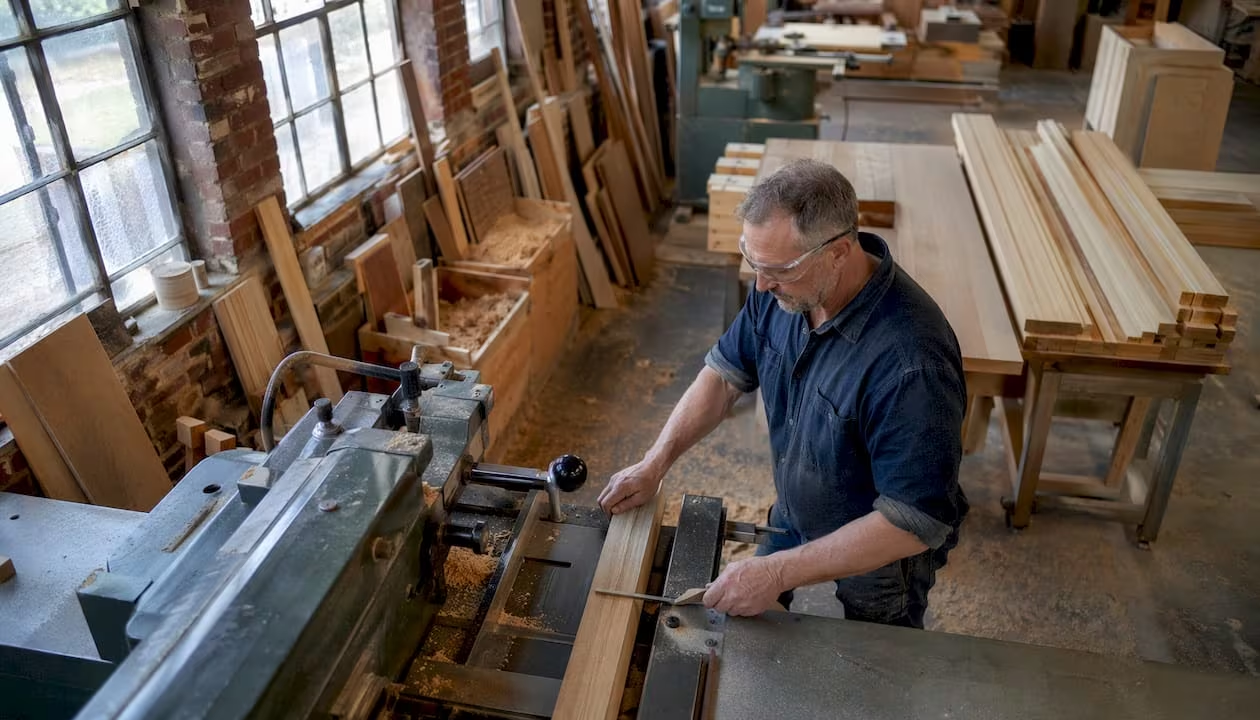
Millwork is the product of precision manufacturing in a controlled mill environment. Raw materials are cut, shaped, and finished to exact dimensions before they ever reach a job site. That process separates millwork from general carpentry, where workers shape and fit wood on location with less consistency.
Mill fabrication delivers superior quality and consistency compared to onsite finish carpentry. A mill uses calibrated machinery to hold tight tolerances across every piece in a run, so a set of crown moldings or cabinet doors matches perfectly from the first unit to the last. Onsite carpentry cannot replicate that level of repeatability.
The millwork definition has expanded well beyond solid lumber. Modern millwork materials now include solid hardwoods and softwoods, plywood, medium-density fiberboard (MDF), laminates, synthetic composites, and metal-integrated components. Each material serves a different purpose: MDF holds paint finishes cleanly, hardwoods accept stain and carving, and composites resist moisture in high-humidity spaces like bathrooms.
Finished millwork products typically receive a protective coating before leaving the mill. Stain, semi-transparent finishes, and paint protect wood from decay and enhance its appearance. That factory finish is more durable than a field-applied coat because it cures under controlled conditions.
Pro Tip: Always confirm whether millwork arrives primed, prefinished, or raw. Prefinished pieces save labor on site, but they require careful handling to avoid surface damage during installation.
Key materials used in millwork fabrication:
- Solid hardwoods (oak, maple, cherry): best for stained or carved decorative elements
- Softwoods (pine, poplar): cost-effective for painted trim and moldings
- MDF: stable, smooth surface ideal for painted cabinetry and flat-panel doors
- Plywood: structural backing for casework and built-ins
- Laminates and veneers: decorative surface layers over engineered substrates
- Synthetic composites: moisture-resistant option for exterior trim and wet areas
- Metal-integrated components: increasingly used in commercial reception desks and partitions
What are the main types of millwork?
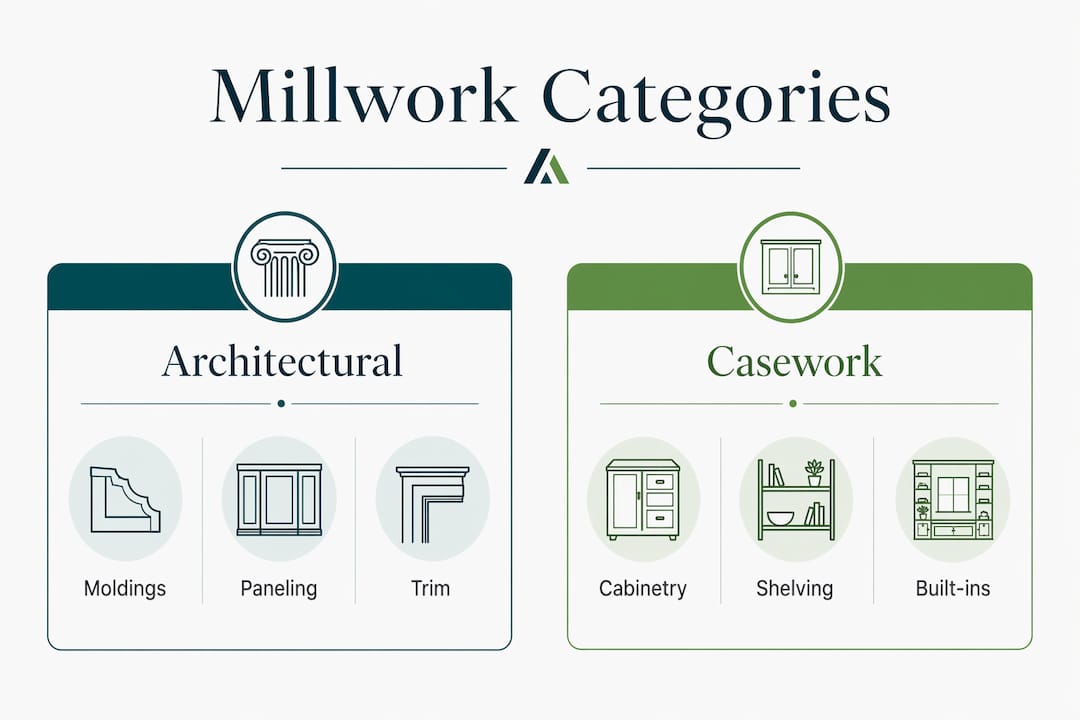
Millwork falls into three categories: architectural millwork, casework, and commercial millwork. Each category serves a distinct purpose and appears in different project contexts.
Architectural millwork
Architectural millwork covers decorative and structural wood elements that define a building’s interior character. Crown moldings, base moldings, chair rails, wainscoting, coffered ceilings, and wall paneling all belong here. These elements appear in homes, hotels, courthouses, and corporate offices wherever design quality matters. Prairie-style millwork, for example, uses flat, geometric profiles that reflect a specific architectural tradition, showing how millwork design ideas can anchor an entire room’s aesthetic.

Casework
Casework refers to functional cabinetry, shelving, and built-in storage units. Kitchen cabinets, bathroom vanities, library shelving, and closet systems are all casework. Millwork differs from modular casework in a key way: millwork is custom-fabricated and permanently integrated into the structure, while modular casework is prefabricated in standard sizes and can be moved or replaced. Custom millwork fits the exact dimensions of a space; stock casework fits approximately.
Commercial millwork
Commercial millwork covers business-specific fixtures built to meet operational and brand requirements. Reception desks, retail display cases, restaurant bar fronts, partition walls, and conference room built-ins all qualify. These pieces often combine wood with metal, glass, or stone to meet both design and durability standards in high-traffic environments.
| Category | Typical elements | Common settings |
|---|---|---|
| Architectural millwork | Moldings, paneling, trim, coffered ceilings | Homes, hotels, government buildings |
| Casework | Cabinetry, shelving, vanities, built-ins | Kitchens, bathrooms, offices, libraries |
| Commercial millwork | Reception desks, display cases, bar fronts | Retail, hospitality, corporate interiors |
AWI grade standards apply across all three categories. Economy, Custom, and Premium grades set expectations for joinery, tolerances, and finish quality. Specifying the right grade at the start of a project prevents cost surprises and quality disputes later.
How does millwork benefit building projects?
Millwork elevates both the look and utility of interiors through tailored design, craftsmanship, and durability. That combination of form and function is the core reason contractors and property owners specify it over stock alternatives.
The benefits of millwork break down into four clear areas:
- Architectural character. Custom profiles, proportions, and materials give a space a finished quality that stock trim cannot match. A room with properly scaled crown molding and paneled wainscoting reads as designed rather than assembled.
- Functional integration. Built-in cabinetry adds storage without consuming floor space. Paneled walls improve acoustics. Solid wood doors provide better sound isolation than hollow-core alternatives.
- Durability. Mill-fabricated pieces use better joinery and more consistent material selection than site-built equivalents. A dovetail-jointed cabinet box outlasts a stapled one by years.
- Long-term value. Quality millwork raises perceived property value. Buyers and tenants notice the difference between a kitchen with custom cabinetry and one with builder-grade stock boxes.
The financial trade-off is real. Custom millwork costs $500–$2,000+ per linear foot, which is 2–3 times the cost of stock materials. That premium buys exact fit, better materials, and longer service life. For a high-use space like a kitchen or a client-facing commercial lobby, the investment pays back through reduced replacement cycles and stronger design impact.
Pro Tip: Compare the 10-year cost of custom millwork against the replacement cycle of stock cabinetry before making a budget decision. Stock cabinets in a busy kitchen often need replacement within 8–12 years; quality custom millwork regularly lasts 25 years or more.
For contractors evaluating custom vs. stock options, the decision usually comes down to project type and client expectations. High-end residential and commercial projects justify custom. Rental units and budget renovations may not.
What industry standards govern millwork quality?
The Architectural Woodwork Institute (AWI) sets the primary quality framework for millwork in the United States. AWI standards group workmanship, joinery, and material selection into three measurable grades: Economy, Custom, and Premium.
| AWI grade | Quality level | Typical application |
|---|---|---|
| Economy | Basic tolerances, functional joinery | Utility spaces, budget projects |
| Custom | Moderate tolerances, consistent finish | Most residential and commercial work |
| Premium | Tight tolerances, superior joinery and finish | High-end residential, luxury commercial |
Custom grade covers the majority of residential and commercial millwork projects. Premium grade applies to work where visual perfection and long-term performance are non-negotiable, such as a law firm’s boardroom or a luxury hotel lobby. Economy grade suits utility spaces where appearance is secondary to function.
The Window and Door Manufacturers Association (WDMA) and the Wood Moulding and Millwork Producers Association (WMMPA) publish additional standards that cover specific product categories. WDMA standards govern windows and doors; WMMPA standards address molding profiles and dimensional tolerances. Together, these organizations create a framework that contractors and buyers can reference when writing project specifications.
Specifying AWI grades matters more than selecting style photos alone. A grade defines tolerances, joinery methods, and acceptable material variation. Without a grade specification, a fabricator and a buyer can look at the same picture and expect completely different products. Understanding millwork quality standards before signing a contract protects both parties.
How to choose and install millwork effectively
Selecting millwork starts with three questions: What style does the project require? What function must the millwork serve? What budget is available? Answering all three before contacting a fabricator saves time and prevents scope creep.
- Define the style and function first. Decide whether you need architectural trim, casework, or commercial fixtures. Gather reference images, but always translate them into AWI grade specifications before requesting quotes.
- Choose custom or stock based on fit requirements. Custom millwork is necessary when spaces have non-standard dimensions or when design continuity across a project matters. Stock millwork works for standard openings and budget-sensitive scopes.
- Engage the fabricator early. Millwork lead times run 6–12 weeks for custom work. Waiting until framing is complete to order millwork delays the entire finish schedule.
- Coordinate fabricators and finish carpenters. Coordination between millwork fabricators and finish carpenters is critical to avoid schedule delays and quality gaps. The fabricator needs accurate field measurements; the carpenter needs the millwork on site before final finishes go on walls.
- Inspect deliveries before installation. Check every piece against the shop drawings for profile accuracy, finish consistency, and damage. Returning a defective piece after installation costs far more than catching it at delivery.
Pro Tip: Ask your fabricator for shop drawings before production begins. Reviewing shop drawings catches design errors before they become expensive wood waste.
The millwork installation process requires sequencing with other trades. Electrical, plumbing, and HVAC rough-in must be complete before built-in casework goes in. Painting and flooring schedules need to account for millwork installation windows. A project manager who treats millwork as an afterthought will pay for it in delays and callbacks.
Key Takeaways
Millwork is custom-fabricated wood or composite architectural elements specified by AWI grade standards, and choosing the right grade and material from the start determines both project cost and long-term quality.
| Point | Details |
|---|---|
| Millwork definition | Custom wood or composite elements made in a mill: moldings, trim, cabinetry, doors, and stair parts. |
| Three main categories | Architectural millwork, casework, and commercial millwork each serve distinct design and functional roles. |
| AWI grade standards | Economy, Custom, and Premium grades define tolerances, joinery, and finish expectations for every project. |
| Cost vs. value | Custom millwork costs $500–$2,000+ per linear foot but delivers longer service life than stock alternatives. |
| Installation coordination | Engage fabricators 6–12 weeks early and align their schedule with finish carpenters to avoid delays. |
Why millwork specification is the step most projects get wrong
I have seen more renovation budgets blow up over millwork than over any other single line item. The pattern is almost always the same: a client picks a photo, a contractor quotes “Custom grade,” and nobody defines what that actually means until the shop drawings arrive and the number is twice the original estimate.
The fix is simple but rarely followed. Specify the AWI grade in writing before you request a quote. That one step forces the fabricator to price the actual product you want, not the cheapest interpretation of a photo. I have watched that single change save clients 15–20% on millwork contracts, not by reducing quality but by eliminating the renegotiation that happens when expectations are vague.
The other shift I have noticed is the move toward composite and mixed-material millwork. MDF core with hardwood veneer faces now outperforms solid wood in many applications because it stays dimensionally stable in heated and air-conditioned spaces. Solid wood expands and contracts with humidity; a well-made composite panel does not. For painted cabinetry and flat-panel doors, MDF is the better technical choice, not a budget compromise.
My advice for any contractor or property owner planning a millwork scope: bring the fabricator into the design conversation before the architect finalizes drawings. Millwork that is designed with fabrication in mind costs less and installs faster than millwork that is designed in isolation and then handed to a mill to figure out. The role of millwork in design is too significant to treat as a finish-phase detail.
— Grzegorz
Agny’s millwork services for your next project
Agny works with contractors and property owners across New York on millwork design, specification, and installation coordination. Whether you are planning a kitchen renovation with custom cabinetry or a commercial interior with built-in fixtures, Agny’s team brings fabrication knowledge and installation experience to every project scope.
Agny also helps clients navigate the financial side of millwork projects. The renovation financing options Agny offers make it easier to budget for custom work without compromising on AWI grade or material quality. For contractors who need a clear process from shop drawings to final trim, the custom millwork installation guide covers every step. If you are weighing the investment, the case for investing in millwork breaks down the long-term value in plain terms.
FAQ
What is the millwork definition in construction?
Millwork refers to wood or wood-composite architectural elements fabricated in a mill, including moldings, trim, cabinetry, doors, and stair parts, installed as permanent fixtures in residential and commercial buildings.
How does millwork differ from finish carpentry?
Millwork is manufactured in a controlled mill environment to precise specifications before arriving on site. Finish carpentry is the skilled trade that installs millwork and performs onsite wood fitting and detailing.
What are the AWI grades for millwork quality?
The Architectural Woodwork Institute defines three grades: Economy for basic utility work, Custom for standard residential and commercial projects, and Premium for high-end applications requiring tight tolerances and superior finish.
How much does custom millwork cost?
Custom millwork costs $500–$2,000+ per linear foot depending on complexity and materials, which is 2–3 times the cost of stock alternatives. The premium reflects exact fit, better joinery, and longer service life.
What types of millwork are most common in residential projects?
Architectural millwork such as crown molding, base trim, and wainscoting, along with casework including kitchen cabinetry and bathroom vanities, are the most common millwork applications in residential construction.